Robert Stone gave City of Hope three years. It was a reasonable offer from a young lawyer: enough time to learn the organization, do useful work and leave for the next opportunity. He joined in 1996. By 2026, the proposed stopping point had receded by twenty-seven years. Careers have a way of making a mockery of calendars. This one did so without requiring a change of employer.
The scale of the job changed considerably. Stone began in the legal office and eventually became chief executive, taking responsibility for an institution that expanded far beyond its original Southern California campus. But the most interesting question in his story concerns the decision to remain. What makes an ambitious person keep choosing the same place while that place becomes something different?
His answer has been culture. That word can sound suspiciously convenient in an executive's mouth. It can mean almost anything, especially when printed beside a photograph of happy employees. Stone gives it a more demanding meaning: something people have to build, adapt and practice. Staying for thirty years, in his account, requires room to change. Loyalty need not come with a preservation order.
Before the corner office, the basketball court
Stone grew up in Whittier, California, and studied political science at the University of Redlands. At six feet three, he also played basketball, scoring 1,077 career points and earning Academic All-America recognition. There is a pleasing specificity to that number. An executive biography can make achievement feel weightless; a basketball total returns it to possessions, missed shots and afternoons in a gym.
A law degree from the University of Chicago followed. Back in Southern California, he worked as a securities litigator at Christa & Jackson in Century City. It was a recognizable professional route: college, law school, private practice. City of Hope recruited him repeatedly before he accepted. A later interview recorded that he had declined twice. The eventual yes therefore belongs to a story with some hesitation in it.
That hesitation matters. Long careers are often narrated backward, as though the destination were visible at the start. Here, the original agreement was deliberately modest. He would contribute, learn and move on. The institution had to earn the rest of his working life. Its success in doing so became, years later, part of his explanation of what makes people want to stay.
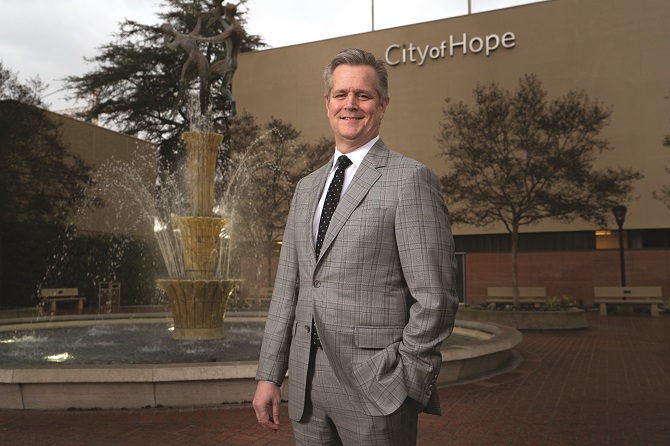
An apprenticeship in the organization itself
The progression was gradual. Associate general counsel in 1996 became general counsel for the medical center in 2000, then general counsel and corporate secretary in 2003. In 2009, Stone became chief strategy and administrative officer. The legal work had widened into responsibility for the organization's direction, including the development of a ten-year strategic plan.
In 2011, he served as the initial president and executive officer of the City of Hope Medical Foundation. He became City of Hope's president in 2012. The announcement selecting him as the next CEO arrived in February 2013; he assumed that role in January 2014. Those dates distinguish being chosen for the job from actually taking it, a small distinction with eighteen years of preparation behind it.
A career with this sequence offers an unusual kind of institutional education. A corporate secretary sees governance. A strategist works on priorities. Someone managing a new foundation deals with an organization while its routines are still being invented. Stone's route gave him several views of the same place before he inherited overall responsibility. The promotion story is also a story about changing vantage points.
- 1996Joins the legal office
- 2009Moves into strategy
- 2012Becomes president
- 2014Assumes CEO role
- 2026Thirty years at City of Hope
A chief executive who leaves room for other people
As incoming CEO in 2013, Stone described a leadership structure that distributed responsibilities across an executive team. Steven Rosen, recruited from Northwestern, would lead academic and research functions as provost and chief scientific officer. He would report to Stone, with discretion to arrange the responsibilities beneath him. The organizational chart made room for expertise rather than asking one office to contain all of it.
Stone's argument was straightforward: complexity requires people with different skills who understand the limits of their own knowledge. A lawyer leading an institution with many kinds of specialist work has good reason to take that proposition seriously. Authority can settle who answers to whom. It cannot, by itself, supply the answer to every question.
There is a useful tension here. Chief executives are hired to make decisions, yet some of their consequential decisions concern which decisions to leave to others. Giving a colleague discretion is an organizational choice with practical consequences. It tells that person what the recruitment really means. The impressive title comes with an area in which judgment can actually be exercised.
“It’s to build the leadership community where people bring different skills”
Robert Stone, 2013
Ten to twelve people. Two rules.
Before Stone assumed the CEO role, a donor advised him to keep listening to employees and protect the institution's culture. Stone responded with regular roundtables of ten to twelve people. Participants could raise any question. Their identities would be protected; his remarks could be shared with colleagues. The arrangement put different obligations on the people speaking and the person in charge.
That is a small piece of meeting design worth examining. Employees can have good reasons to weigh every word in front of a chief executive. Anonymity reduces one cost of speaking. Allowing the CEO's answers to circulate gives the discussion a life beyond the room. A private conversation can produce information for a much wider group without making every participant publicly responsible for a difficult question.
The size matters, too. Ten or twelve people can have a conversation. An auditorium tends to produce performances. Stone's account makes the roundtable a way to learn what is occupying people's attention, including matters that may never acquire the polish of an executive presentation. The leadership lesson sits in the rules of the meeting, which is where many lessons would benefit from sitting.
Another organization, another way to work
City of Hope's growth also produced AccessHope, a wholly owned subsidiary whose public launch was announced in 2020. Stone spoke at that launch as City of Hope's president and CEO. The distinction between sponsor and operating executive is important to understanding his connection: AccessHope belongs to his institutional story, while its own leadership team runs the company.
By a January 2022 interview, AccessHope was working with 75 employers. In that conversation, Stone appeared opposite publisher Fawn Lopez to discuss the venture. It gives the biography a second kind of expansion: alongside a wider physical organization, a separate company developed relationships with employers. For an executive trained in law and strategy, the choice of organizational form is part of the work.
A subsidiary raises its own questions about identity, accountability and cooperation. How much should remain shared with the parent? What needs its own management? Those questions follow from the structure; they are useful ways to read Stone's career without mistaking every associated venture for a company he personally operates. His central role remains chief executive of City of Hope.
The donation you should turn down
Stone's thinking about philanthropy contains a proposition that might make a nervous fundraiser reach for a chair. An organization should be willing to decline a donation when the proposed use falls outside its mission or strategy. Accepting money brings obligations. A gift that takes an institution away from its purpose can therefore become a particularly well-wrapped problem.
He also argues against using philanthropy chiefly to plug budget holes. Donors, in his account, want to contribute to something they care about and help it advance. The institution's job is to find the fit, use the contribution well and sustain the relationship. Some of those relationships have lasted decades. The timescale is familiar by now.
This is a more selective view of fundraising than the simple ambition to collect as much as possible. It asks the recipient to retain judgment when gratitude might encourage an automatic yes. For Stone, strategy and relationships belong in the same conversation. A long relationship is valuable partly because the parties can understand what each is trying to accomplish.
“Philanthropy is about building relationships.”
Robert Stone
Dumas, ice cream and the family calendar
For all the institutional machinery, his public biography has some agreeable ordinary details. Stone's first job was serving ice cream at Baskin-Robbins. His favorite book is Alexandre Dumas's The Count of Monte Cristo. The distance between an ice-cream counter and a nineteenth-century revenge epic is considerable; both make better conversation than another list of management competencies.
Away from work, he has spoken about time with his wife, Charlotte, and their children, Ellie and Thomas, as his source of energy. Reading and exercise also figure in his account. The former college basketball and baseball player has described shifting his attention toward his children's athletic pursuits. There is humor in the adjustment: someone accustomed to keeping score now has other people to cheer for.
These details do not need to become a theory of his leadership. A favorite novel is a favorite novel. Family time is allowed to matter on its own terms. They do, however, put a person back into a career that can otherwise look like a succession of titles. A thirty-year tenure still consists of individual days, with work occupying only part of the calendar.
The plan keeps getting revised
In 2026, Stone's public conversations still included recruiting people, navigating uncertainty and deciding where to invest. His current official title is chief executive officer, with the Helen and Morgan Chu Chief Executive Officer Distinguished Chair. The early three-year arrangement has become a long exercise in taking on new responsibilities within a continuing relationship.
That gives the story its shape. A young lawyer made a limited commitment. A sequence of jobs enlarged what he understood about the institution. Leadership brought decisions about teams, meetings, ventures and donors. The recurring question is how to give other people a reason to commit, while keeping enough freedom for the organization to develop.
The modest original plan remains a good ending precisely because it was never grand. Three years would have been a respectable contribution. Thirty years make a different claim on a person, and on the place asking him to stay. Stone's career suggests that an institution earns that time through the opportunities it creates, the judgments it trusts and the conversations it allows to continue.
Keep the conversation going
More from and about Robert Stone.