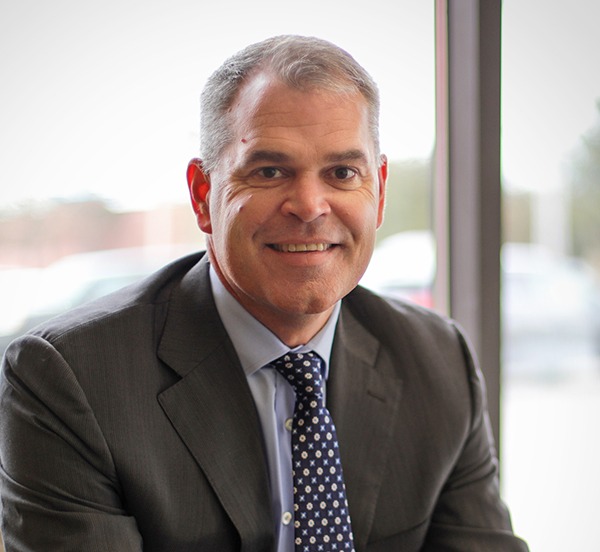
A second opinion, turned into a business model
AccessHope starts with a quiet, uncomfortable fact: the oncologist treating you is probably good, and somewhere there is a specialist who sees only your exact cancer and would do something different. Brad Kreick built his current job around closing that gap.
AccessHope is a commercial venture that grew out of City of Hope, one of the largest cancer research and treatment organizations in the United States. Its product is deceptively simple. When an employee at a client company is diagnosed with cancer, AccessHope connects that person's local oncologist with subspecialty experts at National Cancer Institute-Designated Comprehensive Cancer Centers. An AI-assisted review pulls the case together; the human experts weigh in. The local doctor stays in charge. The patient does not have to fly anywhere.
Kreick was appointed CEO in 2024, the moment AccessHope stopped being a nonprofit benefit and became a stand-alone company with revenue targets. He had been on its board since 2023, so he knew the engine before he was asked to drive it. His first major act in the seat was closing a $33 million Series B from City of Hope to fund product, technology and an expanding network of oncologists.
The numbers he now manages are large in a way that healthcare rarely is. AccessHope serves more than 800 employers, over 80 of them in the Fortune 500, plus nine health plans. By March 2026 it had crossed 10 million covered members and logged more than 20,000 cancer case reviews. In roughly nine of ten of those reviews, the experts recommended at least one change to the patient's treatment. In about a quarter, they flagged a relevant clinical trial the patient had not been offered.
Payer, provider, private equity, oncology
American healthcare is a negotiation between people who rarely understand each other's incentives. Insurers, hospitals, investors and clinicians each speak a different dialect of money and mission. Kreick is unusual because he has sat in all four chairs.
He began on the payer side, eventually serving as Executive Vice President of Business Development at Oxford Health Plans, with earlier work at Healthsource, Inc. He moved into the investor seat in 2008, co-investing alongside The Blackstone Group in the acquisition of Apria Healthcare, then running payer arrangements there as an Executive Vice President. In 2021 he crossed fully into provider territory as CEO of SolutionHealth, the parent of two New Hampshire hospital systems. Now, at AccessHope, he sits inside oncology services.
That résumé is the whole pitch. Selling expert cancer review means convincing employers it saves money, persuading health plans it fits their networks, and reassuring local oncologists it won't undercut them. Kreick has personally been each of those skeptics.
He announced his retirement. Then he didn't retire.
In March 2024, SolutionHealth announced that Bradley Kreick would step down. He had taken the CEO job on December 1, 2021, with a narrow brief: steady a health system rattled by the pandemic and set up Elliot Health System and Southern New Hampshire Health System for what came next. By spring 2024 he judged the work done.
He called it, plainly, the end of something rare. The line was warm without being sentimental, which is roughly how Kreick reads in print.
The word "retirement" turned out to be generous. He had already been sitting on the AccessHope board, and within the same window he stepped into its CEO chair. The exit from one mission was, in practice, the on-ramp to the next.
The case for a louder second opinion
The strongest argument for AccessHope is not rhetorical, it is arithmetic. A peer-reviewed study found that expert reviews led to a treatment change for more than half of patients. Patients in disadvantaged communities were 25% more likely to receive a modification - the gap is widest exactly where access to subspecialists is thinnest.
That equity angle is the quiet center of Kreick's mission. A patient in a major metro can usually find a comprehensive cancer center across town. A patient three hours from one cannot. AccessHope's promise is that geography stops deciding the quality of the opinion in your chart.
Curriculum, then thirty years of fieldwork
Kreick studied Healthcare Policy and Economics at Brown University. It reads like foreshadowing. He then spent three decades living that syllabus from the inside, watching how policy and economics actually behave when a hospital makes payroll and an employer reads a renewal quote.
Outside the day job, he chairs the Board of Trustees at Rivier University and lives in Nashua, New Hampshire, with his wife, Beth. He describes leading a health system in his home state as a once-in-a-lifetime honor - the kind of detail that tells you the New Hampshire roots aren't incidental to how he picks his missions.
What ties it together is a refusal to treat expert oncology as a luxury good. The whole AccessHope thesis fits in one stubborn sentence: the standard of care should be the floor, not the ceiling, and where you happen to live should not move it. Kreick has spent a career learning every reason that's hard, which may be exactly why he took the job of making it routine.