Before Robert Kyncl could negotiate the price of music, he had to find a signal. Growing up in communist Czechoslovakia, he adjusted the antenna on his transistor radio to catch broadcasts from West Germany. Bon Jovi, Scorpions and Tears for Fears arrived across a border that was rather more substantial than a subscription paywall. The reception required effort. The songs were worth it.
Decades later, Kyncl would help make entertainment available with almost absurd ease. Movies through Netflix. Creators through YouTube. Now he runs Warner Music Group, where the ease with which people can listen to a song, copy a voice or generate a new track produces questions that an antenna cannot solve.
His career offers a useful view of the machinery behind the play button. Each apparently simple act of access has people bargaining behind it. Someone controls the work. Someone controls the distribution. Someone must decide how the money moves. Kyncl keeps finding employment at the point where those arrangements need rewriting.
The first border was a real one
Kyncl was born in Liberec in 1970, in what was then Czechoslovakia. His early ambitions included cross-country skiing; he trained seriously enough to turn professional before leaving his teens. Long before the conference stages and corporate presentations, there were mountains and an athletic routine.
In 1992, he crossed the Atlantic to attend university in New York. At SUNY New Paltz he studied international relations and met Luz, a fellow student from the Dominican Republic who became his wife. He graduated in 1995, later adding an MBA from Pepperdine. His American education began with an actual change of country, rather than the management-seminar version of leaving one’s comfort zone.
There is a small linguistic obstacle in his story, too. Kyncl rhymes with “tinsel.” A surname with that much consonant confidence deserves an instruction manual. His professional life, meanwhile, has involved explaining things people initially found unfamiliar, then eventually took for granted.
A volunteer in the DVD business
His entertainment career started in the mailroom of the talent agency J. Michael Bloom. Work at HBO International and the children’s internet startup ALFY followed. In 2003 he joined Netflix, which was then putting movies into envelopes. Acquiring content meant serving a business with a physical journey between the customer and the film.
He volunteered to explore digital video delivery in 2005. That experiment helped lead to the streaming service Netflix introduced in 2007. It is easy to compress those years into a neat arrow on a business-school slide. The people doing the work had to get permission to deliver films in a new way while the existing business continued around them.
In his own account, the initial idea involved a box that downloaded movies overnight. Watching YouTube suggested that people would tolerate grainy pictures in exchange for convenience and speed. The plan changed. New rights and new technical arrangements followed. Kyncl recalled one especially revealing detail about stepping forward for the assignment.
“I was the only volunteer.”
Robert Kyncl, recalling Netflix’s digital delivery project
There is some comedy in the hindsight. A side project can become the thing a company is remembered for. At the time, somebody still has to put a hand up.
The quilting test
He joined YouTube in 2010, moving into a business whose openness presented a different challenge from Netflix’s subscription catalogue. A platform full of uploads needed relationships with both established entertainment companies and people who had never worked inside one. The latter group would become a substantial part of his professional attention.
Across twelve years there, Kyncl oversaw creative and commercial partnerships and operations. He also helped expand the paid businesses that became YouTube Music, YouTube Premium and YouTube TV. The job required familiarity with the advertiser, the subscriber, the studio and the individual creator. They did not always want the same things.
His 2017 book with Maany Peyvan, Streampunks, gives those creators the foreground. Its cast includes Lilly Singh, Tyler Oakley and Casey Neistat, people whose audiences developed around forms that conventional television had not commissioned. The book’s interest lies partly in who gets to begin a career when a commissioning executive no longer has to approve the first attempt.
One example Kyncl discussed was Jenny Doan, whose quilting videos helped build a business in Missouri. Quilting is a useful corrective to the assumption that internet culture belongs exclusively to young people performing elaborate feats of self-display. Sometimes the thing people want to watch is someone showing them how to sew.
Doan’s appeal also clarifies the economics Kyncl was interested in: an audience assembled online could support activity beyond the screen. A video was a point of contact, with a person and a business on the other side. That idea would travel comfortably into a music company, where a listener may also buy a ticket, a record or something to wear.
Changing sides of the table
In January 2023, Kyncl became Warner Music Group’s CEO, succeeding Stephen Cooper. After years inside distribution platforms, he now led a company representing recordings, compositions and the people who create them. Familiar commercial relationships were suddenly viewed from a different chair.
His account of YouTube’s copyright experience helps explain the attraction of that background. The platform’s Content ID system let rights holders identify uses of their work and choose whether to monetize or remove them. Kyncl has pointed to that history when discussing new technology: a difficult relationship between creators and distribution can become a commercial one.
The analogy has limits. A system that recognizes an existing recording and a model that generates music raise different questions. The earlier experience does, however, explain why he looks for an agreement as well as a prohibition. His professional habit is to ask what a workable relationship could pay.
Running Warner has also meant decisions whose consequences do not fit a cheerful account of technological progress. In February 2024, the company announced a restructuring plan anticipating roughly 600 job cuts, around 10 percent of its workforce. The plan targeted annual savings of approximately $200 million, with most intended for reinvestment. Employees faced the immediate cost of that calculation. Any assessment of the strategy has to keep them in the picture.
A raised hand in Washington
On April 30, 2024, Kyncl appeared before the Senate Judiciary Subcommittee on Intellectual Property at a hearing on unauthorized digital replicas. FKA twigs was among the other witnesses. The music executive and the artist were confronting a question with unusual clarity: who should decide how a person’s voice and identity are used?
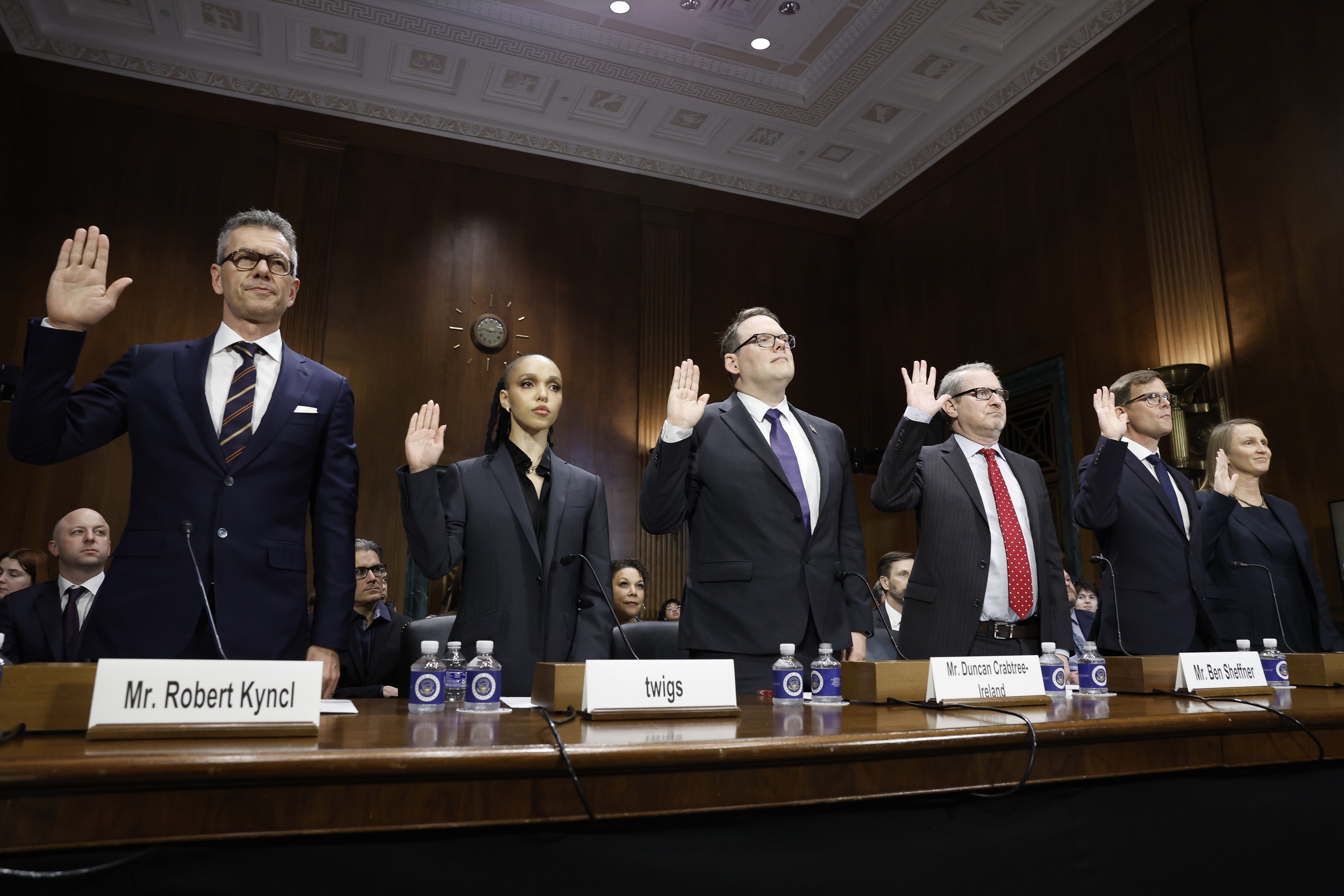
His written remarks began with his own arrival in America and his appreciation of its freedoms. He then argued for protection of name, likeness and voice, alongside a licensing system for copyrighted material used in AI training. The combination matters to his position. He wants technology to develop with permissions and a route to compensation.
The setting supplied a revealing change of scale. Someone who had grown up finding ways to receive restricted culture was asking legislators to protect control over personal identity. Access and permission had become questions he had to consider together.
The next agreement has a melody
Warner’s November 2025 agreement with Suno made that position concrete. The companies settled their litigation and announced plans for licensed AI music models. Warner described artist and songwriter opt-in for the use of names, images, likenesses, voices and compositions in new AI songs as a principle of the arrangement.
That agreement is a decision to participate in shaping a technology whose effects are still developing. Its announcement cannot establish what the eventual earnings, creative habits or audience response will be. Those are outcomes to watch, rather than achievements to award in advance.
By September 2026, Kyncl was describing the resulting models to staff as an opening for income from music creation as well as consumption. Later that month Warner announced another round of leadership changes, including Alejandro Duque’s promotion to President of Warner Music International and Val Blavatnik joining the executive team. Negotiating the future comes with quite a lot of organisation charts.
A reading of Warner’s stated approach to licensed AI music.
The other investment
There is a quieter expression of Kyncl’s priorities at his old university. He and Luz supported a STEM scholarship fund and an experiential learning fund at New Paltz, with opportunities for students from underrepresented backgrounds. The programmes put tuition, research, internships and other practical experiences within reach.
“STEM education today provides life-altering career opportunities,” he said when the scholarship was announced. For someone whose own move to America began with university, the choice has a direct biographical connection. It also places a tangible commitment beside the large abstractions of the technology business.
In his March 2026 shareholder letter, Kyncl set out three ways to increase music’s value: subscription pricing, different offers for different audiences, and more direct digital licensing in publishing. His aim is to make the economics respond more closely to how people engage with music. An enthusiastic fan and a casual listener need not represent precisely the same opportunity.
The boy at the radio had already demonstrated one part of that proposition. People will go to considerable trouble for a song they want to hear. Making access easier creates possibilities. Deciding what those possibilities are worth, and who receives the proceeds, remains the work.
Follow the conversation
- Robert Kyncl at Warner Music Group
- Twitter / X
- Streampunks: the book
- The Netflix experiment, in his own words
- Read the Senate testimony
- In Good Company: the conversation
- Watch Robert Kyncl on YouTube
- His March 2026 shareholder letter
- Warner’s Suno agreement
- September 2026 leadership changes
- New Paltz scholarship announcement