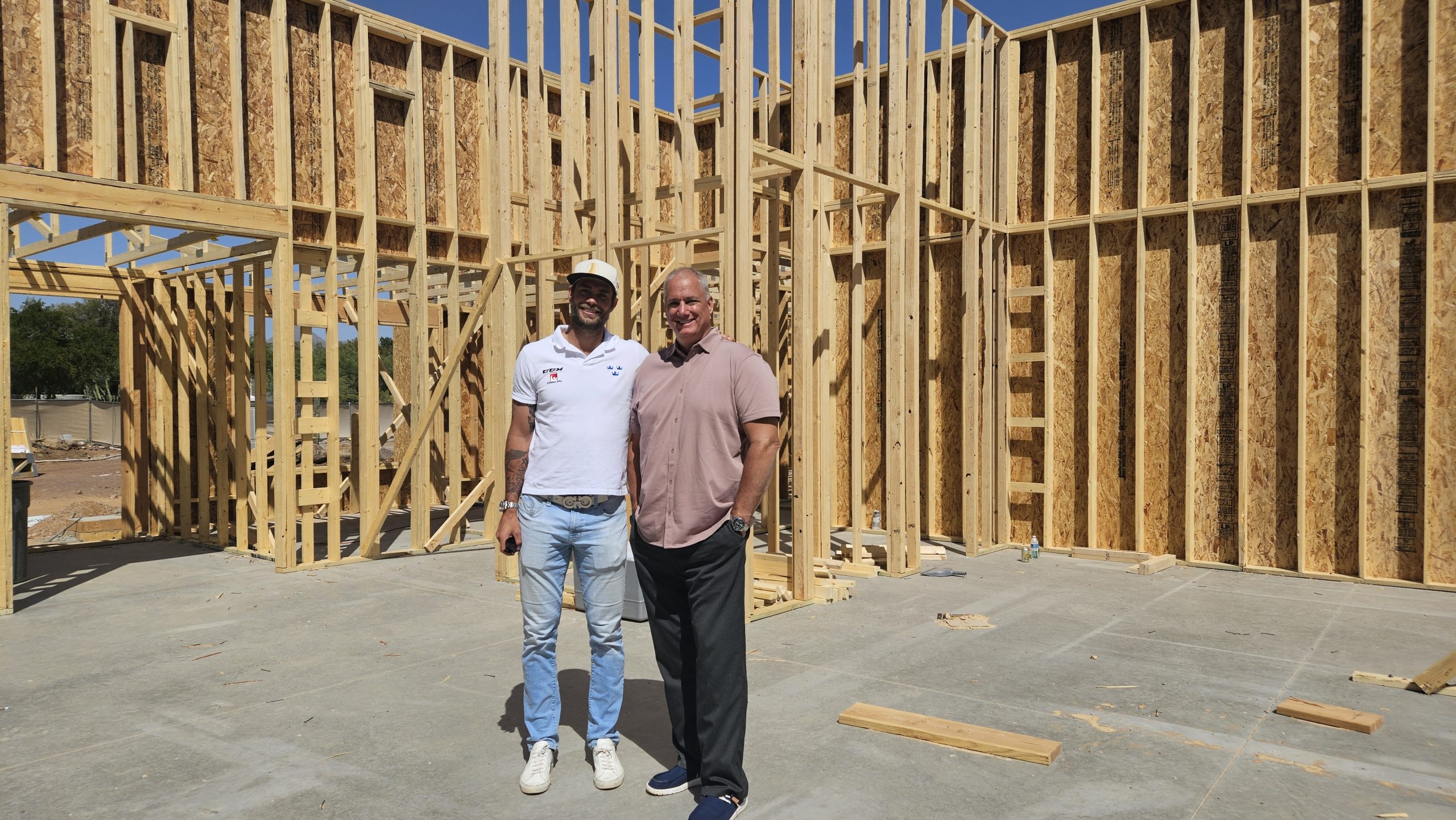
Rob Licopoli is standing inside a house that is still mostly an idea. Timber rises around him. Blue sky shows through the unfinished walls. Beside him is Eddie Lack, the former NHL goaltender. The setting is a construction site, which is a rather honest place to discuss the future: you can see how much work remains.
The picture brings together two strands of Licopoli’s working life. He has organized sports businesses and worked in construction risk management. At 360 Sports, the company he founded, he now pursues athlete ventures and capital-formation projects. The connection between those occupations is more interesting than the usual account of a sports entrepreneur. He has spent years dealing with what has to be arranged around people before their ambitions can function.
Football supplied an early version of the problem. Business ownership supplies the current one. In both, the person at the center needs more than encouragement.
A league for the game that remained
In 1999, Licopoli and Christopher Harrington launched the North American Football League. Adult amateur football already existed; their work was to organize it across teams and places. A league gives scattered games a common structure, an opponent, a schedule and a reason to return next season. It makes an individual wish to keep playing part of something other people can join.
The organization grew through regional relationships. In 2005, it acquired the Mid America Football League, bringing Terry Sullivan into Licopoli’s professional orbit. Sullivan would later work with him on 360 Sports Events. The continuity matters: this business history includes people who stayed connected as the organization and its purpose changed.
Licopoli sold the NAFL in 2010. He moved from Minnesota back to New York and resumed construction risk management full time while continuing to build sports businesses. Events came next; in 2012, he formed 360 Agency. Those operations eventually became part of 360 Sports, Inc., formed in 2015.
The left-handed lesson
There is a smaller origin story in Licopoli’s account of athlete development, and it has the advantage of beginning with an unimpressive golf swing. Playing with his father-in-law, he was losing and wanted to understand why. He asked for a recording of his swing. Watching it supplied the sort of evidence that enthusiasm tends to edit out.
“I didn’t realize how bad my technique was,” he said.
He compared the recording with Phil Mickelson, another left-handed golfer, and worked on the differences. The episode gave him a personal example of something he had seen in football: physical ability could coexist with shortcomings in technique. His interest in tools for athlete development grew from the gap between a player’s potential and the practical instruction available to that player.
A recorded swing also offers a pleasingly modest lesson for a founder. Sometimes the useful thing is to look at what you are actually doing. The camera is unlikely to be impressed by your job title.
The other job was about risk
Licopoli’s construction career is an essential part of the story. His professional background includes Skanska, Aon Risk Solutions and New Line Structures. At Benchmark Construction Company, his public professional biography describes a director of risk management role beginning in February 2024, with responsibility for developing the department.
His education fits that path. He studied occupational safety and risk management at Millersville University of Pennsylvania, and his public profiles also identify business-management study at the University of Minnesota Crookston. Sports entrepreneurship developed alongside an occupation concerned with systems, responsibility and the consequences of getting arrangements wrong.
Read across the two careers and a connection suggests itself. A league has to function across many participants. A construction project depends on coordination. An athlete’s venture needs people doing work around its public-facing owner. That comparison helps explain the shape of his career; it does not require treating every new project as an inevitable success.
Giving the athlete a business to own
360 Sports’ present work puts athlete entrepreneurship at the center. The company describes services to help athletes start, manage and grow businesses, including the operational support around ventures and funds. Licopoli’s stated ambition extends past arranging an endorsement or protecting earnings after a playing career ends. He wants athletes involved in creating businesses while they can still develop the relationships and skills those businesses need.
The distinction has practical consequences. Being recognizable can begin a conversation; it cannot complete every job in a company. A venture still needs administration, financial work, advisers and a clear understanding of who does what. The athlete’s reputation is one part of the proposition. Someone has to attend to the other parts.
His company’s September 2025 initiative involving Millersville quarterback Ryan Zeltt gave that idea a collegiate setting. Licopoli and fellow alumni Chris Harrington, Rob Armbruster and Anthony Scheirer proposed an opportunity for Zeltt to have his own venture company, with community revitalization among its aims. It was an ownership proposal, taking the NIL conversation beyond the immediate exchange between a sponsor and a player.
The alumni connection is a useful detail. The proposal brought people from a shared university background into the athlete’s next-business conversation. It shows the kind of network Licopoli has drawn on, and the particular setting in which the idea was presented.
The work around the athlete
A conceptual view of 360 Sports’ stated approach, not an investment-performance chart.
Why houses keep appearing
Real estate is a recurring subject in 360 Sports’ athlete work. Lack’s venture concerns development in Arizona. The company has also described a fund associated with former collegiate quarterback Malik Zaire and a partnership with Jake Alu aimed at expanding affordable-housing activity. These are different projects, united by the attempt to connect an athlete’s business ambitions with operational and financing support.
The Zaire announcement described a real estate investment initiative and a role for 360 Sports in managing it. The Alu partnership, announced in March 2026, focused on acquiring and revitalizing properties associated with the Section 8 housing market. Its stated purpose was to help a real estate operation expand. A partnership announcement identifies the work being pursued; it supplies no automatic verdict on what the work will achieve.
Another relationship brought in Joe Williams, co-founder of Keller Williams Realty. In an announcement dated September 2024, 360 Sports described mentoring and access to real estate relationships as part of the collaboration. The useful detail is the combination of an athlete’s reach with an experienced property professional’s network. The company presented it as a way for athletes to learn the business and identify opportunities with help.
That is a more tangible proposition than the familiar advice to “use your platform.” A platform can attract attention. A knowledgeable partner can help explain what to do once the meeting begins.
“The athlete business is the asset.”
Rob Licopoli, discussing the exploratory Barrett Powell partnership, June 2026
A football story could become a film
His company has also pursued sports storytelling. An earlier announcement described a partnership with Joe Unitas on a fund intended to support a film about his father, Johnny Unitas. The proposed story followed the quarterback from childhood through the 1958 NFL Championship Game. The project placed Licopoli in a different part of the sports business: organizing capital around a story rather than a team or a property.
That interest continued into the company’s 2026 discussion of the Athlete Films Fund. Film offers another possible setting for the athlete-business model, though an announced financing structure and a finished movie are separate milestones. It is a useful extension of his interests because it brings the public appeal of sport into a business whose work continues after the audience has bought into the premise.
The next chapter has paperwork
By July 2026, Licopoli’s public agenda included the development of private-capital services and infrastructure. A company update described SmallIPO’s next phase, with issuer services and possible future secondary-market capabilities. Those trading capabilities were expressly subject to required regulatory approvals. The ambition concerned the machinery through which growing businesses might raise capital and investors might eventually transact.
He was also announced as a featured speaker for Founders Alley San Diego on July 16, with Regulation A and private capital formation among the planned subjects. The event connected founders, investors and creative professionals. It was a fitting audience for work that now moves between athlete businesses, property and film.
The latest dated company announcement in this profile, August 20, 2026, returned to construction. Minnesota’s 310 Designs & Development engaged 360 Sports to develop a capital-formation strategy for a planned residential development in Prior Lake. A project-specific Regulation A offering was under evaluation, with SEC qualification required before sales under that route could occur.
Licopoli’s role in that announcement was to help arrange a financing structure while the developer concentrated on building communities. The photograph with Lack offers a human-scale counterpart: two people standing among the visible beginnings of a building. His career has moved from giving amateur players a league to helping business ambitions acquire an organization around them. The setting has changed. There is still work to do before the next game can begin.