Ricky Raup keeps two ledgers. One is the familiar ledger of an engineer in a hurry: University of Pennsylvania, Hack4Impact, Bloomberg, AfterQuery. The other is made of trail names and elevation. Flattop Mountain, 12,324 feet. Hallett Peak, 12,713. The Panorama Trail in Yosemite sits at the top of his favorites, while the rounded balds of the southern Appalachians appear farther down the list. Read together, the ledgers describe someone drawn to systems that do not yield all at once.
At AfterQuery, where Raup became a founding engineer in November 2025, the difficult system is artificial intelligence. The company builds training data around expert work: decisions, tradeoffs, context, and the reasoning that turns an answer into a useful answer. Raup's description of his role is much shorter. Beneath the company name on his personal page sits a single bullet: “Building.” The economy of it feels intentional. There is a job to do, and decorative verbs would only add weight to the pack.
01 / The early milesA career with switchbacks
Raup is from Philadelphia and attended Saint Joseph's Prep. Before the engineering titles, there were starting lines. In the 2018 Paul Short Invitational, he ran 5,000 meters in 16 minutes and 48 seconds. The following spring, he ran the opening 53.52-second leg for Saint Joseph's Prep in the Philadelphia Catholic 4x400 at the Penn Relays. The quartet won in 3:23.34. Later, Penn would become more than a track around which he once made a lap.
He earned a BSE in computer science, with a mathematics minor, and then an MSE in computer science. His undergraduate and graduate studies overlapped, a compact academic ascent from 2020 through 2025. Along the way, he spent nearly two years as a teaching assistant. The course pairing is revealing: Automata, Computability & Complexity on one side; Database & Information Systems on the other. One asks what machines can compute in principle. The other asks how information should be organized so that machines can do something useful in practice. His later work would live in the productive tension between those questions.
Outside class, Raup worked with Hack4Impact from September 2020 through December 2023, first within the orbit of software for nonprofits and eventually as a project manager and technical lead. It was an apprenticeship in the unglamorous parts of software: other people's constraints, real users, handoffs, and the moment a clean diagram meets an untidy institution. Code written for a mission has to answer to more than its author.
02 / Campus laboratoriesTwo products, one recurring question
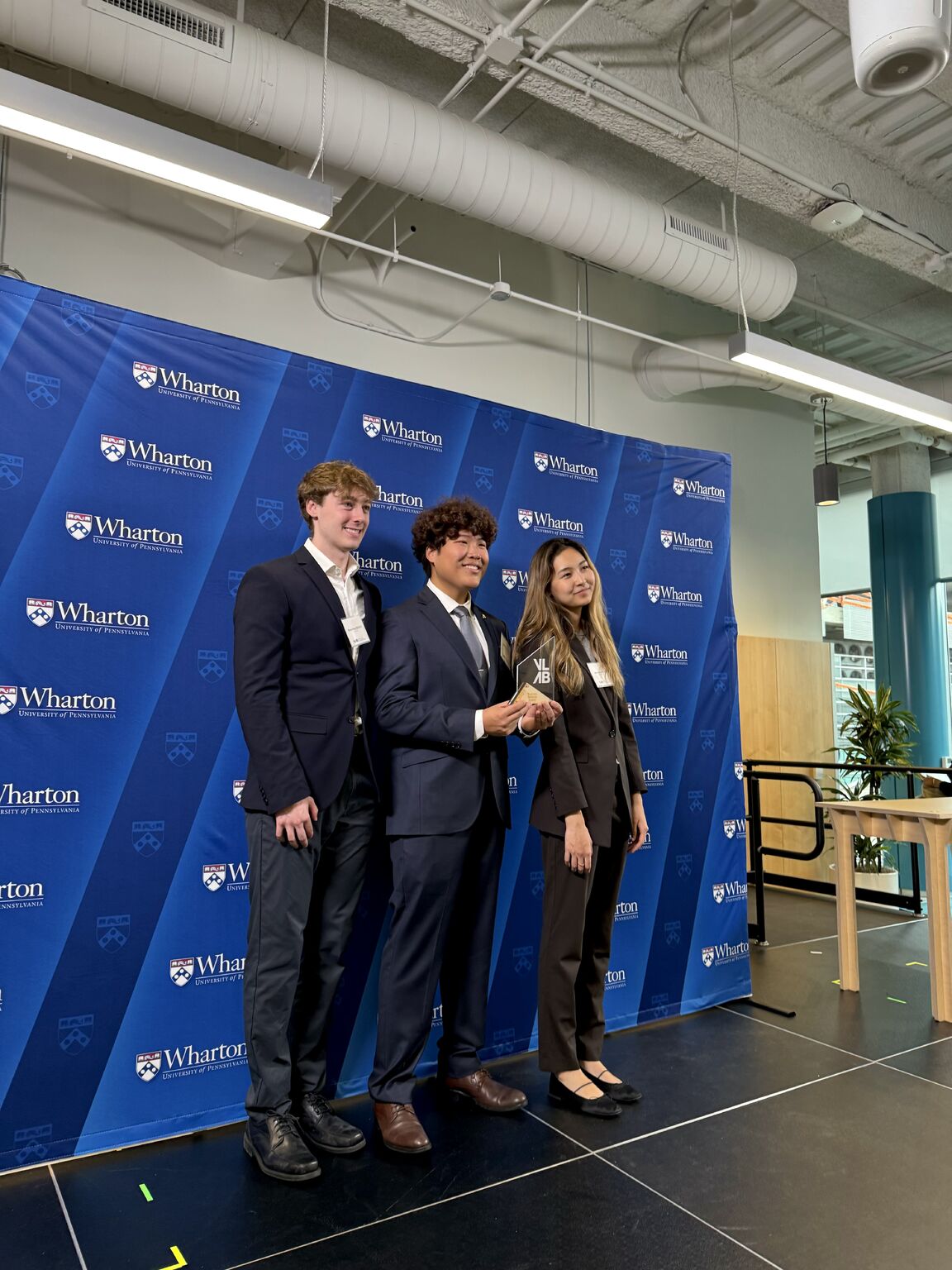
Penn also gave Raup room to test a founder's life. SphereUs, built with Ace Kim and Alima Aset, was a platform for matching students with brand-ambassador opportunities. The team won the UPenn Summer Venture Award and a Startup Launch Award from the Penn Wharton Innovation Fund in 2024. There was a live platform, an audience, and the particular education that comes from asking strangers to use what you have made.
Another student project, Second Brain, approached a different kind of overload. Raup was one of five names on its business plan, which proposed a personal archive for papers and articles. Users could upload documents, search their full text, group them automatically, read summaries, and ask questions of an integrated language model. The team envisioned researchers finding a buried fact in seconds rather than hunting through folders for fifteen minutes.
SphereUs dealt in people, campaigns, and opportunities. Second Brain dealt in papers, folders, and recall. Yet both began with the same irritation: valuable information exists, but is scattered and difficult to act on. The builder's task was to give it a shape. That theme is less visible than a company logo, but it has followed Raup from student projects into professional engineering.
“Always chasing the next summit, trail, or starting line.”Ricky Raup, on his personal site
03 / Data with consequencesFrom sanctions to judgment
After graduation, Raup joined Bloomberg in June 2024. His focus was sanctions data, a phrase that sounds dry until one remembers what sanctions are: rules about who may transact with whom, across jurisdictions, aliases, ownership structures, and shifting political realities. In such a system, neatness is not cosmetic. Records have consequences. A missed match and a false match are different failures, and both matter.
That work lasted a year and a half, ending in November 2025. Then came AfterQuery. The company describes itself as an applied research lab that turns real-world expert work into training data for foundation models. Its menu includes supervised fine-tuning data, expert-designed rubrics, agent environments, and demonstrations of people operating software. The premise is that a model needs more than polished outputs. It needs evidence of how informed people reason through a task.
The move from financial data to AI training may look like a leap between fashionable nouns. At the level of engineering, it is more continuous. Both domains depend on provenance, structure, edge cases, and the discipline to resist a plausible but wrong answer. Both bring the world, in all its exception-filled inconvenience, into contact with a machine-readable system.
For Raup, AfterQuery also joins the two halves of his Penn teaching. There is the formal question of capability: what can this model do? Then there is the database question: what information, organization, and feedback will let it do that reliably? A founding engineer at an applied lab works in the interval. Research must become infrastructure; infrastructure must make new research possible.
04 / The useful blank spaceOne word: “Building”
Raup's public biography is spare. It does not offer a theory of leadership or a procession of grand claims. The projects section says “Coming soon.” So does the blog. There is something refreshing in a young engineer leaving blank space blank. The internet has an abundant supply of people narrating the work before doing it.
What he does record is concrete. Dates. Courses. Employers. Six national parks. Seven or more peaks. Three favorite hikes. Rocky Mountain in October 2025, Acadia in September, Zion in March. The list has the satisfying clarity of a test log. The adventures are not presented as a retreat from engineering so much as another column in the same notebook.
A trail rarely cares about the elegance of one's self-description. It rewards preparation, judgment, and continued movement. Software has more meetings but similar indifference. The system works or it does not. The data holds or it buckles. The user finds the thing or remains lost. Raup's record, from nonprofit projects through a financial terminal and into AI research, is a record of increasingly consequential versions of that test.
The common thread is not artificial intelligence. It is the older craft of making difficult information usable.
05 / No summit speechThe next stretch of trail
It is too early to render a verdict on Raup's career, and verdicts are not especially useful at the base of a climb. What can be seen is a preference. He has moved toward larger systems and less forgiving information: from nonprofit software to research tools, from research tools to sanctions data, from sanctions data to the expert judgment used to train AI models.
The geography has shifted too. Philadelphia remains the origin point, marked by coordinates on his site. Penn supplied degrees, classrooms, collaborators, a relay oval, and venture experiments. Bloomberg brought him to work in Princeton, New Jersey. He is now based in New York while building for a San Francisco AI company. The professional map is distributed; the logic is not.
Hallett Peak rises above the Continental Divide in Rocky Mountain National Park. Raup reached it in October 2025, one month before he began at AfterQuery. There is no need to force providence onto the calendar. A mountain is not a startup metaphor; it is a mountain, magnificently unconcerned with résumés. Still, the timing offers a clean image: one summit logged, another difficult route beginning.
On that new route, the problems are not merely technical. AfterQuery's work depends on representing how experts make decisions, including the caveats and context that disappear when judgment is flattened into an answer key. The engineer's challenge is to build systems sturdy enough to hold nuance without turning it into mush. That is a worthy climb, with plenty of false peaks.
Raup has not published the summit speech. Good. His page still says “Building.” The word leaves room for experiments that fail, systems that improve, and switchbacks no one saw from the trailhead. It also puts the emphasis in the right place. At twenty-something, a career should be less monument than motion. One foot. One system. One difficult piece of information made useful. Then the next.