An empty restaurant chair is an unusually unforgiving piece of inventory. Leave it unoccupied tonight and you cannot sell tonight again tomorrow. An airline mile has almost the opposite property: it can sit in an account, accumulating possibility. Rewards Network makes a business out of putting these two things together. The chair needs a person. The person would quite like a holiday.
- Restaurants buy access to diners through established loyalty brands.
- Linked-card purchases trigger rewards and a restaurant marketing fee.
- Optional funding turns future card receipts into cash today.
The reward lives somewhere else
Here is the ordinary version of an extraordinary arrangement. A diner enrolls in a partner dining program, links a payment card, chooses a participating restaurant, and pays. Rewards Network matches the purchase through payment data. The partner supplies the reward currency. Nobody needs to announce a membership to the waiter. The restaurant charges its usual menu price.
The participating brands include American Airlines, United, Marriott Bonvoy, and Hilton Honors. Each brings an audience with an existing reason to care about points. Rewards Network supplies the restaurant relationships and the machinery behind the exchange. For an independent operator, this means appearing inside loyalty ecosystems it would be difficult to assemble alone.
- 01The restaurantWelcomes a full-price guest
- 02The networkRecognizes a qualifying purchase
- 03The loyalty partnerAwards points, miles, or cash back
The January 2026 leadership announcement reported more than 21,000 restaurant customers and 25 million enrolled cardmembers. Those are enrollment figures, not a count of people eating through the network every month. The distinction matters. A network can have considerable reach while an individual restaurant still has to establish whether the right guests are nearby.
Before the miles, there was a cash problem
Founder Melvin Chasen’s early idea involved barter. Transmedia, the predecessor business, traded advertising for restaurant meal credits. According to the company’s published business history, restaurateurs preferred cash to advertising space. That preference redirected the offer toward advances against future meals. The customer had supplied the more useful product brief.
The early arithmetic was blunt. A 1991 example, later recounted by industry publication deBanked, described a restaurant receiving $10,000 against $20,000 in meals. Consumers bought those meals at a discount. That is historical pricing, not a quote for today. It shows the original insight: a future dinner could help finance the business serving it.
The company subsequently passed through the iDine name before becoming Rewards Network in 2003. TowerBrook acquired it from Equity Group Investments in 2017, without disclosing the price. Stephen Fusco became CEO in January 2026; predecessor Edmond Eger moved to executive chairman. The current company connects restaurant financing to a broader loyalty-distribution business.
Full price has a price
The menu price can obscure the economics. A diner pays the full check, but the restaurant pays Rewards Network a percentage of qualifying marketing transactions. Part of that percentage funds rewards. The public pricing explanation describes the mechanism without setting a universal rate. The operator’s relevant number is the contribution left after food, labor, other variable costs, and the program fee.
Funding adds a second calculation. Dining Credits provides money upfront by purchasing future card receivables, with collection tied to member spending. Premier Restaurant Funding uses total credit card sales and collects a percentage across those sales. Both include marketing. Rewards Network describes them as merchant cash advances rather than loans. A sales-linked collection schedule still commits future receipts.
“I like paying Rewards Network through guest-driven revenue”
Gary Mantelli / West Saloon & Kitchen
Company-published customer testimonial
Two products. Different slices of tomorrow’s receipts.
The alternatives solve overlapping problems. inKind also combines restaurant capital and demand, purchasing food-and-beverage credit and distributing it through its own app. Paid advertising buys exposure. A restaurant’s own loyalty scheme builds a direct customer relationship. Rewards Network’s distinguishing move is distribution through established outside loyalty currencies, with payment data connecting the promotion to a completed purchase.
A receipt becomes a second conversation
The purchase generates something besides a reward: information. Rewards Network’s dashboard tracks check sizes, repeat spending, guest geography, and ratings. An owner can see patterns that a busy dining room conceals. Are first-time guests returning? Are visitors coming from nearby offices or farther away? These questions make the reporting useful beyond the weekly sales total.
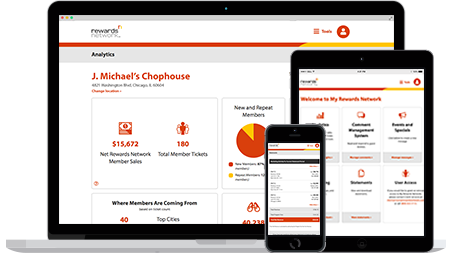
Its review system verifies a purchase before allowing feedback. Operators can reply and examine ratings over time. Verification establishes that a meal occurred; it does not make every opinion objective. Still, a comment connected to an actual visit gives a manager something specific to investigate, whether the issue was service, food, or value.
Distribution keeps evolving. The May 2025 Fetch partnership introduced an important variation: diners submit receipt photographs to earn Fetch Points. The September 2025 Wyndham launch extended dining rewards to another hotel audience. The business can therefore reach beyond the familiar frequent-flyer habit, while the restaurant remains the place where the transaction happens.
The work behind those partnerships spans sales, technology, operations, and analytics. The careers site describes collaborative teams and volunteering at the Greater Chicago Food Depository. One benefit suits the assignment: employees can receive a 33% dining reimbursement at partner restaurants. In January 2026, Built In recognized Rewards Network in two Chicago workplace categories. Even the staff has a reason to study the menu.

The useful question is about Tuesday
A tracked visit does not automatically prove an additional visit. Some members may already be regulars. Others may arrive during a rush when every chair would have filled anyway. The company’s own guidance points toward restaurants with available seating, higher checks, and access to travelers. Thin margins and an already-full room make the bargain harder.
For an operator, the practical approach is to examine the agreement, compare new and returning guest behavior, and ask what remains after the fee. For other businesses, the copyable idea is smaller: connect your spare capacity to an incentive customers already value. Then measure whether they come back. The first dinner is an introduction. The next one is the business.