The origin story of Restore Hyper Wellness is almost suspiciously tidy. A triathlete steps into a cryotherapy chamber, enjoys the blast of cold, and dislikes nearly everything around it. The booking feels awkward. The room feels clinical. The service is treated like a strange machine instead of a welcoming habit. Jim Donnelly and Steve Welch look at that gap and open a better studio in Austin in 2015. The company grows from one chilly room into a national chain where customers can freeze, sweat, glow red, squeeze their legs in compression boots, sit for an IV or climb into a gently pressurized oxygen chamber.
The interesting part is not the hardware. Restore did not invent cold, heat, light, oxygen or vitamins. It packaged a scattered shelf of wellness services into one understandable retail experience. In a category famous for gadgets and jargon, the company built an aisle.
The first thing that failed was the assumption
Restore's founders initially imagined an audience of athletes who wanted faster recovery. That was reasonable: Donnelly found cryotherapy while training for a triathlon, and sports performance gave the unfamiliar treatment an easy story. But according to a later founder interview, athletes represented only about 15 percent of customers. Everyone else had arrived with more ordinary ambitions - less soreness, more energy, better sleep, a calmer hour, brighter skin, or simply curiosity about feeling better.
That discovery changed the addressable market. Restore stopped behaving like a recovery room for serious competitors and began presenting itself as a place between a gym, a spa and a clinic. The brand's broad promise - “do more of what you love” - is deliberately less intimidating than “optimize your mitochondrial function.” A customer does not need to identify as a biohacker. She can be a parent with tired legs, a desk worker intrigued by red light, or a runner who wants three minutes in the cold.
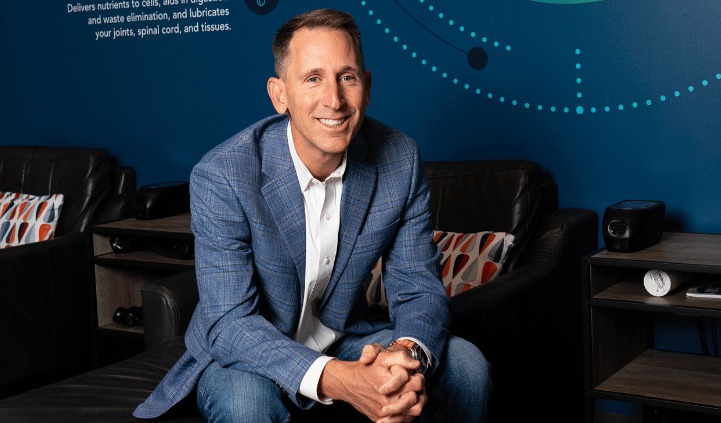
The smartest Restore product is the ability to try several wellness products without assembling several providers.YesPress analysis
What Restore actually sells
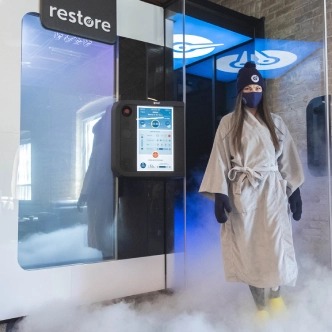
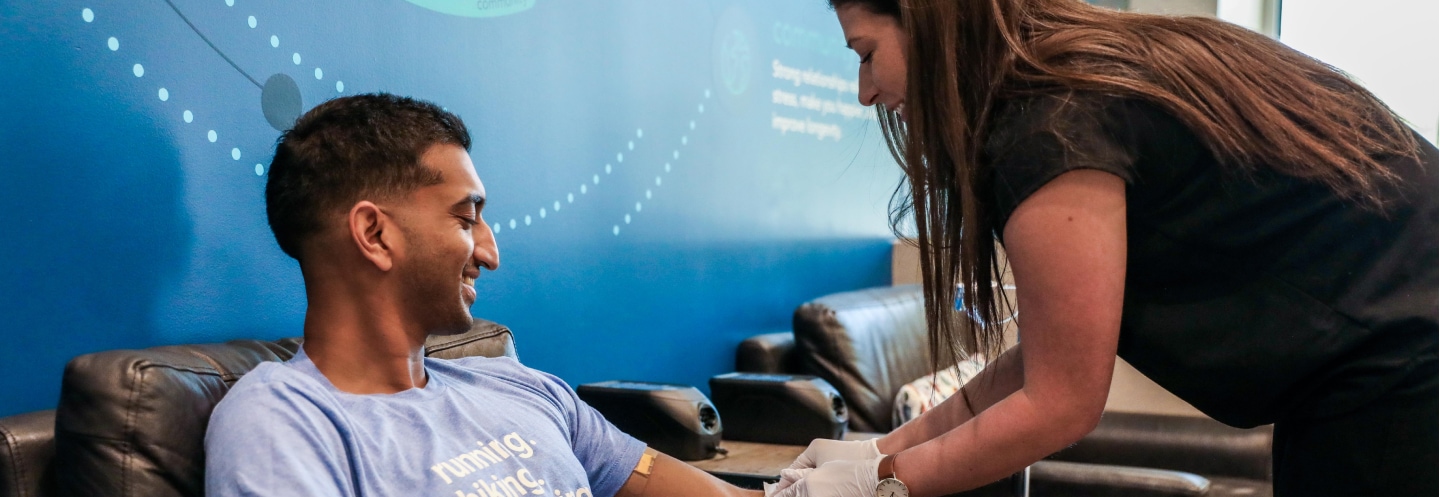
The menu begins with four “core” therapies: whole-body cryotherapy, red light therapy, infrared sauna and pneumatic compression. Around those sit clinician-supervised IV drips and intramuscular shots, including NAD+ and Niagen NR options; mild hyperbaric oxygen; biomarker assessments; skin treatments and peels; and medicated GLP-1 weight-loss plans for eligible clients. Not every studio offers every service, and prescriptions cost extra.
The company groups the services around goals rather than mechanisms: athletic performance, immunity, intentional aging, focus, sexual health, skin health, pain and recovery. That is useful merchandising. “Near-infrared light” is a specification. “I want to sleep better” is a job a customer recognizes.
The machine behind the machines
Restore makes money in layers. A first-time visitor can buy a single session. Packs encourage another visit. Monthly memberships add credits, discounts and guest passes, and work across participating studios. Recurring NAD+ and Niagen plans apply the same cadence to higher-ticket services. Local franchisees fund most of the physical expansion; the parent earns an initial fee, royalties, brand-fund contributions and technology fees.
The membership matters because many wellness services promise benefits from consistency. That makes recurring revenue feel aligned with the product story rather than bolted on. It also creates the central risk: a membership only works if customers use it enough to perceive value and not so much that capacity or labor collapses.
Growth arrived in a hurry
The numbers show how quickly a local experiment became a franchise system. Restore began selling franchises in 2017. It entered 2020 with 34 locations, then announced $32 million in system-wide revenue for the year - up 141 percent - and the delivery of its millionth service. More than 600,000 of those services reportedly happened during 2020 alone. At that point the company said its headquarters and retail locations employed more than 1,500 people across 28 states.
Outside capital followed the demand. Public funding databases record a $1 million seed round in 2016, two early rounds totaling $5.2 million in 2017 and 2018, and an $8 million 2020 round involving Level 5 Capital Partners and Banyan Ventures. General Atlantic then led a $140 million investment in December 2021, bringing reported funding to roughly $154.2 million. The money was earmarked for new markets, technology and an increasingly integrated experience. It was growth capital for a retail-and-medical operating system, not just a fleet of freezers.
By the end of 2022, Restore reported more than 186 locations in 37 states and said services rendered had increased 47 percent from the prior year. In 2023 it described a footprint above 225 studios. Today's company materials use the more measured phrase “200+.” Store counts can move as franchises open and close, but the overall arc is clear: Restore demonstrated that the concept could travel well beyond Austin and the expected coastal markets.
The Restore loop
What did it cost?
For consumers, there is no honest national answer. Restore says prices vary by studio, membership and service. That local flexibility suits a franchise network but makes comparison shopping less tidy. Members can save up to 30 percent on some offerings, while nonmembers can book without a subscription.
For operators, Restore is unusually specific. Its franchise site currently quotes a total estimated investment of $817,674 to $1,289,925, with $300,000 in liquidity and a $1 million net worth required. The one-time franchise fee is $44,500. Ongoing charges include a 7 percent royalty, a 2 percent brand-fund contribution and a $600 monthly technology fee. Studio development typically takes six to nine months after a lease is signed.
A seven-figure room full of optionality
- $44,500 initial franchise fee
- 7% royalty + 2% brand fund
- $600 monthly technology fee
That expense explains both the differentiation and the danger. A single-purpose sauna studio can be simpler. Restore needs specialized equipment, suitable real estate, trained staff and medical infrastructure. Specialty services such as IV therapy and mild hyperbaric oxygen must operate under authorized clinical supervision even where local rules might be looser. The range of services can raise customer value, but every new modality adds training, scheduling and compliance work.
Culture has to cross the franchise line
Restore's stated culture is refreshingly direct. Employees are asked to live the Hyper Wellness lifestyle, “fix what is broken,” and help people do more living. Free or discounted services make the first principle literal. The second asks staff to treat a broken process as their problem rather than somebody else's ticket. In a 2020 Great Place to Work survey, 95 percent of respondents called Restore a great place to work, and 98 percent said they were given significant responsibility.
Those figures are a historical snapshot, not a guarantee at every counter. Restore studios are independently owned and operated, and the labor mix can include wellness representatives, estheticians, nurses, nurse practitioners, managers and medical directors. A culture can be printed once at headquarters; it has to be performed hundreds of times by local owners. That is why founder Jim Donnelly's description of self-awareness as the company's “superhero” is more useful than a perk list. A franchise network must notice its weak locations before customers turn local inconsistency into a national reputation.
Where it sits - and why it is different
Restore competes directly with iCRYO, Next Health, SWTHZ and Perspire Sauna Studio. Indirectly, the list is much longer: med spas, IV bars, gyms, physical therapists, massage and stretching chains, and a growing stack of home cold plunges, saunas and red-light panels. Its advantage is aggregation. A customer can sample several modalities in one clean studio, ask staff for a plan, manage bookings in an app and use membership credits while traveling.
The medical layer is another divider. Restore says nurse practitioners are connected to studios and medical services are provided through independently owned physician practices. It also states that its materials are not medical advice and that results vary. Those disclaimers matter. Evidence strength is not identical across cryotherapy, red light, vitamin infusions, hyperbaric oxygen and weight-loss prescriptions, and broad wellness language can outrun what any one service has been shown to do. The responsible customer treats the menu as a set of options to discuss with qualified clinicians, not a substitute for care.
The part an operator can steal
The copyable lesson is not “buy a cryo chamber.” It is to find a product people already like but experience badly. Start with one clear entry service. Watch who actually arrives, especially the customers who violate the pitch deck. Add adjacent products around their recurring jobs. Explain the menu in outcomes customers use in normal conversation. Finally, turn consistency into a product through booking, credits, education and follow-up.
Restore also shows why a category name can help. “Hyper Wellness” gives a shelf label to a bundle that otherwise looks random. The phrase does not prove efficacy, and no trademark can rescue weak service, but a good category label tells customers why cold, heat, light and an IV belong in the same store.
It can work when...
- Customers have repeat goals and disposable income.
- The trade area supports premium rent and staffing.
- Clinical oversight is trusted and consistent.
- Several services share the same customer journey.
It breaks when...
- Curiosity does not become a habit.
- Equipment sits idle while fixed costs keep moving.
- Claims become broader than evidence or regulation allows.
- Franchise execution varies enough to damage trust.
The harder second act
Restore's first decade proved that the appetite for accessible wellness extends beyond coastal biohackers and elite athletes. By 2021 it had 115 locations, and General Atlantic led a $140 million growth investment. In 2022 the company reported 186 studios and a 47 percent annual increase in services rendered. Current materials describe more than 200 studios, below some earlier expansion ambitions but still a substantial national footprint.
The network has kept widening the menu. A 2025 partnership with Jan Marini added facials, peels and home skin care. NAD+ and Niagen plans pushed recurring longevity services. GLP-1 programs moved Restore closer to mainstream medical demand. Its leadership page now lists former medical-device executive and Restore franchisee Andy Ayers as CEO - a combination that fits the next problem: making a clinically complicated franchise feel consistent from one ZIP code to the next.
Restore began because a useful service had an unlovable wrapper. The company rebuilt the wrapper, discovered the audience was bigger than expected, and made the return visit its economic center. That is the honest payoff. The cold chamber is memorable. The habit is the business.