The security report arrived clean. No vulnerabilities. For many founders, this is the part where shoulders drop and somebody forwards the PDF to a customer. Rene Brandel reads the same blank result and hears an alarm bell. Software changes too quickly, he argues, and its surface is too broad for a point-in-time inspection to confer innocence. A spotless report can mean the test failed to look hard enough. Comfort, in this business, is not the same thing as evidence.
Brandel has built his career around shrinking the distance between an intention and useful feedback. At AWS Amplify, that meant helping developers get cloud-connected applications running without first becoming infrastructure scholars. With Kiro, the agentic development environment he helped build at AWS, it meant giving AI coding a more structured path from an idea to an implementation. At Casco, the San Francisco company he co-founded with Ian Saultz in 2025, the feedback is more adversarial: an agent attacks your running software, shows what can actually be exploited, and tells you what to patch.
The idea sounds inevitable only after someone has built it. Developers now ship continuously. AI helps them produce still more code. Yet security often arrives as an annual ceremony involving scheduling, consultants, a static report, and the solemn passing of several weeks. The modern codebase sprints; its inspection takes the scenic route. Casco's proposal is to put the inspector on the deployment train.
Before the security agent, a website bot
The through line begins in Karlsruhe. As a student at Karlsruhe Institute of Technology, Brandel worked on enCourage, a mobile app designed to let a person in danger alert nearby users who could call for help and gather at the scene. The team represented Germany at Microsoft's Imagine Cup world final in Seattle in 2015. During presentation coaching, judges asked for more of the demo to happen live. That meant another evening of alterations. “Six hours of work, no big deal,” Brandel joked. It is a neat early portrait: pressure converted into a work session, with just enough mischief to keep the room breathable.
A year later, he joined Yue Ou, Julian Brendl, and Michael Vakoč for 40 hours at HackZurich. Their project, Ivy, let a user build a personalized website by talking to a bot. The team won the overall competition and the audience award. The prize was CHF 5,000; the more durable result was a theme. Long before “vibe coding” earned its nickname, Brandel was interested in translating conversation into working software.
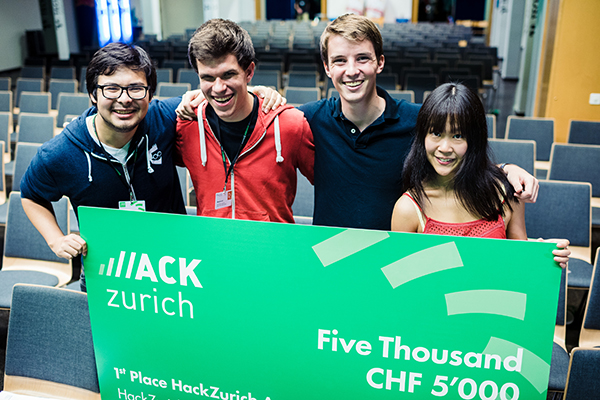
He moved through product work at Microsoft and a software-engineering role at Prisma before joining AWS. At Prisma, he has said, he learned to care about developer experience at the granularity of a keystroke: each one should help the developer finish the job faster. It is the sort of principle that sounds fussy until one remembers that friction compounds. Save a developer ten awkward steps once and you have a nice feature. Save them on every build and you have changed the product.
The product manager in the engine room
At AWS, Brandel's public trail is unusually tangible. His name appears across launches for Amplify's visual form builder, real-time authorization, GraphQL integrations, a slimmer JavaScript library, and Amplify Gen 2's TypeScript experience. These are not monuments. They are connective tissue: tools that let builders spend less time wrestling the cloud and more time shaping what their users encounter.
He eventually led product work around AI agents and helped build Kiro, AWS's agentic IDE. Kiro's central bet was that generative coding improves when enthusiasm acquires a specification. A prototype can be loose; a production system needs the details written down. Brandel later described the leverage in almost proverbial terms: one good line of specification can lead to a hundred good lines of implementation, while one bad line can multiply just as efficiently.
That efficiency contains its own trap. An agent can generate a great deal of code, and it can generate a great deal of vulnerable code. Brandel has recounted watching an AI tool handle credentials in a way that left them in his shell history. Nothing about the interface looked dramatic. The danger sat quietly in the wake of an otherwise productive act. More code, shipped by smaller teams at greater speed, means more places for a small mistake to become a live one.
The operating idea behind Casco: put testing next to development, return evidence rather than a pile of possibilities, and let each cycle improve the next.
Brandel and Saultz left AWS in March 2025. Both had worked close to generative AI, application security, and cloud infrastructure. They entered Y Combinator's Spring 2025 batch with Casco, initially framing it around AI agents and applications. The scope soon expanded to web apps, APIs, cloud infrastructure, and AI systems. The mission stayed compact: make all software effortlessly secure.
A hacker that brings receipts
Traditional scanners are diligent in the manner of a smoke alarm installed above a toaster. They find many things that resemble danger, then invite a person to sort breakfast from combustion. Brandel calls the resulting deluge “security slop.” The problem is not merely aesthetic. A thousand alerts with a 99 percent false-positive rate create a new job for a security team that was trying to finish the old one.
Casco's product philosophy therefore prizes signal. Its agents interact with running software, attempt multi-step attacks, and return reproduction steps and remediation guidance. Human supervision is available for customers that need it. In 2026, the company received CREST accreditation for penetration testing, placing its supervised work inside a recognized framework of technical, ethical, and quality controls.
The point is not to eliminate the security engineer. It is to stop treating that engineer as the recipient of every machine's vague suspicion. Brandel imagines security and software engineering “swimming in one lane,” with tools that carry business context and give engineers a way to contribute fixes directly. The language is revealing. He does not describe a gate with a sterner guard. He describes a shared direction.
Small teams, tight loops
Brandel's view of company building resembles his view of software. Small, talent-dense teams can outperform larger organizations when they build reinforcement loops instead of merely accumulating features. Casco's hiring process makes the theory concrete. A candidate speaks with Brandel for 30 minutes, then Saultz for 30 minutes, then completes a paid five-day trial. The person works alongside the team and ships real features. Both sides observe reality. A decision comes within 24 hours of the debrief.
The published qualities are customer obsession, ownership, bias for action, craftsmanship, and transparency. None is exotic. Their arrangement is the interesting part: speed sits beside craft, ownership beside transparency. Moving quickly is useful only if the feedback is honest enough to correct the movement.
Casco's early promotion occasionally turned this philosophy into theater. The company offered cash if its system could not hack a prospect within a set period. Brandel also demonstrated seven exploitable apps among 16 publicly launched companies from a Y Combinator batch in about 30 minutes. The stunt earned attention because it condensed an abstract mismatch into a stopwatch. Software exposure was arriving faster than the rituals designed to find it.
The valuation and the velocity
In July 2026, Casco announced a Series A led by Standard Capital, with FundersClub, Y Combinator, and Rebel Fund participating. The round valued the company at $100 million and brought total capital raised to $17 million. The distinction matters: a $100 million valuation is not a $100 million cheque. Precision is a pleasant habit in security stories.
Casco said it had found critical vulnerabilities in more than 300 companies, including businesses that already used established scanners and human pentesters. Its Y Combinator profile listed more than 100 customers and described software it secures as deployed across 60 percent of Fortune 500 companies. Those are company claims, but they clarify the shape of the ambition. Casco is not trying to make the annual test a little faster. It wants security to become a standing property of software development.
There is a pleasing symmetry in Brandel's path. Ivy listened to a person describe a website and tried to build it. Kiro listened more carefully, turning a specification into structured code. Casco listens to what a system is supposed to do, then behaves badly on purpose until reality contradicts the intention. Build, specify, challenge: three phases of the same conversation.
The final aspiration is almost domestic in its simplicity. You commit code. A preview appears. The security test begins. A real vulnerability comes back with proof. The patch follows while the context is still warm. No ceremonial season. No dashboard snowstorm. No immaculate report placed in a drawer. Software hires its own hacker, and the hacker, if Brandel gets the product right, has the manners to explain what it broke.