A wedding is a dangerous place to meet Renato Ramirez if you have money and he has a cause. With construction of the Tejano Monument waiting on a final funding gap, the Zapata banker took his appeal to friends at a wedding. The project needed $70,000. By Monday, he had raised $130,000. Presumably, the newlyweds received something too.
The episode contains much of what makes Ramirez interesting: a banker’s attention to the outstanding balance, a fundraiser’s willingness to interrupt a pleasant evening, and a conviction that Texas should give its Hispanic history a visible place. He had spent years helping people finance their futures. Here was a chance to help a state look more carefully at its past.
Ramirez was one of a group of organizers behind the monument, which was dedicated on March 29, 2012, on the Texas Capitol grounds. Its bronze settlers, family and vaquero stand on granite. Getting them there required years of fundraising and legislative work. Even a permanent monument, it turns out, begins with people making calls.
A place on the front lawn
The project began with an absence. In 2000, Cayetano Barrera visited the Capitol and noticed the lack of a memorial to the Spanish and Mexican chapters of Texas history. He gathered supporters, including his nephew Richard Sanchez. Ramirez became a fellow organizer and fundraiser; Armando Hinojosa, the Laredo sculptor, gave the undertaking its physical form.
Permission, money and location each became a separate obstacle. Authorization alone would not pay for bronze. Funding alone would not settle where the work could stand. The organizers wanted the south grounds, where visitors approach the front of the Capitol. The distinction mattered: a memorial teaches partly through the company it keeps and the people who walk past it.
Texas lawmakers later recognized Ramirez as one of the monument organization’s vice presidents, alongside Homero Vera and historian Andrés Tijerina. Barrera was president; Sanchez served as secretary and treasurer; Jaime Beaman was a director. The names belong together. A finished sculpture can look inevitable. The committee behind it had spent years discovering how many ways a proposed sculpture could remain proposed.
Ramirez’s part was practical and political. He helped secure contributions and supported the effort through changes in state law. His family also gave money. This was philanthropy with paperwork, a form of cultural advocacy requiring both a persuasive account of history and somebody willing to ask for the next check.
An engineer takes the long way home
Before the bank and the bronze, there was mechanical engineering. Ramirez graduated from Texas A&M University in 1961. He also wrestled there, earning letters in the sport for three years. The combination makes a pleasing early portrait: calculations in one part of university life, an opponent determined to ruin your calculations in another.
He studied at the University of Texas at Austin from 1964 to 1966, earning his MBA. He subsequently undertook doctoral studies in finance and economics at the University of Tennessee. His education crossed disciplines and university loyalties. An Aggie who went on to UT already has some experience negotiating differences.
Teaching occupied a substantial part of his early career. He taught finance at Tennessee, Louisiana State University and Laredo State University. At LSU, his responsibilities included serving as associate dean of its Escuela Bancaria Superior de Centro-America. He also consulted for the Tennessee Valley Authority on banking practices and regional economic development.
Those assignments placed banking inside a wider question: what does access to capital allow a region to do? His later work brought the question back to South Texas. Before joining IBC, he managed loans to Mexico through the Export/Import Bank program in Laredo. The classroom material had acquired customers, repayment schedules and a border.
Banking, with a hometown attached
Ramirez joined IBC on July 1, 1983. He became the founding president and CEO of IBC Bank-Zapata when it opened in February 1984. For someone whose career had taken him to university classrooms outside Texas, this was a durable commitment to home. Zapata became the base for work that extended across neighboring South Texas communities.
His explanation of banking could be refreshingly unfashionable. Addressing TAMIU graduates in 2010, he defended attention to borrowers’ payment histories, credible property appraisals and lending terms that borrowers could actually meet. He described a bank that had lived through peso devaluations, the savings-and-loan collapse and upheaval in housing. Financial novelty did not automatically impress him.
“I’ve never been one to just sit around.”
Renato Ramirez, 2010 commencement address
In the same address, he connected commercial success to a bank’s capacity to support its surroundings. He described IBC-Zapata’s $300,000 donation to the Zapata Boys and Girls Club, alongside recurring giving and support for education. His argument was straightforward: local businesses and local people share an interest in one another’s success.
There was also a family succession. In December 2010, his son Ricardo was promoted to president and joined the board, while Renato continued as CEO and chairman. The distinction is useful when following the family’s public story. Their names occur together often, but the father’s founding career and the son’s leadership are separate chapters.
By 2020, Renato had retired from his leadership role at IBC-Zapata. His professional identity had widened well beyond a job title by then. He was a rancher, an education donor and a participant in projects whose timetables bore little resemblance to a quarterly reporting cycle.
A million dollars, aimed at the next class
In May 2004, Ramirez provided a $1 million scholarship gift to Texas A&M International University. It established the Renato and Patricia Ramirez Scholars, recognizing him and his wife, Patricia. The university’s endowment listing identifies the R. and P. Ramirez, LTD Endowed Scholarship and specifies students from the Zapata area attending TAMIU.
The 2004 scholarship gift supporting students at TAMIU.
The geography makes the gift more revealing than the figure alone. Ramirez had earned his engineering degree in College Station. He directed this contribution toward a university in Laredo and students from his own area. Educational gratitude traveled home, rather than remaining exclusively attached to the campus on his diploma.
His involvement in education also extended to Laredo Community College. In 2004, he became one of nine founding directors of its district education foundation. He secured donations and contributed $62,000 on behalf of the family partnership. Earlier, he had served as president of the Zapata school district’s board of trustees from 1993 to 1997.
These are different kinds of participation: school governance, foundation work and an endowment. Together they show someone willing to deal with education’s administrative machinery as well as its ceremonial moments. A scholarship announcement is brief. Institutions need people willing to stay interested after the photograph.
The banker who helped pay for the music
Ramirez’s cultural interests have a soundtrack. He supported the University of Texas mariachi program, including the first mariachi summer music camp at the Butler School of Music in 2013. A Texas House resolution commemorating that camp specifically credited his efforts in funding it. Students came for instruction in composing, arranging and performing.
By 2017, he was contributing at least $15,000 a year to send students to the Longhorn summer camp. The students came from places including Laredo, Zapata, Roma and Rio Grande City. Support covered an obstacle that enthusiasm alone could not remove: the expense of attending a residential university music program.
There is an appealing specificity to that choice. Supporting culture can mean underwriting a building or sponsoring an evening. Here it also meant helping a high school musician get to campus, learn from instructors and play alongside other students. A tradition survives through people who can practice it. Practice requires time, teaching and somewhere to sleep.
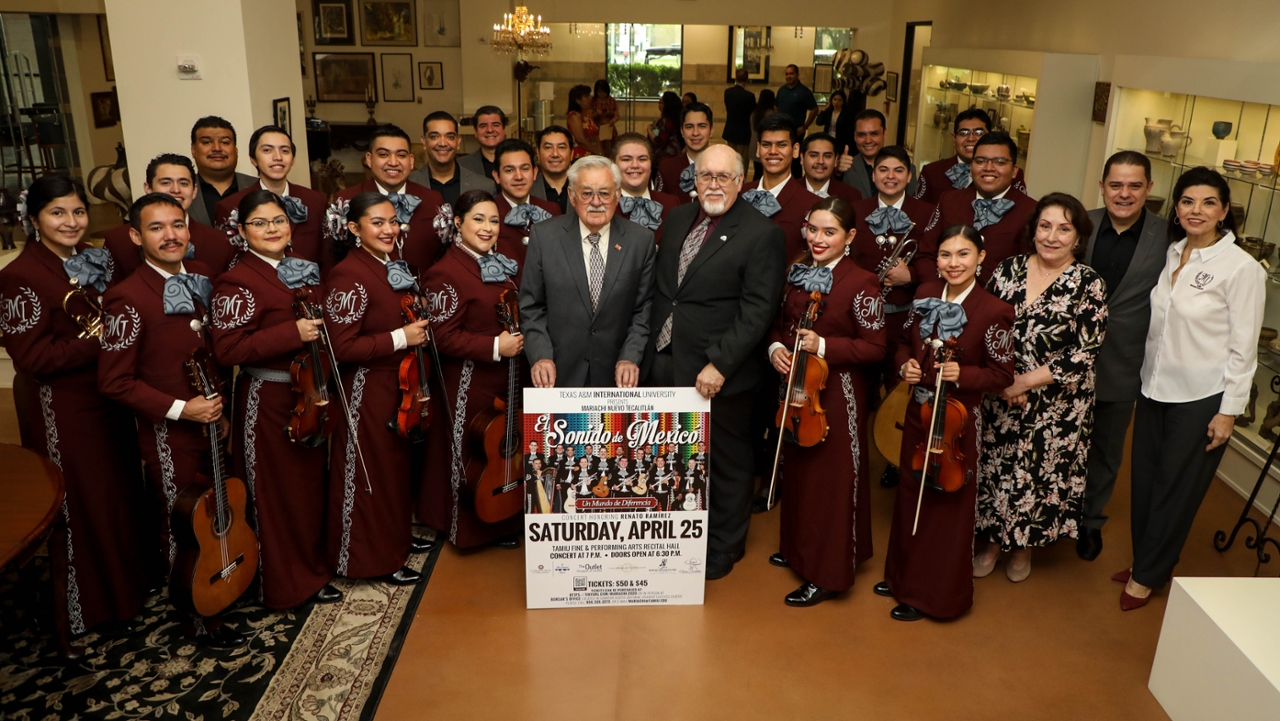
The Butler School publicly thanked Ramirez for donor support when Mónica Fogelquist took the lead of its mariachi ensemble in 2019. His relationship with the music was also visible in Laredo. TAMIU announced in 2020 that its International Mariachi Festival would honor him; its 2022 festival announcement again identified him as the honoree.
The 2022 program linked concert proceeds to mariachi student scholarships. That brings two of his enduring interests into the same room. Students could receive help pursuing an education while performing music connected to their cultural inheritance. The monument has bronze figures. The musicians have rehearsals. Both ask the next generation to pay attention.
Recognition, then another thing to do
The honors followed several strands of the work. In 2005, the Texas Civil Rights Project made Ramirez the inaugural recipient of its Bernard and Audre Rapoport Philanthropic Award for Human Rights. The Mexican American Legislative Caucus recognized his contribution to Texas history and culture with its Latino Leadership Award in 2011.
In 2019, Texas A&M University-Kingsville’s College of Business named him an honorary Beta Gamma Sigma inductee. IBC’s announcement also credited Ramirez and IBC-Zapata with helping the college obtain AACSB accreditation. The former finance teacher’s relationship with higher education had continued through institutional support as well as student aid.
He and his family also became donors behind the Texas Institute of Letters’ scholarly book award. It is a quieter companion to the Capitol monument: support for the research and writing through which history gets examined. One project puts people into a public landscape. Another helps sustain the books people might read afterward.
Ramirez’s public life repeatedly returns to a question of access: to money, to college, to a music program, to the state’s account of itself. The answers have varied in size and form. Sometimes the useful instrument was an endowment. Sometimes it was a committee. And once, with a construction deadline approaching, it was a wedding guest list.