The useful part of a broken hot-water heater is rarely the heater. It is everything that happens around it: the resident submits a request, the property manager reads it, someone calls from an unfamiliar number, a technician tries to schedule access, the owner wonders what the repair will cost, and the resident waits. Somewhere along the way, a small domestic failure becomes a chain of missed handoffs.
Ray Hespen knew that chain from the resident’s side. His work had moved him around the country, and renting came with each move. When maintenance failed, he often found it easier to make the repair himself than to invite the coordination headache. His college friend David Kingman, living in Albuquerque while Hespen was in Baltimore, had reached the same conclusion. During a call in the winter of 2014, Kingman asked whether renting was always this bad when something needed fixing.
Their complaint could have ended there. Instead, Hespen took it into the field. He spoke with roughly 25 property-management operators and learned that the people receiving maintenance requests were frustrated too. Residents saw a black hole. Managers saw too many calls, too little visibility and a process that depended on several people remembering the next step. The shared annoyance suggested a company.
“The customer is not always right, but their problem is always real.”Ray Hespen
An engineer meets the messy middle
Hespen came to software by way of mines, oil fields and cement plants. He grew up in Gillette, Wyoming, one of six children in a blue-collar city shaped by energy. Summer work in the oil fields supplied an early lesson in physical effort. A single conversation later redirected him toward mining engineering at the South Dakota School of Mines and Technology in Rapid City.
He graduated in 2009, a brutal moment for construction materials. The weak economy became an operating education. Resources were scarce, budgets mattered and manufacturing problems could not be softened with elegant language. Hespen moved where the work took him: Tulsa, California, the Chicago area, Baltimore and Colorado. He learned to ask the factory-floor questions. Where is time being lost? Which handoff creates variation? What can be standardized? What does the data reveal that the organization’s habits conceal?
Property maintenance had the same shape, only the conveyor belt was invisible. A work order crossed households, office desks, calendars, vendor networks and accounting systems. Each participant could perform a reasonable local action while the overall experience still failed. Hespen’s manufacturing background made the waste legible.
Every transfer can add delay, ambiguity or a missed call. Property Meld’s product thesis is to keep the context attached as the work moves.
The day they decided to be poor
Kingman left his job first. Hespen followed after they had raised a little money. He later described the commitment with a laugh as “the day we decided to be poor.” The joke carries a useful amount of fear. In the early period, Hespen worked from his basement while Kingman built the software. No established category promised that customers were waiting. The problem was complicated, and the absence of a clear predecessor was both the opportunity and the warning.
The first ten customers were, in Hespen’s telling, an absolute grind. He was learning consultative sales without the comfort of a mature playbook. But ten also became evidence. If the founders could persuade ten operators to change a sensitive workflow, one hundred no longer sounded imaginary.
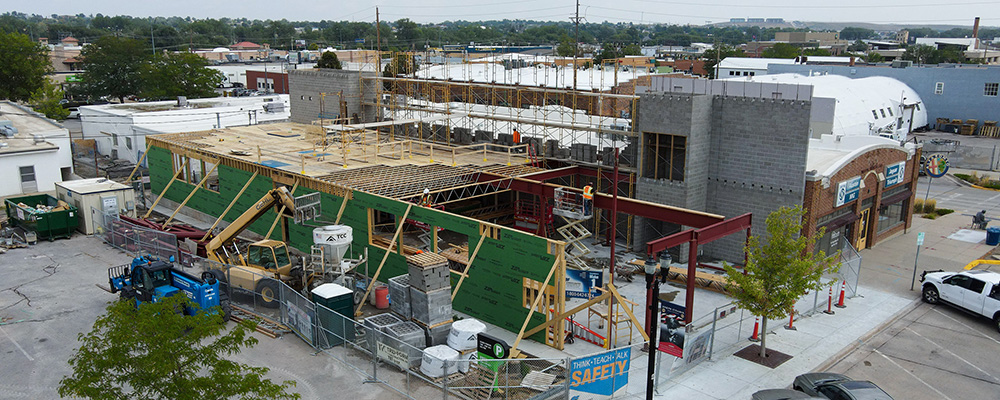
In 2017, Hespen brought the company back to Rapid City, the place he had wanted to remain after college. The Ascent Innovation Center offered flexible space and a community that could grow with an uncertain young company. Property Meld moved from the incubator into downtown offices and later built a headquarters on Saint Joseph Street. Hespen spoke about the location in human terms: talent needs coffee, restaurants, walkability and a city core worth joining.
That regional choice became public policy testimony in 2020. Before a U.S. Senate subcommittee examining entrepreneurship outside traditional hubs, Hespen described leaving the Midwest because opportunity pulled elsewhere, then returning to build. Capital and mentorship mattered. So did proving that a company in western South Dakota could sell nationally and create technical work locally.
Two renters validate a maintenance problem, then commit to building Property Meld.
The company moves into Rapid City’s startup ecosystem.
Hespen testifies before the Senate on regional entrepreneurship.
A $15 million Series B brings announced funding to $22 million.
Mezo, MAX Intelligence and TrueCost extend the platform into AI-assisted intake and repair economics.
When the founder becomes the bottleneck
A product can scale faster than its founder’s habits. Hespen has spoken plainly about the moment Property Meld grew from four people to 17, then toward 35. His calendar filled. When he could no longer jump into a sales call, an onboarding problem or a specific operating decision, things began to break. The growth line flattened near the limit of his availability.
He had been telling people what to do, which works until the number of decisions exceeds the hours in a day. Managing managers, developing people and giving teams enough context to act independently became the next engineering problem. Hespen said the lesson took about a year and a half of getting his “ass absolutely handed” to him. The candor fits his interview style: quick to joke about his qualifications, equally quick to identify the process hiding behind a personal failure.
The company’s announced $15 million Series B in January 2023 was a marker of institutional scale. At the time, Property Meld reported more than 650 customers across more than 450,000 rental units, with 1.7 million maintenance requests and nearly $550 million in repairs facilitated during the prior year. Frontier Growth led the round, joined by Vesta Ventures, South Dakota Equity Partners and Badlands Capital. Announced total funding reached $22 million.
By 2026, the company said its platform was processing about 3 million service issues a year for clients managing more than 800,000 doors in the United States and Canada. The numbers matter less as trophies than as raw material. Every repair records timing, messages, assignment, outcome and cost. Together, those details make maintenance behavior measurable.
From closing tickets to changing outcomes
Hespen’s larger argument is that maintenance should influence the business before a resident decides to leave or an invoice surprises an owner. Property Meld’s research has linked service gaps with lower lease renewal rates. It has also examined how repair speed, technician performance and communication affect satisfaction. The old dashboard asked whether a ticket was open or closed. The newer questions concern who should take the job, which risk deserves attention and what operating choice can improve the likely outcome.
This is where artificial intelligence enters his story without becoming a magic trick. Property Meld acquired Mezo in January 2025, bringing the virtual maintenance assistant MAX into its platform. MAX was designed to collect details, assist with triage and help mitigate emergencies. Later features used operating data to recommend technicians or vendors based on speed, resident experience and category expertise.
“It is a math game now, so every CFO should care how their maintenance operations are running.”Ray Hespen
Hespen’s 2026 forecast put a boundary around the technology. Maintenance optimization needs granular repair records, historical timing, local vendor conditions and operational context. General language ability is useful for intake and communication, but the consequential decision depends on domain data. He expects AI to expand the maintenance coordinator’s judgment, helping a person make a better assignment or recognize a risk that would otherwise remain buried.
TrueCost, introduced in 2026 as part of MAX Intelligence, pushes the same logic into money. The system projects likely repair-cost ranges, captures labor and material expenses, and connects the work performed with owner-ready billing. Hespen frames the opportunity around the moment of choice: financial clarity is most useful before and during a repair, while someone can still change the outcome.
The overlooked system
There is a recurring pattern in Hespen’s career. He notices a process people have learned to tolerate, breaks it into handoffs, then looks for the data that can improve each one. Manufacturing taught him the method. Renting supplied the problem. Property managers confirmed its scale. Rapid City supplied a place to build.
The result is personal in a quiet way. Hespen left a region he loved because the right early-career work was elsewhere. He returned with an operating education and built the kind of employer he once could not find. He and Kingman also turned the renter’s least satisfying moment into a shared record that follows the repair from complaint to cost.
A maintenance request still begins with something ordinary going wrong. A faucet leaks. A heater stops. A resident opens a form. The difference Hespen is pursuing comes afterward: fewer blind transfers, a better diagnosis, a more suitable technician, a visible cost and enough accumulated evidence to make the next repair less random. The black hole becomes a system people can inspect.