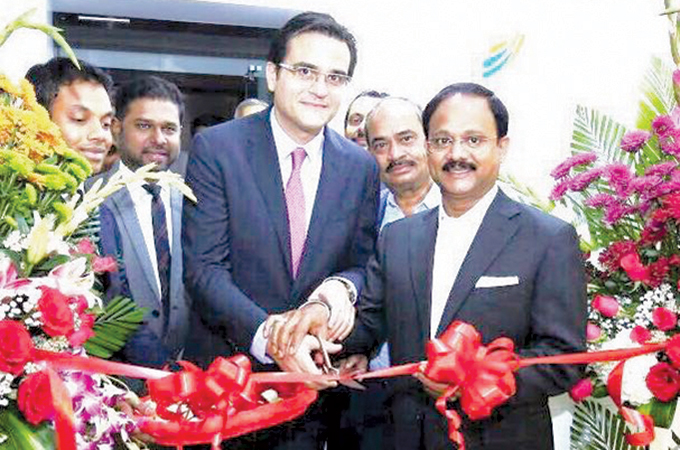
In a photograph from 2017, Ramzi Al-Qassab has a hand on the scissors. There is a red ribbon, an extravagant supply of flowers and a small crowd leaning into the occasion. Beside him stands Dr Siddeek Ahmed, chairman and managing director of Eram Group and ITL World. They are opening a corporate office. For a business built around software, the scene is wonderfully physical: people, a doorway, something that needs cutting.
The picture catches a recurring feature of Al-Qassab’s working life. His business sits between a technology platform and the people expected to make a living using it. The contract matters. So does what happens at the agency desk after the flowers have gone. Over the years, that desk has acquired more information, more selling possibilities and more ways for a simple journey to become complicated.
Based in Bahrain, Al-Qassab has worked across travel sales, regional commercial leadership and managing director responsibilities at Sabre. His career follows the changing ambitions of Middle Eastern travel businesses: establish a local presence, reach more suppliers, understand the customer, then make all those connections manageable. The vocabulary has moved from booking workspaces to artificial intelligence. The practical question has remained remarkably durable: can the person arranging the trip do a better job?
A doorway before a dashboard
Al-Qassab’s earlier roles included area manager at Gulf Air and senior sales and marketing manager at Gulf Hotels Group. Those jobs placed him on the supplier side of travel, before his later regional work at Sabre. Airlines, hotels and booking technology occupy different parts of the same purchase. His career has crossed those boundaries rather than staying within a single kind of travel business.
By October 2006, he was appearing alongside Saudi agency partners in coverage of Sabre’s regional expansion. Mosaid Travel and Tourism Services was moving from Worldspan to Sabre’s global distribution system. Attar Travel was installing Sabre technology across its branches and would use Sabre as one of two distribution systems. Both agreements involved MySabre, an internet booking platform.
These were specific commercial decisions, made agency by agency. Sabre had also opened an office in Jeddah. Daniel Naoumovitch, then chief executive of Sabre Travel Network Middle East, connected that local presence with the company’s ability to build relationships in the Kingdom. The juxtaposition is useful: internet distribution was growing through a very old business practice, being close enough to the customer to be useful.
In June 2011, Al-Qassab attended the opening of Sabre’s Kuwait City office as regional commercial director. The Al-Qibla premises included room for workshops and a training room accommodating 20 agents. Kuwait’s civil aviation official Nabil A. Al Zamel opened the office; Naoumovitch and country manager Robert Musleh were also there.
Twenty training seats make an unusually revealing detail in a technology story. They turn the abstract promise of a new platform into a room in which people have to learn it. The expansion included Sabre Red Workspace, intended to let travel management companies search, book, issue tickets and manage travel. Someone still had to sit down and acquire the confidence to use it.
The ribbon comes with a relationship
By the time of the ITL World photograph, the agency operated 39 offices across Asia, the Middle East and Europe. Its new agreement with Sabre extended an existing relationship. The technology on offer included mobile capabilities, analytics, personalisation and automation. For ITL World, the commercial point was to serve customers whose expectations were growing along with the business.
Ahmed linked Sabre’s understanding of traveller behaviour with ITL World’s expansion in the Middle East. The platform also brought market information into an agent’s working environment: fare trends, seasonal patterns and alternative airports. Those details could change the conversation from a request for a ticket into a discussion about the journey.
A ribbon-cutting photograph has a limited vocabulary. Everybody smiles; the ribbon loses. Yet this one belongs in Al-Qassab’s story because the agreement behind it concerned continuity. An established agency was choosing to keep building with an established technology partner. In this part of his career, growth often meant making an existing relationship useful for the next stage.
Other agency agreements put that work in different settings. In Kuwait, TVS Travels renewed its Sabre relationship in 2017. Al-Qassab, then commercial director for GCC and global partners, discussed mobile tools, data, merchandising and automation as ways to respond to changing customer expectations. He also described an ambition for agencies to become more consultative and to compete beyond their home markets.
In 2018, Bahrain’s Al Ghazal Travel chose Sabre to support regional expansion. Al-Qassab’s title then combined regional commercial responsibilities with global partners. The proposed advantage was access to a broader supplier network and a workspace that made information more useful. The geography changed; the agency’s problem was familiar. More choice creates an opportunity only if somebody can turn it into a recommendation.
- 2006Saudi agency partnerships
Mosaid and Attar Travel - 2011Kuwait office opening
Training capacity: 20 agents - 2017ITL World renewal
An agency with 39 offices - 2024Managing director
Middle East appointment - 2026Wider regional remit
Travel servicing and AI
A promotion with a practical brief
In March 2024, Sabre appointed Al-Qassab managing director for the Middle East. He had previously been a senior director in the region and had held commercial responsibility for Saudi Arabia, Bahrain, Qatar, Kuwait and Yemen. The appointment came alongside Abdul-Razzaq Iyer’s move into an EMEA operations and strategy role.
Al-Qassab’s new brief placed artificial intelligence, machine learning and real-time analytics alongside the longstanding business of supporting travel buyers. He talked about working with specialised, customer-focused teams and improving personalisation. It was a regional leadership appointment with a technological agenda, built on years of commercial work in the same market.
At Arabian Travel Market that May, he joined a discussion about putting travellers first with AI. Kate Harden-England moderated; fellow panellists included Geotourist’s Shaon Talukder, Lokalee’s Samir Abi Frem and Sabre Hospitality’s Frank Trampert. Data quality became part of the conversation. Personalised recommendations depend on what a system knows and how reliably it knows it.
Al-Qassab acknowledged the difficulty of sorting and marketing data while arguing for learning about the technology. That combination matters more than a prediction about what AI might eventually do. Travel businesses have customers to serve while the systems are changing. A managing director’s enthusiasm has to coexist with the agency’s ordinary working day, which is rarely considerate enough to pause for a transformation programme.
The inconvenience of having every option
In an April 2025 interview, Al-Qassab described a problem any traveller with too many browser tabs might recognise: “the overwhelming number of options travellers have to sort through.” Flights, prices, seats and baggage compete for attention. His argument for AI began with reducing that sorting work, so people could reach relevant choices sooner.
“the overwhelming number of options travellers have to sort through”
Ramzi Al-Qassab, April 2025
He also discussed bringing different kinds of travel inventory into a shared working environment. Traditional airline content, newer airline distribution connections, low-cost carriers and other travel products all create demands on the people selling them. His emphasis was on helping agents deal with those differences while keeping their attention on service.
At Arabian Travel Market in 2025, that subject acquired an admirably candid session title: “Turning Fragmentation into Opportunity for Smarter Retailing.” Al-Qassab and Trampert were listed alongside Jumeirah’s Paolo Federico, Saudia’s Alexander Gali and almatar co-founder Faisal Alrajhi. The mix of hotel, airline, agency and technology voices suited the problem. A connected journey requires businesses that usually have their own systems and priorities to cooperate.
The same event’s startup pitch competition named Al-Qassab among its judges. Organised with Intelak, it invited businesses at pre-seed or seed stage to present on the Future Stage on May 1. It placed a regional executive from an established technology company in the audience for much younger businesses. The announcement promised access and exposure; it did not make every pitch a success story. That distinction keeps the occasion interesting.
When the itinerary changes
By October 2026, Al-Qassab was being identified in Sabre’s almatar announcement as managing director for the Middle East, Türkiye, Africa and Eastern Europe. The update concerned an expanded use of Sabre Mosaic, including tools for flight changes, exchanges and refunds. It brought the conversation from finding a trip to rescuing one whose original arrangements no longer worked.
Sabre described almatar’s use of Exchange and Refund and Flight Reshop to help with alternative flights and the calculations surrounding rebooking. The announcement also reported the agency’s expansion into African markets and growth in newer airline distribution bookings. It supplied no numerical growth rate. The tangible story was the work being addressed: costs, eligibility and the rules that become urgent when plans change.
That is an instructive destination for Al-Qassab’s long commercial thread. The early office openings were about bringing booking tools closer to agencies. The later software is intended to help those agencies respond when a booking becomes a problem. A traveller may never know the platform’s name. They will have an opinion about whether someone can change their flight.
Room for a less corporate detail
There are glimpses of Al-Qassab beyond the commercial titles. He has publicly listed past certifications in diving and motorsport, including a Bahrain Motorsport Federation licence. His professional profile also records recognition for mentoring young people. These are small details, but they provide welcome company for an otherwise formidable quantity of distribution terminology.
His own writing has returned to a less technical phrase: partnerships. An article titled Power in Partnerships appeared in February 2020; another was called Strength in Strategic Partners. In May 2024, he used that theme again when sharing news of Sabre’s renewed agreement with Oman’s Bahwan Travel Agencies.
Read alongside the office openings and agency renewals, those titles describe a consistent professional interest. Al-Qassab’s story contains an expanding regional remit and a changing collection of software. It also contains repeated decisions to work with other people for another stretch of the journey. The scissors in that 2017 photograph did their brief job. The relationship had considerably more work ahead.