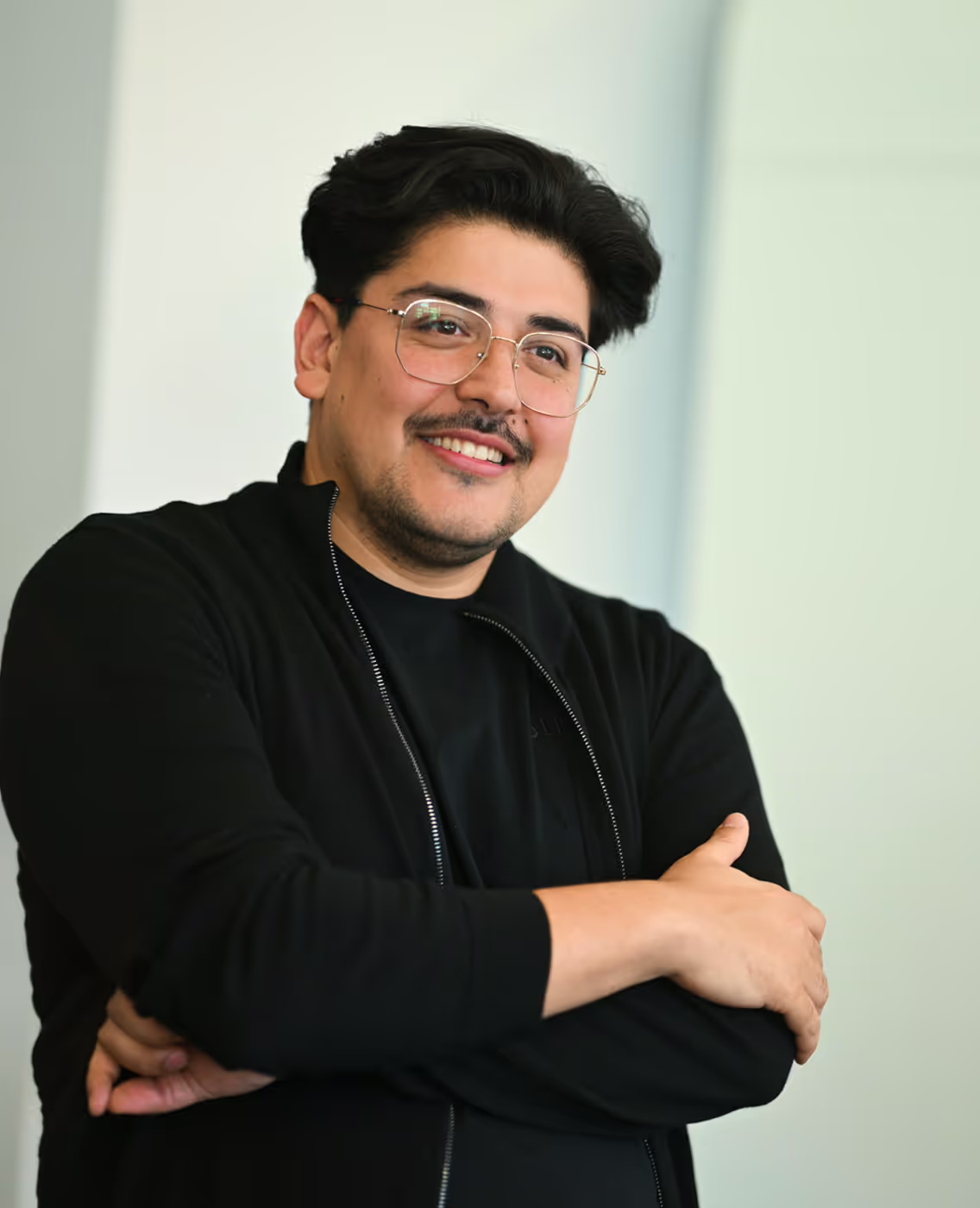
The CompanyWhat Ramin Hasani Actually Does
Ramin Hasani runs Liquid AI, the MIT CSAIL spin-off he co-founded in 2023 with Mathias Lechner, Alexander Amini, and MIT's Daniela Rus - who was, until Liquid, his postdoctoral advisor. Founders and their PhD supervisors don't usually end up on the same cap table. In this case, they built the same architecture together for four years, so the arrangement is more like a joint patent than an unusual startup.
The architecture is called a liquid neural network. It descends from Hasani's doctoral thesis at Vienna University of Technology, which he defended with distinction in May 2020. Liquid networks are continuous-time systems. The parameters shift while the model is running, in response to the input. If you have used a transformer, the mental model to hold is that transformers are frozen at inference and liquid networks are not.
Liquid AI's product is a family of Liquid Foundation Models - LFMs - that compete with transformer-based systems on general-purpose tasks but claim large advantages on memory, latency, and edge deployment. The company is selling this as a substrate for foundation-model intelligence that runs on the device rather than in the data center. Automotive, defense, consumer electronics, and enterprise infrastructure are the stated verticals.
In December 2024, AMD Ventures led a $250 million Series A into Liquid AI at a $2.35 billion valuation, with Automattic and OSS Capital participating. AMD is a chipmaker with an obvious interest in a foundation-model architecture that runs efficiently on hardware it sells. Hasani, as CEO, is the person who has to convert that architectural bet into a business.
I wanted to understand human intelligence.- Ramin Hasani, on why he began the work
The OriginThe Worm on the Cap Table
Caenorhabditis elegans is a nematode, roughly one millimeter long, transparent, and living in soil across most of the planet. Its nervous system is completely mapped. There are 302 neurons, wired in a specific and known way. The connectome is small enough to fit in a diagram and large enough to produce the animal's foraging, mating, and avoidance behaviors.
Hasani spent years working with that connectome. The intuition he took from it: complexity in the world does not require complexity in the network. If you get the dynamics right, small can suffice. A drone that had never seen weather could stay upright in weather. A car in an unfamiliar city could still make the correct turn. The empirical result at MIT CSAIL was that liquid networks generalized where fixed-weight networks brittled.
This is a bigger claim than it sounds. The mainstream position in AI over the last decade has been that intelligence is what you get when you scale up transformers on more data and more compute. Hasani's counter-argument is that a different math - continuous-time dynamics rather than discrete attention layers - can produce better behavior with fewer parameters. He now has $537 million in cumulative funding and a chipmaker's endorsement to prove it.
Every neuron and connection in the C. elegans nervous system has been mapped. That completeness is why Hasani used it as a starting point - it is one of the few nervous systems small enough to reason about in full.
Liquid AI, by the numbers
The PathVienna, Vanguard, Cambridge
Hasani, who is Persian-Austrian, did his doctorate at TU Wien. The dissertation was on liquid neural networks and was nominated for the TÜV Austria Dissertation Award in 2020. He then moved to MIT CSAIL as a postdoctoral associate with Daniela Rus, where the LTC (Liquid Time-Constant) paper - now a foundational citation for the field - was published in 2021.
A less obvious line in his CV is the joint appointment as Principal AI and Machine Learning Scientist at Vanguard, the index fund manager. Quantitative finance is one of the more demanding testbeds for machine-learning systems, because the return on getting the prediction right is measurable in dollars and the return on getting it wrong is measurable in dollars. That period sits between the academic work and Liquid AI.
He collected an HPC Innovation Excellence Award in 2022 and, with collaborator Djordje Zikelic, an Outstanding Scientific Achievement Award at IST Austria in 2023, for work on proving safety properties in stochastic ML systems. Safety proofs and dynamical systems are the two threads that keep showing up.
TimelineCareer, Compressed
Facts & AnglesDetails
Persian-Austrian
Studied and defended his PhD in Vienna, then relocated to Cambridge for the MIT postdoc that became Liquid AI.
Rus, Lechner, Amini
Rus runs MIT CSAIL. Amini and Lechner were co-authors on the original liquid networks work. The founding team predates the company by roughly four years.
Liquid Foundation Models
LFMs are engineered for on-device inference, low latency, and small memory footprint - a different set of constraints than most GPT-class systems.
AMD Ventures
A chipmaker leading a Series A into an architecture-first AI company is not a coincidence. The hardware and the model are the pitch.
A worm's brain of only 302 nerve cells can produce complex behavior that current AI systems cannot.- Ramin Hasani, TEDxVienna
What's InterestingThe Contrarian Bet
The interesting question at a company like Liquid AI is not whether the models work - the benchmarks exist and the customers are running them - but whether Hasani's architectural bet holds against the scale bet. Transformer people believe more parameters and more data will keep producing better outputs for the foreseeable future. Liquid people believe that continuous-time dynamics and adaptive parameters are a categorically better substrate, one that can produce comparable performance with an order of magnitude less compute.
Those views are not fully compatible. If Hasani is right, the industry's compute intensity is a specific engineering choice rather than a fundamental requirement. If he is wrong, Liquid AI is a very well-funded niche vendor of edge-optimized models. AMD Ventures is betting the former; time is the referee.
What is notable about Hasani specifically is the durability of the through-line. TEDx Vienna in 2018: worm brains. TU Wien dissertation, 2020: liquid networks. MIT CSAIL, 2021: LTC paper. Liquid AI, 2023-2024: LFMs and $250 million. There is no pivot in the story. It is one idea, developed patiently, that met a market.
FAQCommon Questions
Who is Ramin Hasani?
Co-founder and CEO of Liquid AI, and a machine-learning scientist affiliated with MIT CSAIL. Earned his PhD with distinction from TU Wien in 2020.
What is Liquid AI?
An MIT spin-off building Liquid Foundation Models - AI systems based on liquid neural networks, an alternative to transformer architectures, designed to run efficiently on edge hardware.
Who co-founded Liquid AI?
Ramin Hasani, Mathias Lechner, Alexander Amini, and MIT CSAIL director Daniela Rus.
How much has Liquid AI raised?
Roughly $537.5M in total, including a $250M Series A led by AMD Ventures in December 2024 at a $2.35B valuation.
What are liquid neural networks?
Continuous-time neural networks inspired by C. elegans that can adapt after training, offering strong performance with fewer neurons.