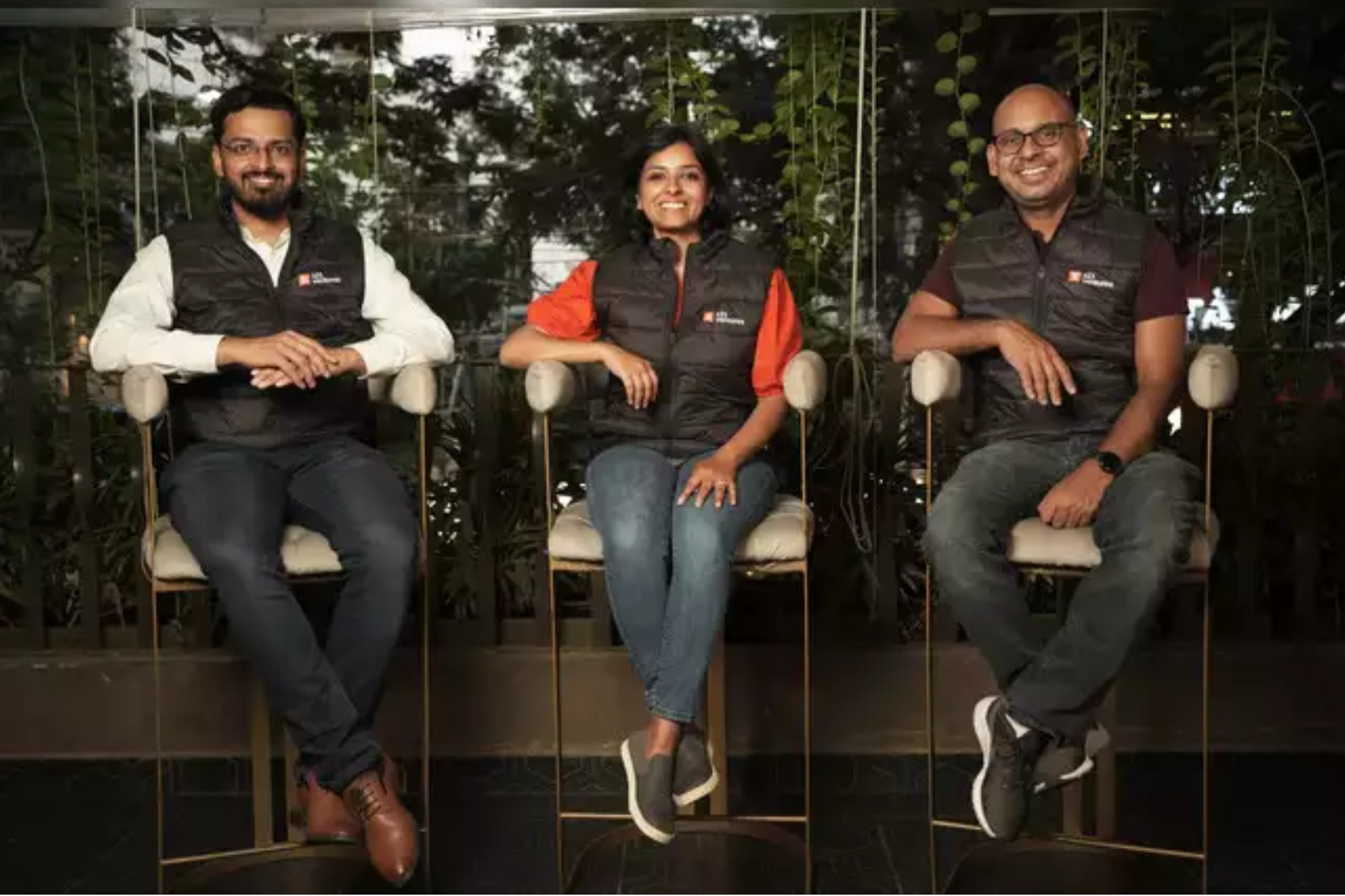
Writing Checks Before the Crowd Arrives
Most venture capitalists discover a startup after a TechCrunch headline, a warm intro from another VC, or a founder who already has term sheets in hand. Raj Shekhar Singh does something different: he shows up at the pre-seed stage, when the product is a prototype, the pitch deck has stock photos, and the only thing separating a real company from a hobby is the founder's refusal to quit.
That specific appetite - for the raw, the unproven, the too-early - is the organizing principle of z21 Ventures, the San Francisco-based firm Singh co-founded in 2022 alongside fellow IIT Kharagpur alumni Abhinav Shashank, Jyotika Gupta, and Sudarshan Ravi Jha. With average check sizes between $500K and $1 million, z21 deploys capital into companies that most institutional investors haven't gotten around to modeling yet. Fund I, a lean $5 million vehicle, backed 26 startups and deployed its full capital by mid-2024. Two of those bets have already returned - Rexera through an acquisition by RealPage in July 2025, and earKART through an IPO on the Bombay Stock Exchange in October 2025.
"This successful fundraise is a validation of our community-led model and our track record of identifying and supporting promising early-stage companies."
- Raj Singh, announcing the $20M first close of Fund IIThe $5M first fund was barely enough to cover a couple of Series B extensions elsewhere in the Valley. Singh treated it like a systems test: could a community of operators add enough value around a tiny check that the math could still work? The exits suggest yes.
z21 Ventures Fund Snapshot
The Operator Who Became the Investor
Singh's path to venture capital runs through the kind of resume that makes traditional VCs nervous: too hands-on, too operational, too close to the actual work. After completing his BTech at IIT Kharagpur - one of India's most competitive engineering institutions - he moved to UC Berkeley for a PhD. Then McKinsey. Then, in 2017, a decision that would define the next five years: joining Innovaccer as a founding executive.
Innovaccer is a healthcare data platform that Singh helped build from an early-stage startup into a $3.5 billion unicorn. His role as Head of Product meant he wasn't just advising on strategy - he was in the weeds on product-market fit, on building teams, on the specific pressure of trying to sell enterprise software to hospital systems while running out of runway. That experience is what z21's community model is built on: not pattern-matching on pitch decks, but having been inside rooms where real decisions get made under real constraints.
He didn't stop there. Around the time he launched z21, Singh also co-founded International Battery Company as its Chief Revenue Officer - a Li-ion cell manufacturing startup that raised a $35 million Series A from RTP Global in January 2024. And Hyperspec AI, an autonomous vehicle vision company, where he served as COO. Multiple companies, multiple roles, all running in parallel. For Singh, the portfolio isn't just a metaphor - it's a lifestyle.
Community as Infrastructure
The most unusual thing about z21 Ventures isn't the fund size or the sector focus or even the US-India corridor positioning. It's the network architecture. The firm's LP base isn't just a group of capital allocators - it's a community of 110+ experienced operators and investors who are expected to actively support portfolio companies. In z21's model, an LP isn't passive. They mentor founders, make introductions, sit on advisory boards, and invest personal time alongside the firm's capital.
The closest analogy is something between a VC firm and a guild. Singh built it this way because he'd seen from the inside what founders actually need when things get hard: not another board deck template, but a CFO who's been through a Series B process, or a sales leader who's sold the same type of enterprise deal, or a regulatory expert who knows which corner of a compliance issue to attack first. z21's network is designed to be that resource, on demand.
The US-India Angle Everyone Keeps Missing
The conventional narrative about US-India venture flows tends to focus on outsourcing talent, not building companies. Singh and his co-founders - all IIT Kharagpur alumni who've built their careers across both geographies - see it differently. z21 Ventures runs offices in both San Francisco and Bengaluru, and invests specifically in founders who are building at the intersection of Silicon Valley ambition and Indian engineering density.
The thesis isn't complicated: the best Indian engineers now have real options beyond a US Big Tech job. The startup infrastructure in Bengaluru has matured. US-savvy founders who grew up in India, or Indian-American founders who understand both markets, have an arbitrage advantage that most Bay Area VCs don't fully price in. Singh does. His fund structure is designed around it - with partners and LPs on both sides of the Pacific actively opening doors in both directions.
The IIT Kharagpur partnership is an explicit expression of this: the "KGP Forge Entrepreneur" accelerator program, co-launched with the institute, is a pipeline designed to catch exceptional founders at the earliest possible moment - before they've even left campus. Singh's view, articulated plainly, is that his alma mater should be producing founders the same way it produces engineers. He's putting the resources in to make that happen.
"We are deeply honored to partner with our alma mater, IIT Kharagpur, to prioritize entrepreneurship and propel it to the forefront of the student experience."
- Raj Singh, on the KGP Forge Entrepreneur accelerator launchFund II and What Comes Next
In September 2024, z21 Ventures announced the first close of its second fund: $20 million, with WestBridge Capital - one of India's most established growth-stage funds - as anchor investor. The total Fund II target is $40 million, which would make it 8x the size of Fund I.
The jump matters for a specific reason: WestBridge's participation signals that the community-led, operator-dense model isn't just a cute early-stage experiment. An established institutional LP writing an anchor check into a second fund is a signal read by the rest of the LP market. Singh is raising Fund II at a moment when emerging managers are having a harder time closing; the WestBridge anchor effectively accelerates the rest of the fundraise.
With 34 active portfolio companies and two exits already on the board, the portfolio data is starting to tell a story. Singh's pitch for Fund II is built on that track record: a model that has already validated itself at small scale, now being tested at 8x the capital. The sectors remain consistent - AI, enterprise software, fintech, healthtech - but the US-India corridor positioning is increasingly a differentiator in a market where LPs are looking for geographic diversification without sacrificing deal quality.
Career Arc
Education
-
Indian Institute of Technology (IIT) KharagpurBachelor of Technology (BTech), Engineering2005 - 2009
-
University of California, BerkeleyPhDPost-2009
-
UC Berkeley Haas School of BusinessManagement StudiesPost-2009
Field Notes
- z21 Ventures is named after the 21st-century generation of founders - the fund's name is a thesis statement, not just a brand
- All four z21 co-founders are IIT Kharagpur alumni - making it one of the most IIT-concentrated VC founding teams in Silicon Valley history
- Fund I's $5M deployed across 26 companies means an average check of ~$192K per company - checks that most VCs wouldn't bother processing
- Singh's LP network of 110+ operators is itself a startup support platform - LPs are expected to actively mentor portfolio companies, not just allocate capital
- Singh ran offices in San Francisco and Bengaluru simultaneously, physically living the US-India corridor he invests in
- Raj Singh appeared on the Immigrant Nation Podcast (Ep. 71) discussing how constraints specific to immigrant founders can become competitive advantages
Personality & Approach
Singh's investing style is a direct product of his operating background. He doesn't just ask founders about their product - he asks about the specific constraints they're navigating. At Innovaccer, those constraints were real: healthcare compliance, enterprise sales cycles, data interoperability. At International Battery Company, they were physical: supply chains, manufacturing yields, the gap between what a cell does in a lab and what it does at scale. That texture of experience shapes the questions he asks and the judgment he applies to a pitch.
On the Immigrant Nation podcast, he talked about what it actually means to build a company in America as an immigrant - the network gaps, the cultural translation work, the specific disadvantages that can paradoxically sharpen focus and resourcefulness. It's a frame that runs through z21's portfolio too: many of its founders are navigating similar dual-geography, dual-culture dynamics. Singh is building for people who look like the path he walked.