At fourteen, Raj Khaira sat in a classroom where the desks formed a square. A teacher put a quotation on the board, or sometimes just a shape, and the children argued about it. The subject was called humanities. The reading included Nietzsche, Kant and Plato. Khaira remembers being treated as an intellectual equal. Years later, she still considered that year unusually demanding, and unusually liberating.
It is an appealing place to begin the story of someone who would become a lawyer, a campaign founder, a children’s author and an AI company co-founder. Before the job titles came a room in which an assumption could be put in the middle and inspected from every side. School rarely gets a better review than this: she wanted more of the difficult work.
A celebration with someone missing
Another formative memory was less cheerful. Khaira was ten when her sister was born, and the negative reactions stayed with her. That experience became one of the reasons she created the Pink Ladoo Project in 2015. The campaign took aim at a custom in some South Asian communities: distributing sweets to announce a boy’s birth while a girl’s arrival received no equivalent celebration.
The imbalance was easy to overlook precisely because it arrived dressed as tradition. A box went from one household to another. Someone offered congratulations. A child learned what counted as good news. There was no need for anyone to deliver a formal lecture on the relative value of sons and daughters. The celebration had already done the talking.
Khaira’s response gave families an action they could repeat: distribute pink ladoo when a girl was born. The project officially launched in the UK on 11 October 2015. Its ambition was substantial, but the first instruction was wonderfully concrete. Buy the sweets. Share them. Announce the daughter with the same pleasure that would accompany a son.
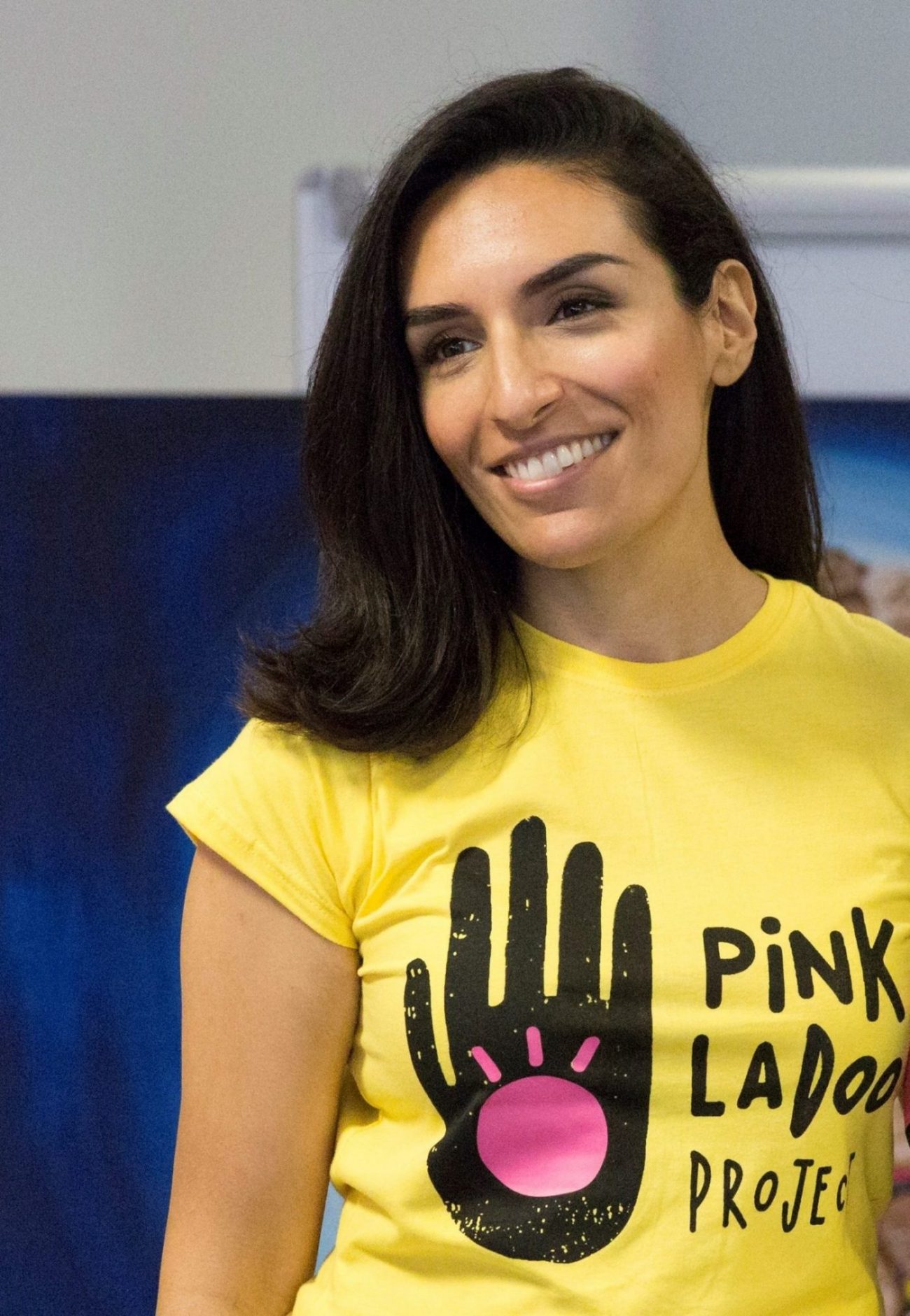
The colour was deliberate. The project’s explanation draws on pink’s association with women in the West and with prosperity, celebration and strength in South Asian traditions. It wanted a symbol whose meaning could travel quickly. A familiar sweet, visibly changed, would invite the question that an ordinary box might never prompt.
There is wit in the method. An argument about equality can be made over something delicious. The recipient is free to disagree, though doing so while accepting the celebratory sweets makes for an awkward little performance. Khaira had found a way for an everyday exchange to carry an uncomfortable question into the house.
The Pink Ladoo Project’s model of participation.
The campaign also shares examples of women taking roles customarily reserved for men, including mothers giving daughters away at weddings. A photograph of someone doing it makes the possibility easier to imagine. The project’s own account describes sweetshops adding pink ladoo to menus in the UK, Canada and Australia. An idea becomes more durable when other people can put it into practice without waiting for its founder.
Khaira has been emphatic that she does not make or sell the sweets. This is a useful distinction for anyone imagining her surrounded by industrial quantities of sugar. Her work was to encourage participation and make it visible. Reflecting on the campaign’s ninth anniversary, she described her guiding motto as “Maximum reach for minimum effort.” Even a social movement must have some regard for the diary.
Fifty lives, instead of one prescribed future
The next form of the argument was a book. Stories for South Asian Supergirls, first published by Kashi House in 2019, collected fifty women’s lives. A Puffin edition followed in November 2021. Its subjects include entertainers and business leaders, as well as figures such as Noor Inayat Khan and Jayaben Desai. Ten South Asian women artists supplied the portraits.
The book’s variety matters. A reader can encounter several ways of being ambitious, useful, brave or inventive rather than being offered a single approved route. The biographies give an abstract promise some particulars: a name, a face, a piece of work, a decision. A child has something more interesting to consider than a general instruction to believe in herself.
“I want South Asian women to realize their power.”
Raj Khaira, discussing the purpose of her work
Khaira committed the author proceeds from the original book to three charities: the Flying Seagull Project, Child Poverty Action Group UK and the Canadian Women’s Foundation. The writing extended a campaign already concerned with how children are valued. It also asked for a different kind of attention: the slower engagement of reading someone’s life rather than scrolling past a post.
She has spoken candidly about the work involved. The idea of the book excited her; producing all the biographies within the time available was difficult. Her advice to aspiring writers was to find a publisher that believed in the work, and to remember that publication still left the business of marketing. A book does not sell itself out of gratitude for having been written.
In discussing writers she admired, she named Sathnam Sanghera and Angela Saini, both of whom she also described as friends. Charles Dickens made the list for his descriptions and humour. It is a revealing combination of interests: clarity, an absorbing explanation and a well-placed joke. Children can detect a lecture remarkably quickly, even when it has illustrations.
Her 2020 picture book, The Night the Reindeer Saved Christmas, made room for a different cast at the North Pole. Illustrated by Kasia Nowowiejska, it features a South Asian Santa, a Black Mrs Claus and female reindeer who can fly. Christmas survives the revision quite comfortably. Familiar stories can accommodate more people than their previous tellings suggest.
In 2025, Stories for South Asian Super Kids broadened the biographical project with another fifty figures. The book moves across centuries and professions, from the mathematician Brahmagupta to basketball player Satnam Singh. Its closing material gives readers space to write their own life story. The invitation is pleasantly direct: after meeting the people in these pages, consider where you might go.
The operator behind the words
Khaira’s professional career began at Accenture in management consulting. She then trained as a lawyer at Travers Smith before moving into work helping venture capital and private equity backed technology businesses resolve operational problems and scale. Her education crossed biology, politics and law. These are several different ways of asking why something behaves as it does.
Startup operations offered a setting in which the answer had to become practical. A problem could be diagnosed, but the company still needed someone to implement the solution. By her October 2023 appearance on the 40 Minute Mentor podcast, her career had included work with more than twenty startups. The conversation covered rejection, prioritisation and the importance of a team environment with little ego.
She joined Sean Williams on the AutogenAI journey in 2022 and became its co-founder, serving as COO and later deputy global CEO. The company applied generative AI to bids, tenders and proposals. It was a specific business problem: organisations competing for work through written submissions needed help producing and managing those submissions.
There is a connection here to her books, though the readers and stakes differ. In each setting, writing has a job to do. A biography can enlarge a child’s sense of possibility. A proposal must explain why an organisation should be entrusted with a contract. Good intentions are insufficient in either case; the words have to reach the person making the judgement.
- Pink Ladoo Project launches in the UK.
- Stories for South Asian Supergirls is published.
- Khaira begins building AutogenAI with Sean Williams.
- Stories for South Asian Super Kids reaches readers.
- A Times Tech 100 award, followed by her departure from AutogenAI.
Her connections also took her into the Knowledge Quarter, the network of academic, cultural, research and other organisations around King’s Cross. Her election to its board was announced in 2024 for a four-year term. It brought an operator from an AI business into a setting concerned with collaboration and the exchange of knowledge.
A licence is easy. Learning takes time.
At a May 2026 conversation with Ben Fletcher at Claridge’s, Khaira advocated learning AI by making things. She wanted organisations to set aside working time for teams to experiment together. People could begin with playful projects, develop competence and then look at processes they might improve. She cautioned against demanding an immediate financial result from every exercise in learning.
The distinction is useful for a leader selling business software. A purpose-built tool can be judged on what it delivers. A workforce learning a new capability needs room to discover what to ask of the tools in the first place. Her recommendation included recognising when an existing product would serve a company better than attempting to build everything internally.
The classroom square comes back to mind. In one setting, children were trusted to wrestle with ideas. In another, employees were to receive time to experiment. The resemblance is an interpretation of her accounts, rather than a declared theory of her career. Still, both make learning something people do, with permission to encounter a difficulty before being asked to produce an answer.
The next page is hers
In March 2026, Khaira received a Female Entrepreneurs Award at the Times Tech 100 celebration for her contribution to AutogenAI’s growth. She said she had not known she was nominated. Her response turned towards the people who had helped her, including Williams and her husband, Adam Martin. Martin, she recalled, had even encouraged her idea for a chai stall at Borough Market.
On 31 July, she announced that she was leaving AutogenAI after four years. Her farewell thanked the team and more than 350 enterprise customers. Williams had been her “most dialled number,” she recalled. The departure brought an end to an engrossing stretch of work, and she described wanting a new chapter.
That is a fitting phrase for an author. Her public work already contains several beginnings: a different celebration for a daughter, another biography on a child’s shelf, a career beyond the professions she first entered. Each required an established story to become open to revision. Somewhere between the classroom square and the pink sweet, Khaira learned to enjoy asking whether things had to stay the way they were.