The awkward thing about a bank balance is how reassuring it looks. There is a number. It is positive. Lunch seems affordable. What the number leaves out is next Tuesday’s insurance payment, the holiday fund, and the credit card bill approaching quietly from another account. Quicken has spent four decades working on variations of this small, consequential misunderstanding.
- Classic keeps the detail. Desktop records, reconciliation, and deeper investment tools.
- Simplifi looks ahead. A cloud spending plan built around income and commitments.
- The choice has consequences. Separate subscriptions; no direct data-file transfer.
A checkbook, with better manners
Its origin is wonderfully domestic. In Intuit’s account, Scott Cook watched his wife struggle with the family checkbook and saw a job for the personal computer. Cook and programmer Tom Proulx founded Intuit in 1983. Quicken arrived in 1984. The task was familiar enough that customers already understood why it mattered.
Years later, CEO Eric Dunn described the early product’s advantage: it resembled a check register and a paper check. Competitors offered more features. Quicken borrowed the shape of something people knew. Dunn recounted Cook’s joke about having the “47th mover advantage.” The useful lesson for anyone making software is disarmingly practical: familiarity can do work that another feature cannot.
That history explains Quicken’s particular place in finance. Its expertise is the machinery of household records: categorizing transactions, reconciling accounts, tracking holdings, and connecting today’s expenses to future obligations. People accumulate accounts as they accumulate responsibilities. Quicken tries to make the resulting paperwork legible.
The desktop did not disappear
Quicken’s present lineup contains an interesting disagreement about how much financial detail a person wants. Classic, installed on Windows or Mac, suits the person who wants a durable working record. Its tiers add budgeting, investment analysis, and business tools. Classic Premier includes Morningstar Portfolio X-Ray on Windows, useful for examining what a collection of funds actually contains.
Simplifi, launched in January 2020, starts closer to the lunch problem. It runs on web and mobile. Connect accounts, review recurring income and bills, and establish savings goals. Its Spending Plan calculates the room remaining in the month after those commitments and other spending. The plan concerns monthly activity; it does not simply relabel the money currently sitting in your accounts.
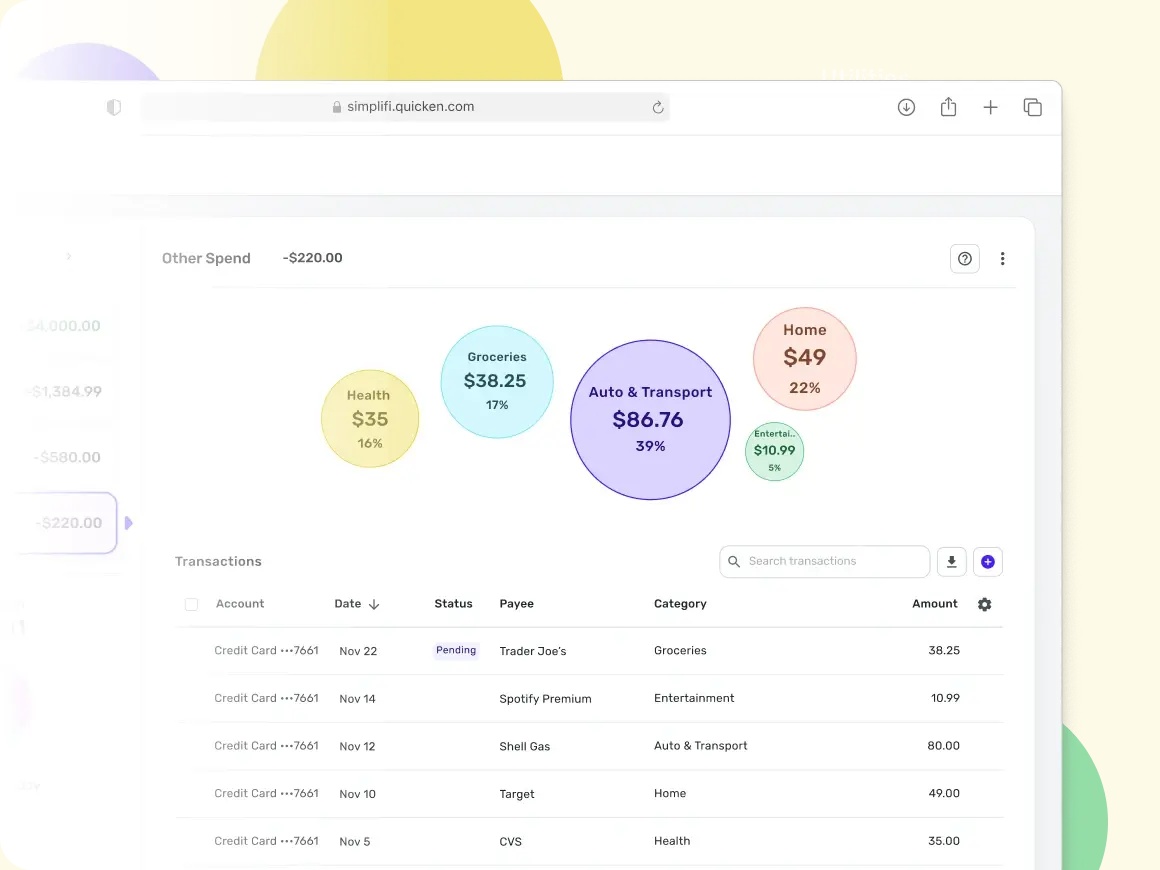
Consider an illustrative household expecting $5,000 this month. Set aside $2,500 for bills, $500 for savings goals, and $1,200 for planned spending. That leaves $800 before additional purchases. The arithmetic is ordinary. Remembering every commitment, across several accounts, is the tiresome part. This is where software earns its subscription.
The catch deserves its own sentence: Classic and Simplifi are separate products. Buying one does not buy the other, and their data files cannot be imported directly between them. Simplifi supports CSV transaction imports, but switching is a decision about records and workflow, not just a fresh coat of paint.
The company its parent sold
There is a second origin date: 2016. That is when Quicken became an independent company after Intuit sold the business to H.I.G. Capital. Contemporary reporting described Intuit concentrating on QuickBooks and TurboTax; Quicken lacked the cloud service and subscription offer that fitted its parent’s direction. A recognizable brand had become an awkward strategic fit.

Dunn stayed with the business. Subsequent years brought subscription pricing and Simplifi’s separate cloud approach. Aquiline acquired majority ownership in 2021, with Dunn and employees retaining equity. The sequence suggests a useful business lesson: a product can require a different owner and operating model even when its underlying customer problem remains.
In June 2026, Edward Jones invested, while Aquiline remained majority owner. The stated intention was to expand access to personal financial management alongside the wealth manager’s advisor-led model. Aquiline reported more than two million subscribers. Quicken’s familiar figure of more than 20 million describes people served across its history, a different measurement.
The subscription on the kitchen table
The buyer might be a couple coordinating bills, an investor tracking holdings, or a freelancer whose business income pays the household mortgage. Cloud-based Business & Personal, introduced in 2025, adds clients, projects, invoices, and business reports to the Simplifi foundation. Classic Business & Personal offers another route, including desktop rental-property tools.
The alternatives depend on the job. Monarch and YNAB compete for household budgeting; Moneydance and Banktivity appeal to desktop finance users. Dedicated business accounting packages become relevant as requirements grow. Quicken’s distinctive proposition is the span between everyday spending, investments, and owner-operated business finances. A buyer should compare the specific workflow rather than count features.
At the October 25, 2026 research check, Quicken’s comparison page displayed Simplifi at $3.99 a month, billed annually, against a $6.99 regular monthly equivalent. That promotional figure implies roughly $48 for the first year before tax. Check the annual checkout total and renewal price: a monthly equivalent still means an annual payment.
“Our customers inspired us to create Quicken LifeHub”
Eric Dunn / LifeHub launch, November 2024
There are practical boundaries. Quicken says its products are designed for the United States and Canada. Platform differences matter too: a Windows investment tool should not be assumed to exist on Mac. Before committing, check the accounts and reports you actually need. A feature list is less persuasive than a successful first reconciliation.
Who knows where the documents are?
LifeHub extends the household idea beyond transactions. Announced in November 2024, it organizes financial information, medical records, wills, and other essential documents, with controls for sharing information with trusted people. The problem is recognizable: one family member knows where everything lives. Everyone else may discover how much that knowledge matters during an emergency.
Inside the company, the stated working habits sound appropriately methodical: small teams, weekly business updates, and an emphasis on owning commitments and learning through iteration. Those are Quicken’s descriptions of its culture. They fit the challenge at hand, where a glamorous new chart is worth little if the transaction underneath it is wrong.
The practical takeaway is available even without buying anything. List recurring commitments. Review categories. Decide who can find important records. Quicken can make those habits easier, but missing accounts and mistaken categories still distort the picture. Its own AI guidance acknowledges that incomplete information affects answers. The most useful number on the screen is the one whose ingredients you understand.
Take a closer look
Try the workflow. See whether it fits yours.