The trouble with a competitor’s price is that it arrives wearing the costume of a fact. There it is: a number, a currency, perhaps a cheerful red discount badge. Surely the difficult part is over. But before a retailer can decide whether to lower its own price, it must answer a question that looks almost embarrassingly simple. What, exactly, is being sold?
QL2 has made a business out of the work behind that question. It collects information from competitor websites, organizes it and supplies tools for comparing products, prices and assortments. Its customers include businesses selling pizza, travel and retail goods. These are different markets with a shared irritation: the internet makes rivals visible without necessarily making them comparable.
- Collect: Data Scout gathers and normalizes competitive data.
- Compare: Product Match distinguishes identical items from plausible substitutes.
- Decide: Opti Price and Opti Mix expose price gaps and assortment differences.
- Test first: Papa Johns expanded its use after a national pricing-data trial.
The book with the missing identity
Consider QL2’s published case study of an unnamed audiobook retailer. The customer wanted to see which titles were exclusive and which overlapped with competitors’ catalogs. An obvious shortcut was to compare ISBNs. Unfortunately, the web data did not reliably supply the tidy identifiers the exercise required.
The team was spending hours manually checking matches. QL2 used supervised machine learning with weighted product attributes to look beyond ISBN alone. Its 2022 case study reports match accuracy reaching 96%, describes a 23% increase, and says the customer could redirect effort toward additional regions. Those are vendor-reported results for one customer.
Reported product-match accuracy.
A customer result, not a universal guarantee.
The interesting lesson is about the identifier. A code is a convenient agreement about identity; when it disappears, someone must reconstruct the agreement. Gathering more prices will not, by itself, settle which listings belong together. A spreadsheet can become impressively large while remaining impressively confused.
Same thing. Similar thing. Different decision.
QL2 distinguishes exact matching from smart matching. Exact matching seeks the identical item on another site. Smart matching looks for similar or compatible alternatives a customer might buy instead. That difference gives pricing teams two views of competition: the price of their particular product, and the price of the choices surrounding it.
Its Product Match system considers attributes including names, brands, model numbers, descriptions and image similarity. QL2 describes an ensemble of machine and deep learning models, followed by human verification and quality checks. The company’s approach therefore includes both automated suggestions and scrutiny of those suggestions.
The same model and specification at another retailer.
A different product that could satisfy the same customer need.
For a pricing manager, confusing the two can be costly. An identical product advertised more cheaply deserves investigation. A cheaper substitute may instead prompt a discussion about quality, positioning or assortment. The number can look much the same on a dashboard. The appropriate response can be entirely different.
A dashboard needs a supply chain
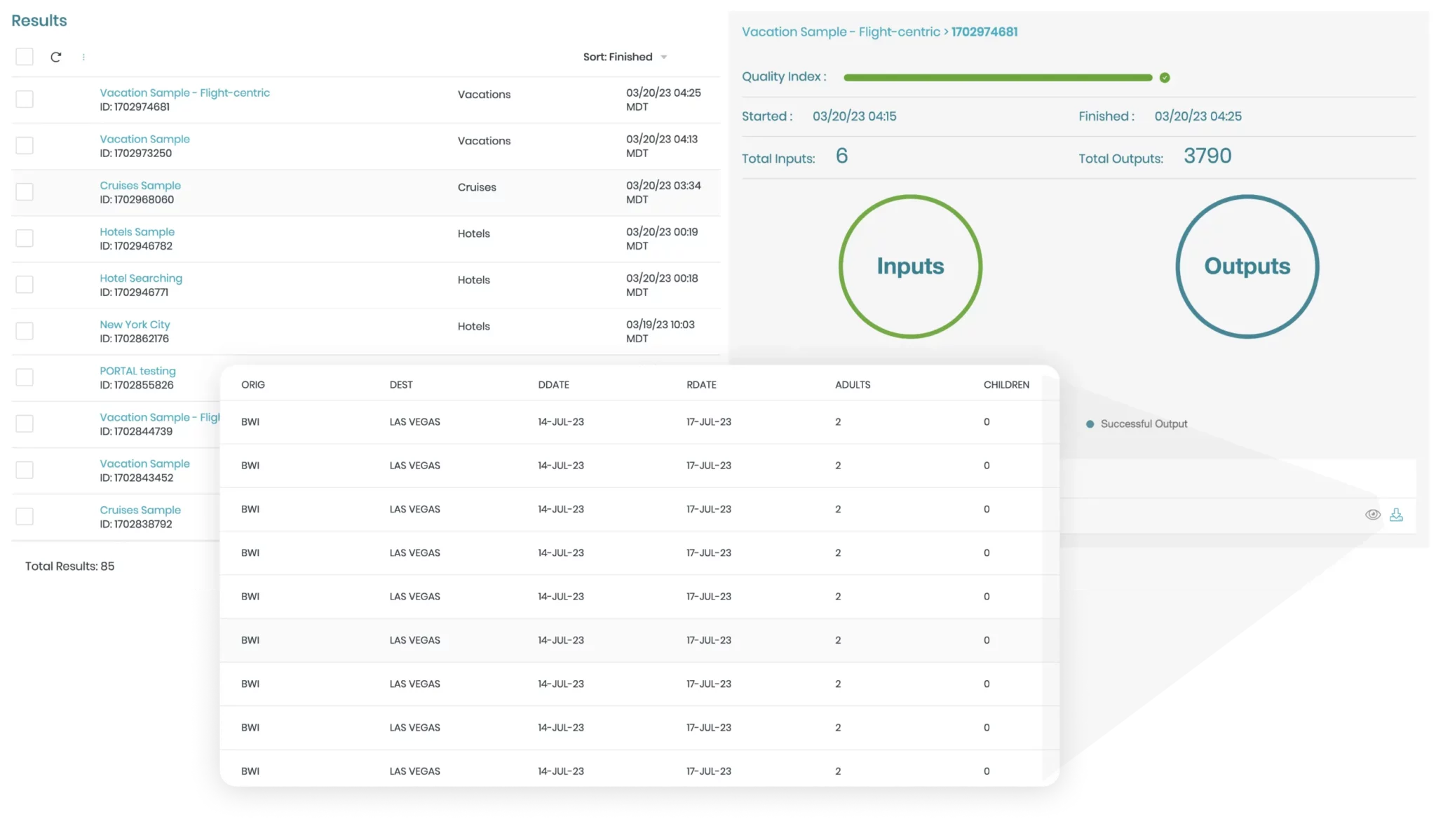
QL2’s product names describe stages of the job. Data Scout handles acquisition: users configure searches, manage jobs and schedule one-time or recurring collection. APIs support automation, while mapping tables normalize the results. The point is to make repeated observation manageable, rather than turn every new market question into a fresh engineering project.
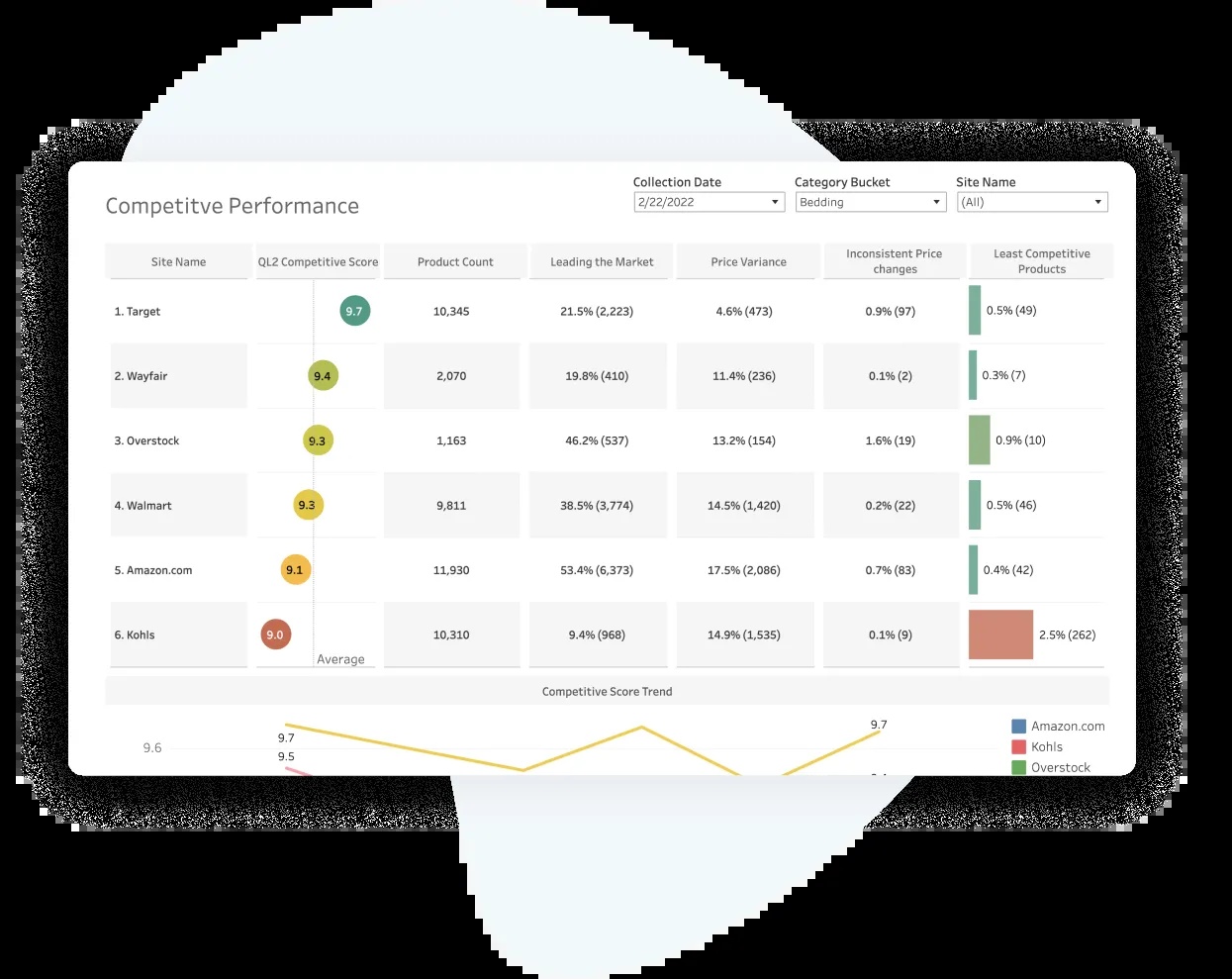
Opti Price presents competitor pricing from the perspective of a customer’s catalog. Users can inspect products and segments, see price differences and manage matches. The November 2024 getting-started guide lists a dashboard, Product Finder, Product Details, Price Insights and Audit History. That last item is quietly revealing. Comparisons need a history of decisions, including requests to add or remove a match.
Opti Mix addresses another commercial question: what should be in the catalog? QL2 positions it around assortment gaps and opportunities. A retailer may be competitively priced on everything it sells and still be missing a category customers want. Price monitoring and assortment analysis are related jobs, but one cannot stand in for the other.
- 01 / CollectCompetitor listings
- 02 / MatchIdentity + alternatives
- 03 / InspectPrice + catalog gaps
- 04 / ActYour pricing rules
There is also WebQL, a self-hosted licensing option. Customers download software builds and write extraction scripts; supported inputs extend beyond websites to documents and ODBC-compatible databases. This gives technically equipped buyers another route through the business. They can run the collection machinery locally rather than use only the managed workflow.
The pizza test was local, thousands of times
Papa Johns provides a useful example of how a buyer tests the proposition. In a release dated September 30, 2022, QL2 described an expansion of the restaurant company’s use of Opti Price. Papa Johns had first tested whether it could capture competitive pricing nationally across thousands of ZIP codes.
John Ishmael, then senior vice president of business transformation, attributed the expansion to delivery beyond expectations with “anticipated and measurable ROI.” The statement identifies what persuaded the customer: useful coverage and a commercial case. It does not turn that judgment into a published contract price or a numerical return.
“anticipated and measurable ROI”John Ishmael / Papa Johns / September 2022
A national brand competes in local markets. The practical question is whether its view of competitors follows that geography. For other buyers, the transferable habit is to test the coverage that matters to the actual decision. A demonstration that works beautifully in one place does not settle whether the resulting data will be useful everywhere a business trades.
Travel has its own version of this problem. QL2’s March 2023 news listing announced Data Scout for DIGITRIPS brands MisterFly, Idiliz and Hresa. Its 2017 ExPretio partnership connected competitive observations with Appia rail revenue management, allowing operators to lead, follow or match fares under their business rules. Observation becomes more useful when it reaches the system where decisions happen.
A business with a less tidy backstory
The company’s history resists a cheerful, uninterrupted growth chart. In September 2010, Hale Global and QL2 announced completion of a bankruptcy-court-approved reorganization. The reorganized entity became QL2 Software, LLC. The release said allowed creditor claims were paid in full and exit financing supported the business.
In 2017, Infare acquired QL2’s airline and airport data business. Reporting described a strategic exit from that segment so QL2 could concentrate on other travel markets, retail and finance. It was a sale of part of the operation. Treating it as an acquisition of the whole company would make the subsequent history rather difficult to explain.

Buy the comparison you actually need
QL2 sells to business teams that need recurring competitive information, with requirements scoped around websites, product counts, geography and refresh frequency. It combines software with collection, matching and delivery services. Buyers should approach it as a configured data relationship: specify the observations and the decisions those observations will support.
Alternatives include price-monitoring services such as Prisync, as well as an internal collection operation. QL2’s proposition combines managed acquisition, product matching, assortment analysis and experience across retail and travel. Those capabilities are reasons to examine fit; they are not proof that it wins every comparison with another supplier.
The buyer still has work to do. Agree on what counts as equivalent. Check disputed matches. Make sure observations arrive in time to matter. In any competitive-pricing workflow, incompatible offer conditions or stale data can make a precise-looking gap misleading. Better information also cannot decide a company’s margin requirements or brand position for it.
The most copyable part of QL2’s approach is available before anyone purchases software: settle the comparison before arguing over the price. Then test whether the data survives contact with the market where you operate. The bargain in the rival’s window may be real. It deserves a proper introduction.