The frozen fruit looked lovely. The directions to it were less dependable. Before Pitaya Foods worked with Pear Commerce, its store locator depended on a quarterly ritual: gather information from distributors, retailers and brokers, then rearrange it by hand. Within weeks, the information was stale. Shoppers complained that products were missing from the stores the locator recommended. The brand had paid to make people hungry, then handed them an unreliable map.
- Pear links CPG ads and websites to inventory-verified retail options.
- Its useful trick: put availability into the purchase journey before the shopper reaches a dead end.
- The lesson travels: inspect the destination before spending more on the invitation.
Pear’s proposition begins with that small indignity. Consumer packaged goods brands often own the advertising, the packaging and the website. Retailers own the checkout. Between those two domains lies an awkward stretch of clicks, missing information and abandoned intention. Pear builds software for that stretch: shoppable ads, store locators, product pages, recipes and the analytics behind them.
01 / The turkey that started the question
Eric Martell and Alex Wyler founded Pear in 2018, having previously co-founded food-ordering company EatStreet. Martell described the inspiration in a 2020 interview: his girlfriend marketed perishable turkey products. Instagram could deliver impressions, but the products were sold at grocery stores. Her team struggled to see whether digital attention translated into retail demand. Software had delivered dinner to a door; perhaps it could make a grocery advertisement easier to act upon.
The founders brought experience in ecommerce and data, and a preference for a business serving brands rather than acquiring consumers one at a time. Yet the first product needed reconsideration. In a later public account, Martell said the original offering missed the mark. Moving away from deep integrations let Pear support thousands of retailers. The useful founder lesson is about revising the engineering commitment when customers want a different result.
“Our vision is to empower CPG brands with the same transparency and efficiency that direct-to-consumer brands enjoy.”Eric Martell · Co-founder · June 2024
02 / Let the shelf edit the advertisement
Pear Connect brings where-to-buy technology into social and display ads. Instead of sending everybody through a separate brand landing page, it presents product and retailer combinations informed by inventory. A shopper can choose a retail destination directly. Pear describes these as inventory-aware impressions: the advertisement carries some practical information about where its promise can be fulfilled.
Behind the experience sits daily digital inventory scanning at store level. The distinction matters. A chain stocking an item somewhere is a poor answer to someone shopping nearby. Pear’s June 2024 announcement described coverage of more than 3,000 retailers and 165,000 store locations. Those are dated company figures, but they reveal the scale of the maintenance problem. Every convenient button requires a great deal of checking.
That inventory feeds several products. Store Locators help people find retail options. Shoppable PDPs embed purchase choices on product detail pages. Recipes connect inspiration to ingredients. Landing Pages and Direct-to-Cart Links serve campaigns, email and other media. The shopper keeps a retailer relationship; the brand gets a more useful view of the journey.
03 / The expensive part was the detour
Pitaya replaced its static locator approach with automated inventory visibility and Pear Connect ads on Meta, adding shoppable product pages. Pear’s case study reports 15,523 retailer visits across 160 retailers in 90 days. It compares $0.58 per in-stock retailer visit with $18.13 for Pitaya’s previous Aisle awareness campaign. That is a striking difference in the reported cost of reaching a retail destination.
The numbers invite a sensible question: what changed besides the link? These are vendor-published campaign results, not a controlled promise for every customer. Creative, audience and campaign objectives affect outcomes. Nor does a retailer visit establish a sale. The practical thing to copy is the experiment: compare purchase paths, define the event being counted, and judge cost against that event before declaring victory.
For Jinx, the bottleneck was implementation. Pear’s case study says a partial rollout with its previous provider took more than six months; Pear’s platform went live in under five weeks during the holiday season. Faster setup and easier product updates mattered alongside advertising. Sometimes the valuable feature is simply getting the software working while the marketing calendar still has room for it.
04 / The purchase link becomes infrastructure
Pear sits among where-to-buy and commerce-enablement providers such as MikMak, PriceSpider and SmartCommerce. It emphasizes inventory freshness, store-level coverage and click-level reporting. Those are the dimensions a prospective customer should test using its own products and markets. A broad network offers little comfort if the particular retailer your shoppers use has a weak connection.
The business sells software to brands through a demo-led process, supported by implementation and customer-success teams. Pinterest supplies a revealing exception. In September 2025 it announced native where-to-buy links powered by Pear, available without a Pear customer account and without an additional fee for that option. Media spend remains part of advertising. This puts Pear’s technology directly inside an established buying workflow.
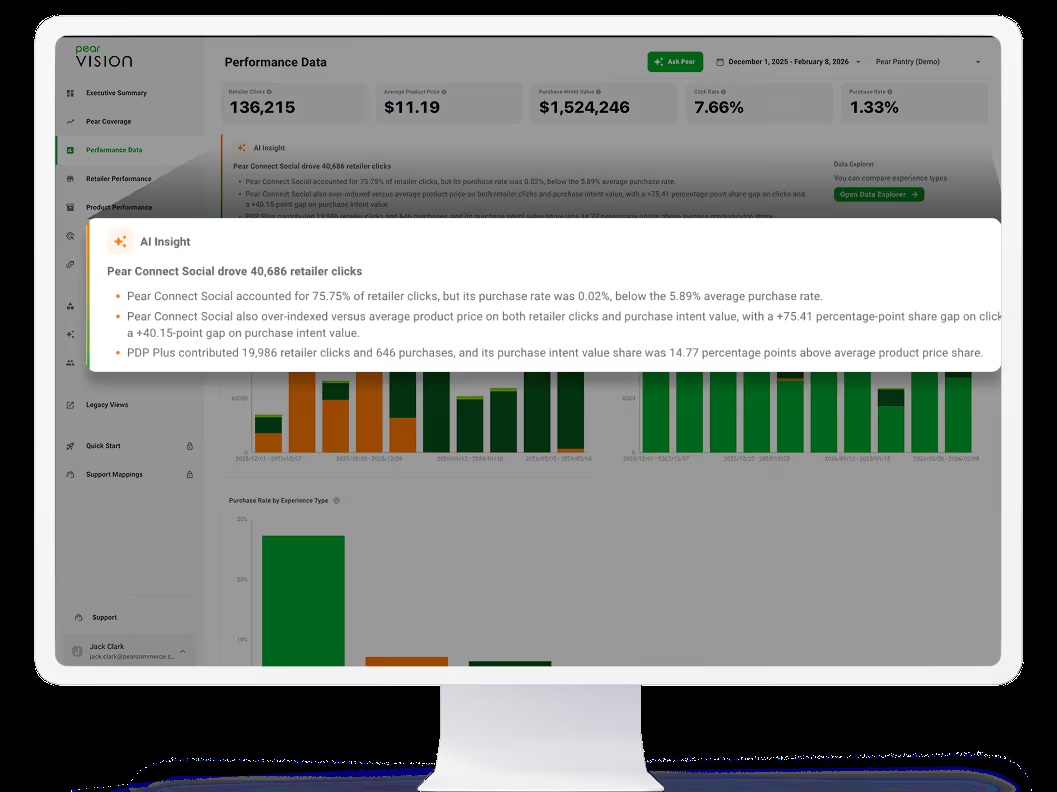
The newer products reach beyond routing. Pear Pulse supplies digital shelf inventory and pricing intelligence for sales and marketing teams. Pear Vision offers reporting, administration, AI summaries and natural-language analysis; its redesign appeared in May 2026. Product updates also describe expanded UK, Canadian and French coverage. In July, Pear announced expanded shoppable recipe capabilities with Ahold Delhaize USA.
05 / Give the click somewhere worth going
Stage 2 Capital led Pear’s $10 million Series A, announced in June 2024. The company reported fivefold year-over-year growth at the time. Its remote-work careers page adds a lighter detail: employees are called Pearrots, with weekly wins and trivia among the rituals. Even the people checking the shelf apparently need somewhere pleasant to land.

The premise has limits. Fresh digital inventory cannot put stock on a physical shelf, and a shorter journey cannot rescue unwanted merchandise. Where a retailer lacks ecommerce, Pear can add manual locator pins, but that does not create a checkout. For brands with retail distribution and measurable digital demand, however, the question is wonderfully concrete: when someone finally wants the product, have you made it easy to find?