The most revealing fact about Datasembly is not that its computers observe billions of retail product records. It is that, not long ago, giant companies were still dispatching people with clipboards to write prices down. Ben Reich and Dan Gallagher heard those stories while working as software engineers at Applied Predictive Technologies, the retail analytics firm Mastercard later bought for $600 million. The embarrassment was also an opportunity: if the shelf could become a reliable data feed, pricing teams could stop driving by the rearview mirror.
The Cornell classmates founded Datasembly in 2014. Their premise was almost aggressively literal - collect public information about every product, in every store, as often as practical; standardize the chaos; then let retailers and consumer packaged goods companies inspect price, promotion, assortment and availability at the level where shoppers actually encounter them. By 2025, the company said its engine covered more than 150,000 stores, 200-plus retailers and 30,000 ZIP codes across North America.

The job to be doneCatch the price while it can still be changed
Traditional syndicated data is useful for market share and sales performance, but it is commonly sampled, aggregated and delivered after the action. A national average may say a category is placid while a competitor is moving prices in Cleveland, Dallas or 80 especially important stores. Manual audits provide local truth, but only in thin slices, at considerable labor cost. Retailer portals add another partial view. The first thing to fail was not analytics. It was observation.
Datasembly automated that observation using publicly available digital shelf sources. It then performed the unglamorous work that makes the feed usable: mapping the same national-brand item across banners, matching comparable private-label goods, attaching an observation to a store, and maintaining those relationships when products disappeared or packaging changed. Its service agreement describes weekly exports, cloud delivery and quarterly maintenance for product matches. Customers can use the web application, ingest exports into a data lake, or work from purpose-built tools.
That architecture puts Datasembly between the data collector and the enterprise decision system. It is not a point-of-sale database, a dynamic pricing engine or a consumer shopping app. It is the outside view: what competitors put on the shelf, where, at what advertised price, with which promotion, and whether the product appears available. Pricing managers, revenue-growth teams, category managers, sales leaders and merchants use the view to investigate a market move before the weekly meeting has become next month's postmortem.
The proof pointThirteen weeks becomes two or three
The company's sharpest case study involves an unnamed leading battery manufacturer. Passing a yearly price increase through retail partners had taken 13 weeks or more. The old process leaned on averaged syndicated data and physical store visits, and the evidence could not readily be shared. Retailers hesitated because they could not see whether Walmart, Kroger and others had moved. That uncertainty created margin risk and demands for more trade spending.
“Last year it took us 13 weeks to get our price increase passed along in the market. With Datasembly we completed it in just 2-3 weeks this year.”Anonymous battery-manufacturer customer
With store-level evidence, the manufacturer showed partners what competing retailers were doing. Datasembly reports that the market change took 2-3 weeks, a reduction of more than 75 percent; the customer gained 1.3 percent in revenue and saved 0.2 percent of its trade budget. Those are vendor-published results from one anonymous client, not a general promise. But they reveal the product's economic argument better than a screenful of features: shortening decision latency has value.
One manufacturer's price-change clock
A cereal manufacturer offered another version of the same lesson. Store-level signals helped it get two retailers to move on price 8-10 weeks faster, according to Datasembly, producing $500,000 in sales gains during the first ten weeks and a projected $2.7 million across those partners. In a separate case, an early price move across just 80 stores warned a revenue-growth team of a broader shift that national averages could have buried.
What changed a buyer's mind? In one published case, a regional grocer put eight providers through a side-by-side trial. Datasembly won because its key-value-item data was the most consistent, its coverage fit the local problem and the company behaved like a working partner. The grocer then used historical local pricing to defend existing markets and set opening prices for seven new stores. The useful point is not that every eight-way trial ends the same way. It is that Datasembly let a skeptical customer test the claim against its own products and trade areas.
The productCompass tries to skip the scavenger hunt
Datasembly's main current interface is Compass, launched in July 2025, weeks after SPINS announced the acquisition. The platform is organized around fast-moving consumer goods categories. A market overview flags movement; modules explore pricing, promotions and assortment; users create product groups, dashboards and reports. Datasembly calls the approach “answers-first.” The phrase is marketing, but the design challenge is real: twelve billion rows a week are impressive only until a category manager has to find the six that matter before a buyer call.
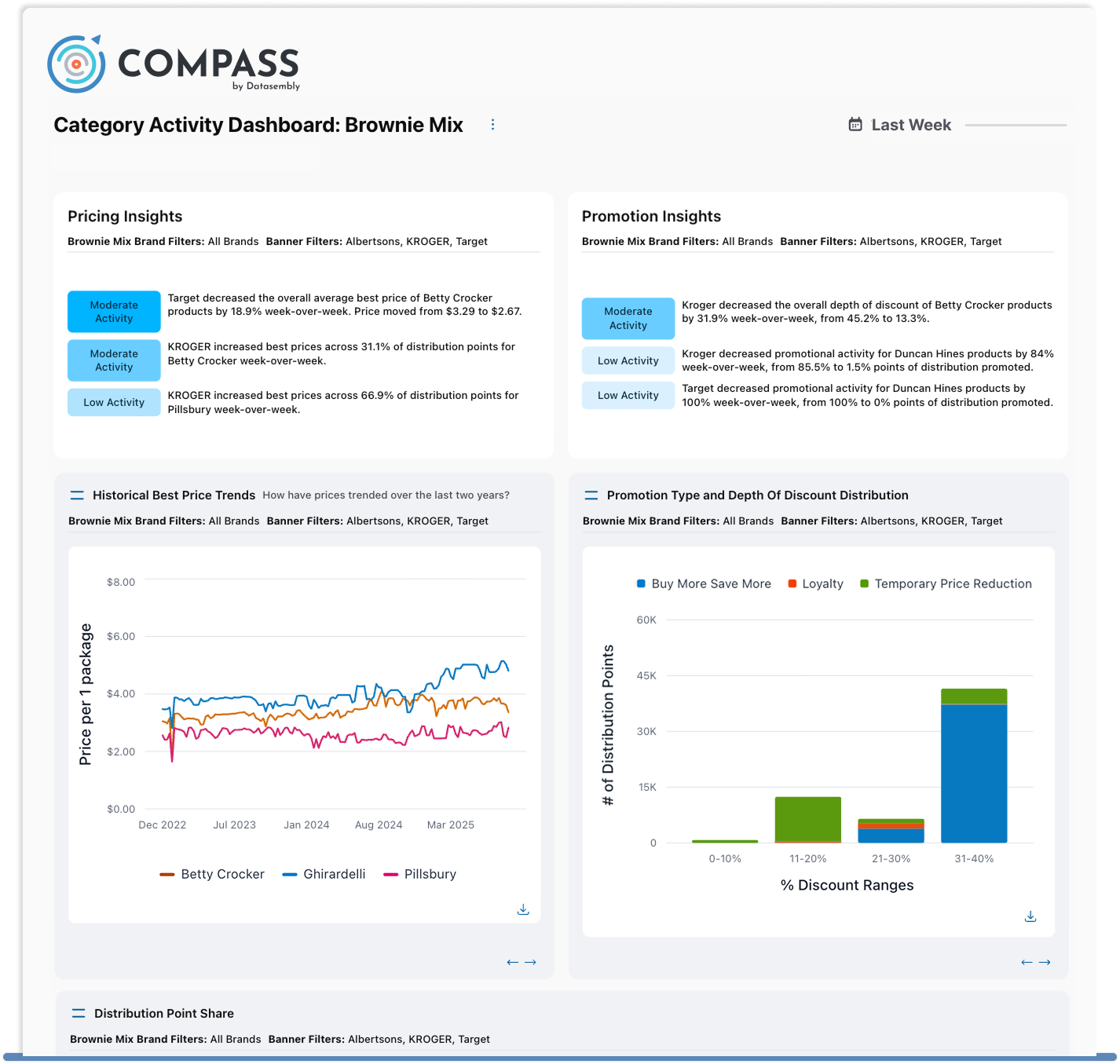
The deeper product is matching. A national brand has a UPC; a private-label equivalent may not line up neatly; produce and meat introduce variable weight and PLUs; a discontinued package can break yesterday's comparison. Datasembly combines similarity models and natural-language processing with human quality assurance, then gives customers a review workflow. This hybrid is less fashionable than declaring the whole job automated. It is also a clue to where trust comes from.
A second differentiator is shareability. Datasembly argues that because its underlying observations come from public digital shelves, customers can take competitive evidence outside their own company. That matters in a retailer negotiation. A chart that cannot leave a licensed dashboard may inform an internal opinion; a chart both parties can discuss can change the decision. In 2026, SPINS described mustard maker Olds Products pairing its performance intelligence with Compass shelf data - one system showed the score, the other showed the price and promotion conditions producing it.
The businessCustom subscriptions, quiet pricing
Datasembly sells to enterprises by custom quote. Public terms show separate purchases for data exports, mapping and matching, with extra-frequency collection priced additionally. There is no public menu telling a midmarket brand what a deployment costs. That makes the buying test straightforward: the subscription must be cheaper than the margin lost to delayed price moves, wasted promotions, missed distribution or the people-hours spent stitching together retailer views.
Capital supplied the collection scale. Public financing announcements add up to roughly $35 million: about $1.5 million in seed funding, a $10.3 million Series A led by Craft Ventures, a $7 million round led by Valor Siren Ventures, and a $16 million Series B led by Noro-Moseley Partners in 2023. The valuation was never announced. SPINS acquired Datasembly in June 2025 for an undisclosed sum, seeking to combine real-time shelf conditions with enriched product, category and performance data.
The alternatives are formidable. NielsenIQ and Circana anchor syndicated measurement. Engage3, Intelligence Node, DataWeave, Wiser and PriceSpider cover overlapping price, assortment and digital-shelf problems. Some retailers build collectors internally. Datasembly's position is narrower than “all retail data”: fresher local observation, broad physical-store coverage, maintained product comparisons and fewer restrictions on sharing. It fits beside sales and consumer data, not necessarily instead of them.
The playbook worth stealing
- Find the clipboard - a recurring field task whose slowness hides money.
- Automate the observation, then budget heavily for normalization and exceptions.
- Ship into the customer's existing workflow, not only your own dashboard.
- Make evidence portable enough to change an external conversation.
- Measure time-to-decision and financial outcome, not database size.
The honest boundaryWhen more shelf data is just more shelf data
This model works best when prices or assortments move frequently, local variation matters, the products are visible through collectable sources, matches can be maintained and the customer has authority to act. Grocery, household goods and other fast-moving categories fit naturally. It is weaker when a category changes slowly, online representation is poor, the relevant price is negotiated rather than advertised, or the organization needs quarterly direction rather than weekly evidence.
Good fit
- Many stores and local competitors
- Frequent price or promotion changes
- Comparable products can be matched
- Teams can act within days
Probably not
- Little public shelf visibility
- Stable or negotiated pricing
- Ambiguous product equivalents
- Decisions remain stuck for months
There is also a human constraint. A live alert does not compel a merchant to change a price or a retailer to accept a manufacturer's argument. Data quality, product coverage and match accuracy must survive scrutiny. A customer still needs a hypothesis, an owner and a decision window. Without those conditions, “real time” becomes an expensive way to watch the market happen.
Datasembly's achievement is making a previously awkward slice of reality inspectable at useful scale. The founders noticed that companies with sophisticated forecasting still lacked a dependable answer to a basic question: what is on the shelf across the street today? A decade, several financing rounds and one acquisition later, that question sits inside a broader SPINS platform. The business lesson is pleasingly unfuturistic. Find the information people still gather badly, make it trustworthy, and deliver it before the decision expires.