Somewhere in your company, a dashboard says revenue is up. Somewhere else, another dashboard disagrees. The analyst who knows why is on holiday, the dbt model has a name fit for a submarine part, and three Slack threads point to an Excel sheet last touched by someone who left in 2022. Select Star exists for this painfully ordinary scene. It connects to the systems where data lives and turns their metadata, query history, usage patterns and relationships into a searchable map. The immediate audience is the data team. The real beneficiary is everyone who has ever asked, “Which number are we supposed to use?”
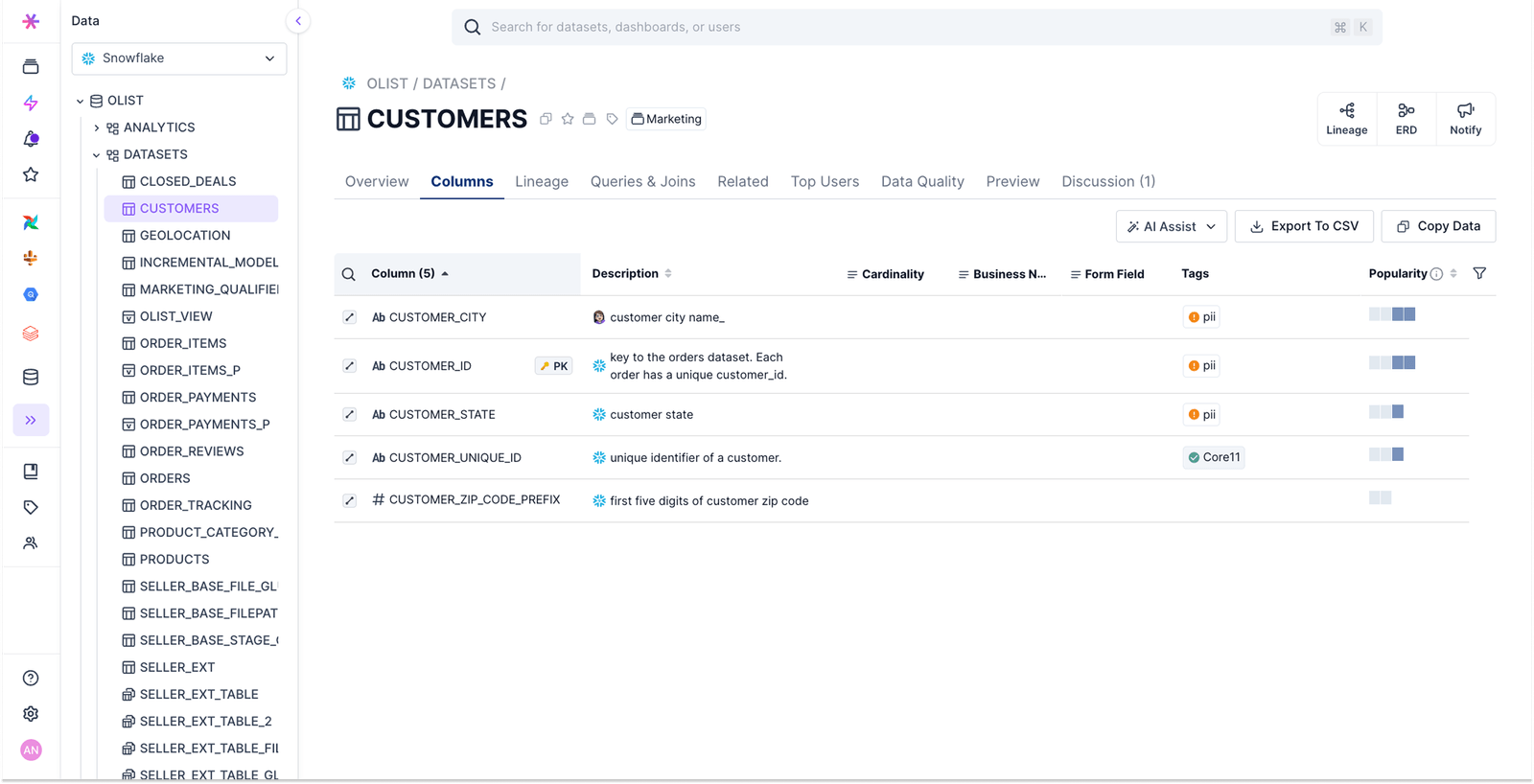
This is enterprise software, but the pitch is pleasingly domestic: label the cupboards, draw the plumbing, and stop making one person remember where everything goes. Select Star automatically inventories tables, columns, dashboards and models. It ranks what people actually use, reveals common joins, assigns owners and follows a field from its source through transformations to the chart in front of the chief financial officer. That combination makes it useful for discovery, governance, migrations and the delicate business of changing a schema without ruining Tuesday.
Who should care, and who can keep walking
Select Star makes sense when your data estate has crossed the point where memory and a shared document can cope. Think several warehouses or databases, a transformation layer, a BI tool, dozens of analysts and enough turnover that tribal knowledge has become operational risk. Data engineers can inspect lineage before changing a column. Analysts can find a certified table and see popular queries. Governance teams can tag sensitive fields and follow those tags downstream. Business users can look up a metric without filing a ticket.
A five-person startup with one tidy warehouse may be buying a filing cabinet before it owns paper. The same caution applies if your main problem is data quality monitoring. Select Star provides context and shows where quality issues may travel, but Capterra reviewers have previously called out missing data-quality metrics, and it is not presented as a full anomaly-detection or testing suite. Pairing a catalog with a dedicated observability tool may be the honest answer.
The clever bit is the exhaust
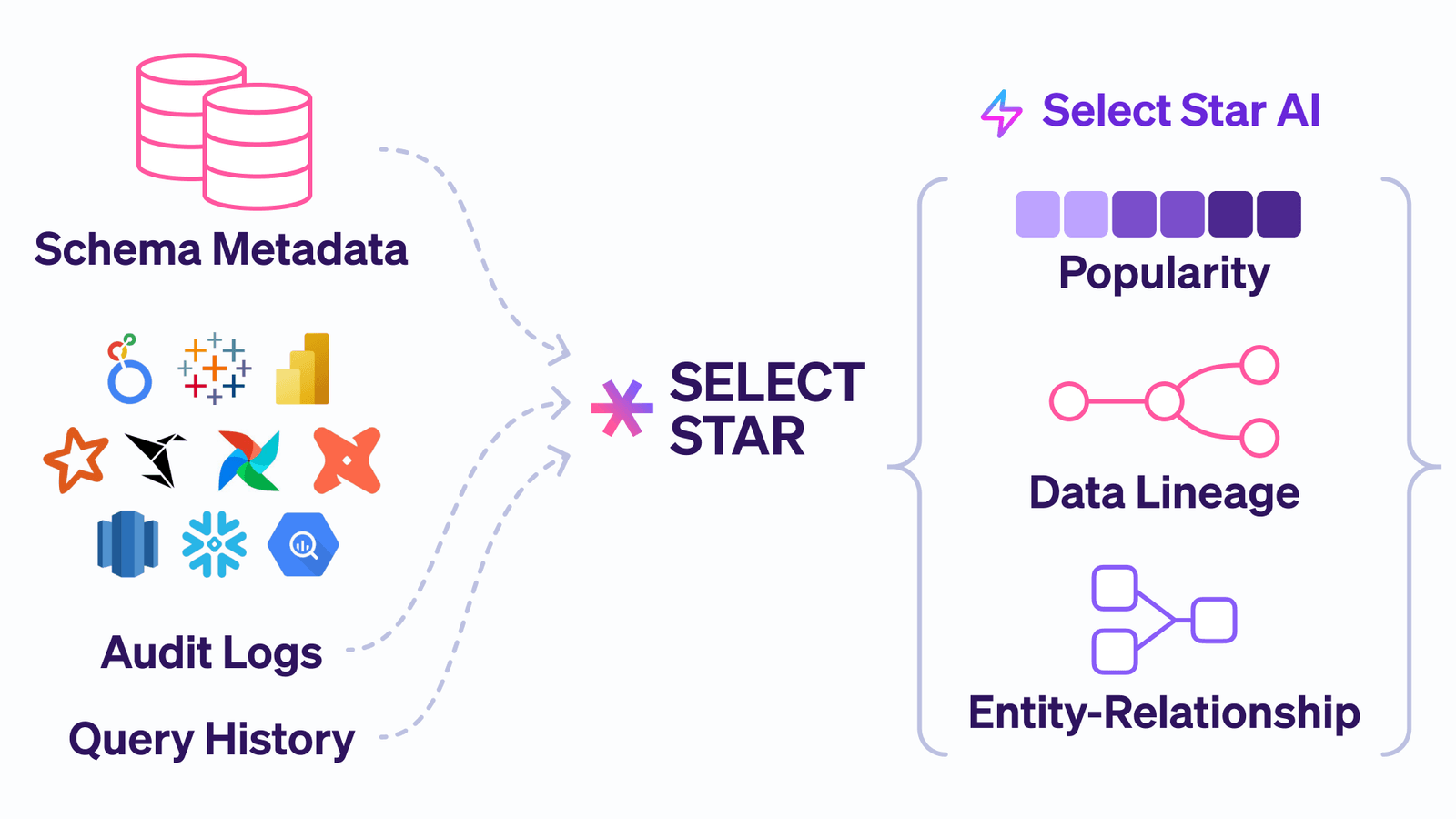
Traditional catalogs depend on humans documenting assets, which is exactly the sort of worthy task that slips behind a production incident. Select Star begins with evidence the stack already emits. Query logs reveal which tables get used, who uses them and how they are joined. Warehouse and BI metadata reveal structure. Parsed SQL and transformation metadata establish lineage. Select Star then puts manual knowledge on top: descriptions, glossary terms, tags, owners, certification and discussion.
+ BI + DBT
+ USAGE + TERMS
+ AI AGENTS
That order matters. Automatic context makes the catalog useful before a documentation campaign is complete. A popular, frequently joined table is easier to identify even if its description is thin. An owner can then add the business nuance software cannot infer. The result is less like a museum inventory and more like a street map that learns where the traffic goes.
“To me, graphical lineage is beautiful but the summaries are more useful.”Alejo Buxeres, Director of Data & Analytics, in a Select Star customer story
Lineage earns its keep on bad days
The product's clearest feature is column-level lineage across tools. Pick a field in a warehouse and you can trace it through a dbt model into a Tableau, Looker or Power BI asset. Reverse the direction and a dashboard number can be followed back toward its source. Before a change, impact analysis shows the downstream assets and people likely to care. After a break, the same map narrows the search for a cause.
The public integrations list covers Snowflake, BigQuery, Redshift, Databricks, PostgreSQL, SQL Server, MySQL and Oracle on the storage side; Tableau, Looker, Power BI, QuickSight, Metabase, Sigma, Mode, ThoughtSpot and Hex on the consumption side; plus dbt, Airflow, Fivetran and AWS Glue in the machinery between them. Connector depth is never identical, so a serious evaluation should test your exact path down to columns, calculated fields and dashboards. A logo on an integrations page is the beginning of a question, not the answer.
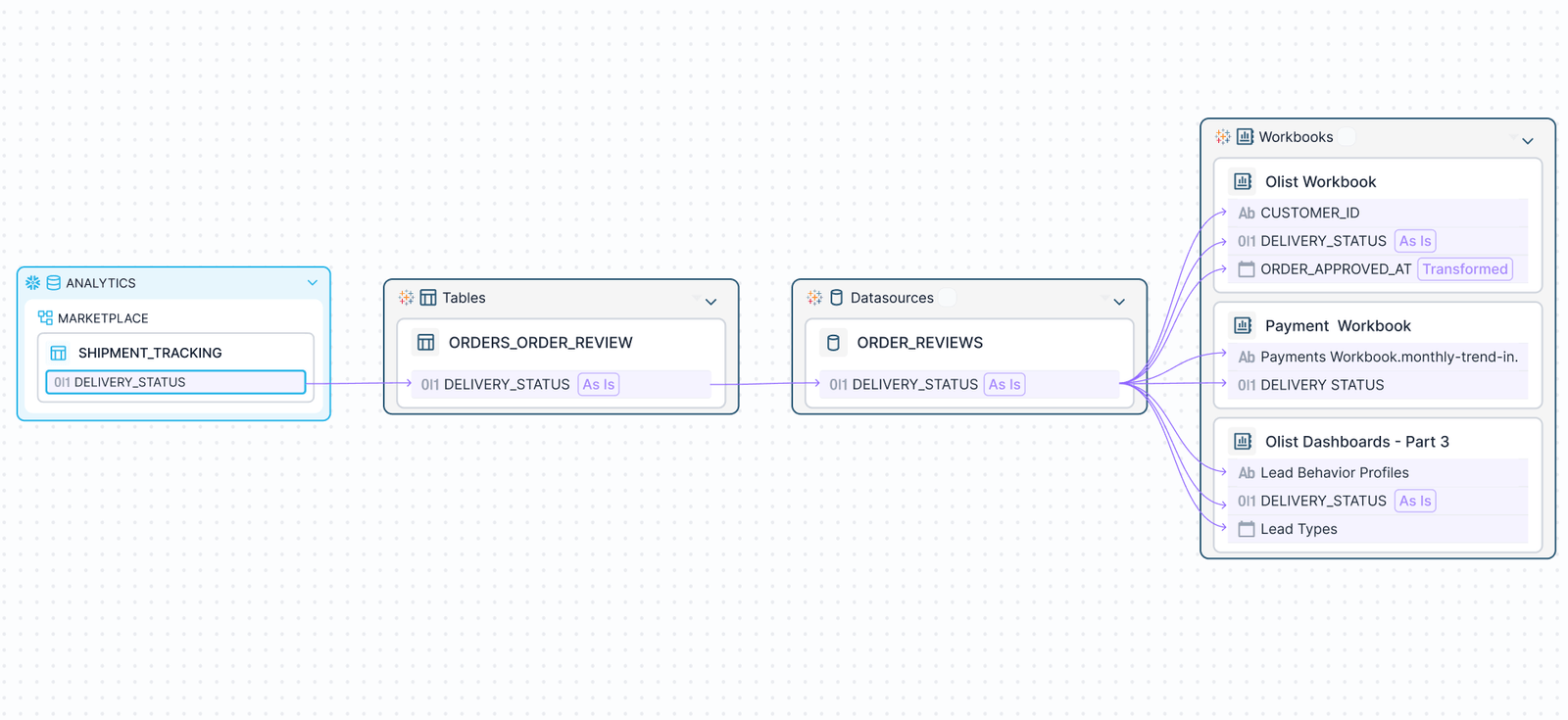
Vendor case studies deserve a raised eyebrow, but these examples are unusually specific. Pitney Bowes said more than 12 teams were using the product daily during its rollout. Livesport said it evaluated seven catalog tools and could immediately see the connection between BigQuery tables and Tableau sources. The useful signal is not a universal promise of saved hours. It is the kind of work that disappeared: manual schema tracking, relationship documentation and repeated support requests.
Now the robots want the map
In 2025, Select Star moved from helping people search metadata to helping AI use it. Ask AI can answer internal questions and generate descriptions. Semantic Models define entities, metrics, relationships and business logic, then export Snowflake Cortex Analyst-compatible YAML. The MCP server lets clients such as Cursor and Claude Desktop search tables and columns, retrieve lineage and use those semantic models.
This is a sensible extension of the catalog. A language model can write syntactically valid SQL and still choose the wrong revenue definition, join or source table. Feeding it a governed metric and the relationships observed in production attacks the less glamorous source of hallucination: missing company context. It also introduces a procurement question. Select Star says optional AI features use OpenAI and Anthropic technology and may share metadata, documentation, usage analysis and user metadata with those providers. Data values are not accessed unless explicitly enabled for features such as AI Data Querying, sensitive query values can be scrubbed with PII tags, and admins can disable AI features. Security teams should verify the precise configuration, not stop at the word “metadata.”
What buyers should compare
| Question | Select Star's angle | What to test |
|---|---|---|
| Can people find the right asset? | Search, popularity, certification, owners and glossary context in one portal. | Give business users five real questions and watch without coaching. |
| Can engineers trust the lineage? | Automated, column-level paths across warehouse, transformation and BI layers. | Compare several ugly production pipelines with known dependencies. |
| Will governance stay current? | Automatic metadata plus tags, PII propagation, owners and AI-assisted workflows. | Measure upkeep after the demo team leaves. |
| Can AI use the context? | Ask AI, semantic models, Cortex YAML export and an MCP server. | Check metric accuracy, permissions, logs and provider data flows. |
| What is the roadmap? | Snowflake plans to bring Select Star capabilities into Horizon Catalog. | Ask about standalone packaging and support for every non-Snowflake system. |
The competitive shelf includes Atlan, Alation, Collibra, Secoda, CastorDoc and data.world, plus open-source DataHub and OpenMetadata. Select Star's appeal is its automatic usage context and approachable lineage, with a portal that reviewers repeatedly describe as intuitive. G2 showed a 4.5 out of 5 rating across 55 reviews in 2026. One recent reviewer praised search for locating tables, columns and dashboards without asking around; another highlighted Snowflake and dbt integration, popular joins and tag propagation. The recurring caution is breadth. Larger governance suites may offer deeper workflow or policy machinery, while open-source options trade license cost for implementation and maintenance.
The Snowflake-shaped question
Snowflake announced its plan to acquire Select Star on November 24, 2025 and completed the deal in December. The stated priority was to bring Select Star's discovery and lineage into Horizon Catalog, supporting Snowflake Intelligence and Cortex Code. Strategically, the fit is plain: Snowflake wants agents to understand enterprise data, and Select Star built context beyond a single table.
For an existing customer, a large owner can mean more reach and integration. For a new buyer, it creates uncertainty around packaging, roadmap and neutrality across rival clouds. The old official pricing page now redirects to the homepage. Third-party listings still describe a trial and Growth and Enterprise editions, but those are historical clues rather than a quote. Ask for current commercial terms, migration commitments, connector roadmaps and a clear answer on whether Select Star remains a standalone purchase.
The verdict
Select Star is for organizations whose data problem is no longer storage but memory. Its case becomes persuasive when a team needs useful discovery before every asset is beautifully documented, and when column-level impact analysis can prevent expensive surprises. The interface and automation lower the social cost of governance: people can find context during work instead of attending a lecture about catalog hygiene.
The reservation is timing. Snowflake bought the company, public pricing vanished, and the future center of gravity is Horizon Catalog. Existing Snowflake customers have an obvious reason to investigate. Multi-cloud buyers should run a careful proof of concept and get roadmap promises in writing. The product solves a real, unphotogenic problem. Just make sure the map will keep covering all the countries where your data lives.