Minea is for the person who has stared into Meta's Ad Library until every posture corrector, portable blender and pet-hair roller begins to look like destiny. It takes that unruly public bazaar and gives it shelves: ads, products, stores, activity signals, supplier links and saved collections. For dropshippers who repeat this hunt every week, the appeal is immediate. A few filters can replace an afternoon of scrolling. For everyone else, the $49 starting price demands a more sober question: will faster research change what you ship, or merely help you collect more tabs?
The short answer is that Minea earns its keep when research is a routine, not an occasional curiosity. It is built around the working habits of e-commerce operators who need to compare creatives, watch stores and reject weak ideas before paying for samples or traffic. The platform is less persuasive for a brand team that only wants an inspiration board, or for a beginner hoping software will choose a profitable business on their behalf. Minea can show where attention appears to be gathering. It cannot tell you whether your margin survives returns, whether a supplier ships on Tuesday, or whether your ad will make anyone care.
Who should put it on the company card?
Start with frequency. A solo seller testing several products a month can use Minea as a reconnaissance desk. Search by platform, country, language, date, engagement or activity; open the shop behind an ad; inspect the offer; save promising candidates; then return later to see whether the campaign is still alive. A creative strategist can use the same machinery to compare hooks and formats. A small team can keep research in collections instead of scattering screenshots across Slack.
Minea's center of gravity is dropshipping. One 2026 Reddit comparison put the distinction neatly: the tool felt well suited to dropshippers because it exposes products and shops, but excessive for a brand selling its own catalog. That is a useful buying rule. If your weekly question is “What should we stock or test next?”, Minea speaks your language. If it is “How are prestige skincare brands framing clinical proof?”, a creative library or the free ad platforms may be enough.
What the product actually does
The main workspace divides the hunt into Ads, Products and Shops. Ad research surfaces creative, run dates, engagement and spending-related signals across Meta, TikTok and Pinterest. Product pages connect the item to stores and, where available, suppliers. Shop Spy steps back to inspect a seller's catalog, active promotions, prices, detected technology and estimated performance. Brand tracking and notifications help turn a one-off search into a watchlist.
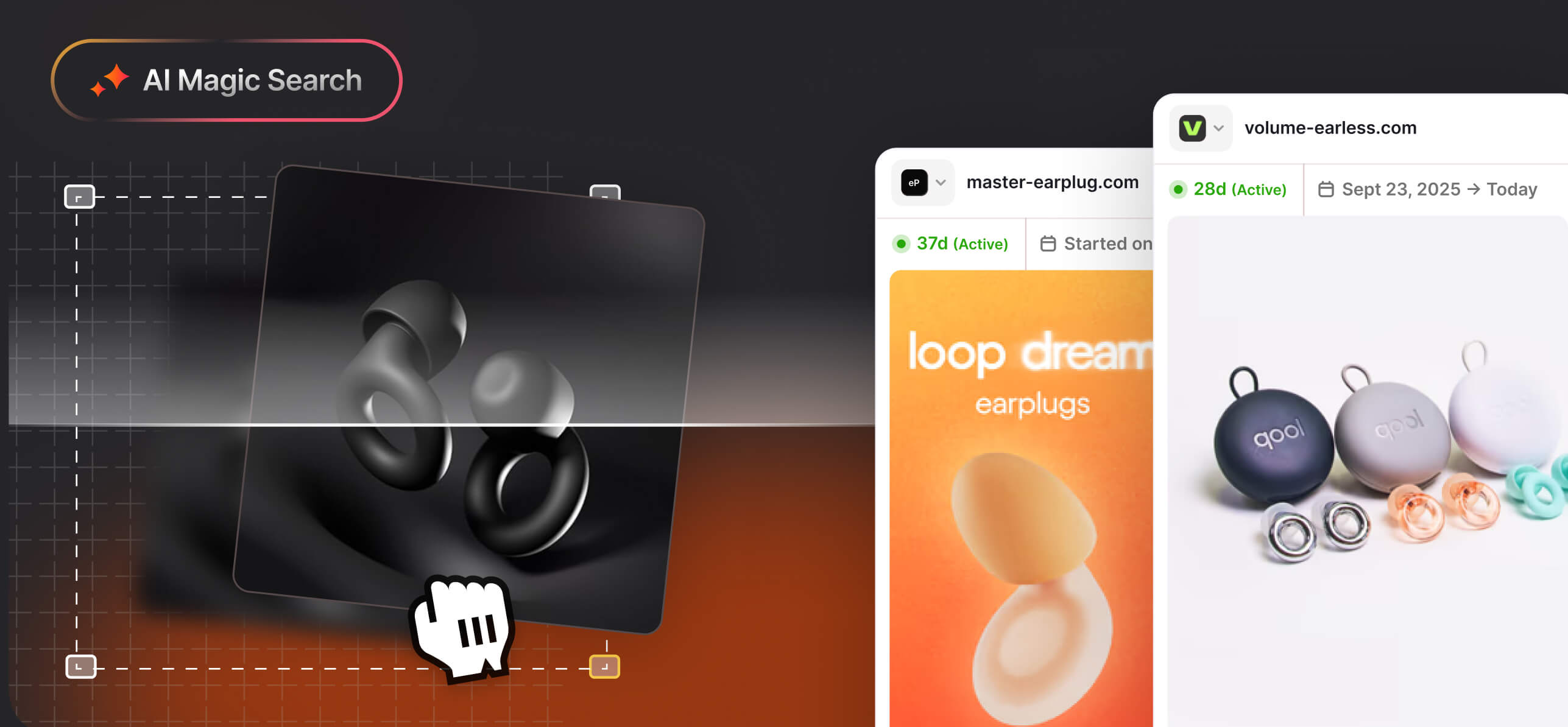
The AI layer handles repetitive reading and retrieval. Magic Search can locate related ads and products from a phrase or an image. Ad analysis and transcript tools pull structure from creatives, handy when a researcher needs to compare ten videos without replaying every “wait, you need this” opening. Saved collections provide the unglamorous but important final step: keeping the evidence tidy enough to revisit.
A better four-step hunt
The price of a shorter rabbit hole
Current monthly pricing is simple on the surface: Starter costs $49, Premium $99 and Business $199. Quarterly billing lowers the advertised effective monthly rates to $39, $79 and $158. Starter covers Meta ad, product and shop listings, brand tracking and limited monthly uses of AI analysis, transcripts and Magic Search. Premium raises those allowances and expands tracking. Business makes the listed AI and notification allowances unlimited. Minea also advertises a free starting route, so the sensible move is to test the exact search you perform in real life before subscribing.
| Route | Best for | Trade-off |
|---|---|---|
| Minea Starter $49/mo | Regular Meta-led product and shop research | AI analysis and transcripts are capped at 10 uses monthly; Magic Search at 50. |
| Minea Premium $99/mo | Active operators needing broader coverage and larger allowances | The price only works if the extra research changes decisions. |
| Minea Business $199/mo | Teams and heavy daily researchers | Unlimited listed allowances can encourage browsing without a testing process. |
| Public libraries Free | Occasional checks and disciplined manual research | More tabs, fewer connections between ad, product, shop and supplier. |
The recurring complaint in independent discussions is credits or feature access disappearing faster than expected. The present pricing page describes usage as monthly allowances rather than the older credit-heavy presentation, but buyers should still map their workflow to the plan table. Run five representative searches. Open the details you normally inspect. Generate the transcripts you would actually use. If the meter becomes the loudest part of the product, upgrade only after calculating what the saved time is worth.
“Use Minea to spot a pattern worth testing. Copying the product at the top of a list is how twenty stores arrive at the same party wearing the same shirt.”YesPress field note
The crowd at the gold mine
Minea says more than 200,000 dropshippers trust the platform, and its homepage reports more than 80 million active ads with 120,000-plus ad and shop updates each day. The scale makes filters useful, but it creates a social puzzle. Every subscriber can see many of the same rising products. A high engagement count may reveal demand; it may also announce that the copying has begun.
Reddit's dropshipping communities are blunt about this. Supporters say ad-spy tools accelerate learning and show how successful stores advertise. Critics say the feeds lean toward products already saturated, the data can be stale, and free Meta or TikTok tools reveal much of the raw material. Both camps can be right. A database does not carry a strategy. The operator who searches for exact products tends to converge with the crowd. The operator who searches for persistent customer problems, durable hooks and gaps in an offer has a chance to leave with something original.
Public customer feedback has a similar split. Trustpilot showed a 3.8 out of 5 score from 326 reviews when checked, with praise for time savings, the clean interface and responsive support. Critical reviews cite outages, unclear feature expectations and refund frustration. Some recent positive reviews are marked as redirected, another reason to read the distribution rather than one glowing paragraph. The most actionable lesson is administrative: inspect plan inclusions, cancellation terms and refund rules before paying, and save the confirmation.
Minea versus the obvious alternatives
PiPiADS remains a common comparison for TikTok-heavy research. BigSpy and AdSpy appeal to marketers who want broad creative search. Winning Hunter and Dropship.io compete for the all-in-one product-research customer. Foreplay is more naturally a creative team's swipe file and workflow. The free baseline is Meta Ad Library plus TikTok Creative Center, supplemented by spreadsheets and patience.
Minea's distinction is the bridge from ad to commerce context. The product wants you to see a creative, identify the store, inspect its catalog and offer, search for a supplier, save the idea and keep watching. That chain is genuinely convenient. Whether it is worth paying for depends less on database size than on how often you traverse the whole chain. Someone checking three competitors once a quarter should keep the $49. Someone qualifying twenty candidates every Monday has a stronger case.
How to get useful answers from it
Begin with a market and problem, not the “winning” shelf. Filter for ads that have remained active, then look for several unrelated sellers using the same promise. Longevity is only a clue, but it is more interesting than a one-day engagement spike. Open the underlying stores and note price architecture, bundles, guarantees, comments and delivery claims. Reverse-search the product image. Compare suppliers and read their recent reviews. Finally, write down the claim that would make your version meaningfully different.
Keep a rejection log alongside saved collections. “Margin dies after shipping,” “creative relies on a medical claim,” and “twelve identical shops launched this week” are valuable results. Product research software pays for itself as much by killing bad ideas quickly as by finding attractive ones. This mindset also tempers the casino language surrounding dropshipping. A shortlist is an invitation to investigate, not a ticket that has already won.
The verdict
Minea is a capable research desk for active dropshippers and e-commerce operators who repeatedly connect ads to products, shops and suppliers. Its filters and consolidated workflow can save real time. Buy it for faster rejection and clearer pattern-finding. Skip it if you only need occasional creative inspiration, dislike metered AI features, or expect a database to supply judgment. The best Minea user leaves with fewer ideas and better reasons.
The backstory in brief
Minea's LinkedIn profile dates the company to 2021 and describes it as an 11-to-50-person software business. A major V2 announcement in 2023 added AI-assisted product-trend and engagement insights, generated descriptions and visuals, Shopify import and a redesigned interface. Loïc Berthelot said in early 2025 that he had become CEO. By 2026, the public navigation had settled around Ads, Products, Shops, AI Lists, Saved Collections, Academy, Community and a Chrome extension. The trajectory is clear: Minea has grown from an ad-spy search box toward a broader operating desk for product discovery.
Keep digging