If your days are a parade of meetings, hallway promises and bright ideas that arrive while both hands are busy, the reason for Limitless is easy to grasp. Clip a smooth black puck to your shirt. Let it hear the day. Open an app later and ask, “What did I promise the client?” The answer comes from your own conversations, with the relevant lifelogs attached. For managers, founders, students and compulsive verbal processors, that can feel less like gadgetry and more like relief.
There is also a blunt reason not to buy one: you cannot. Meta acquired Limitless on December 5, 2025, and the company stopped selling new Pendants that day. It promised to support existing owners throughout 2026, made its Unlimited plan free for those customers and began closing the rest of the shop. Rewind, its earlier desktop memory app, stopped capturing screens and audio later that month. Several regions lost service entirely.
So this is partly a review of a product and partly an autopsy of a category. Limitless showed how an AI wearable could earn a place in an ordinary workday. It also showed why hardware that depends on a private cloud is never fully yours, even when it hangs around your neck.
Who it was for, and who should care now
Limitless worked best for a person whose problem was capture, not composition. A consultant bouncing between rooms could retrieve decisions without reconstructing them from memory. A student could revisit a lecture. A general manager on Reddit described using it for feedback, follow-ups, meetings and training, calling it “a personal secretary taking notes all the time.” Another App Store reviewer reduced the appeal to five useful words: “It is an external brain.”
That last phrase is the product. Voice recorders already existed. Meeting transcription already existed. Limitless removed the moment when you must remember to begin remembering. The Pendant could store up to 35 hours of detected speech without a nearby phone, then offload encrypted audio when the app returned. Silence did not count toward that figure, so a half-spoken day could stretch the effective buffer toward 70 hours.
Existing US owners may still find it useful while service continues. Everyone else should treat it as a field guide for choosing its successor. Look for a current sales channel, explicit service guarantees, full export, replaceable hardware and a privacy model you can explain to the person across the table. An elegant microphone is a paperweight when its servers leave town.
The trick was the retrieval, not the recording
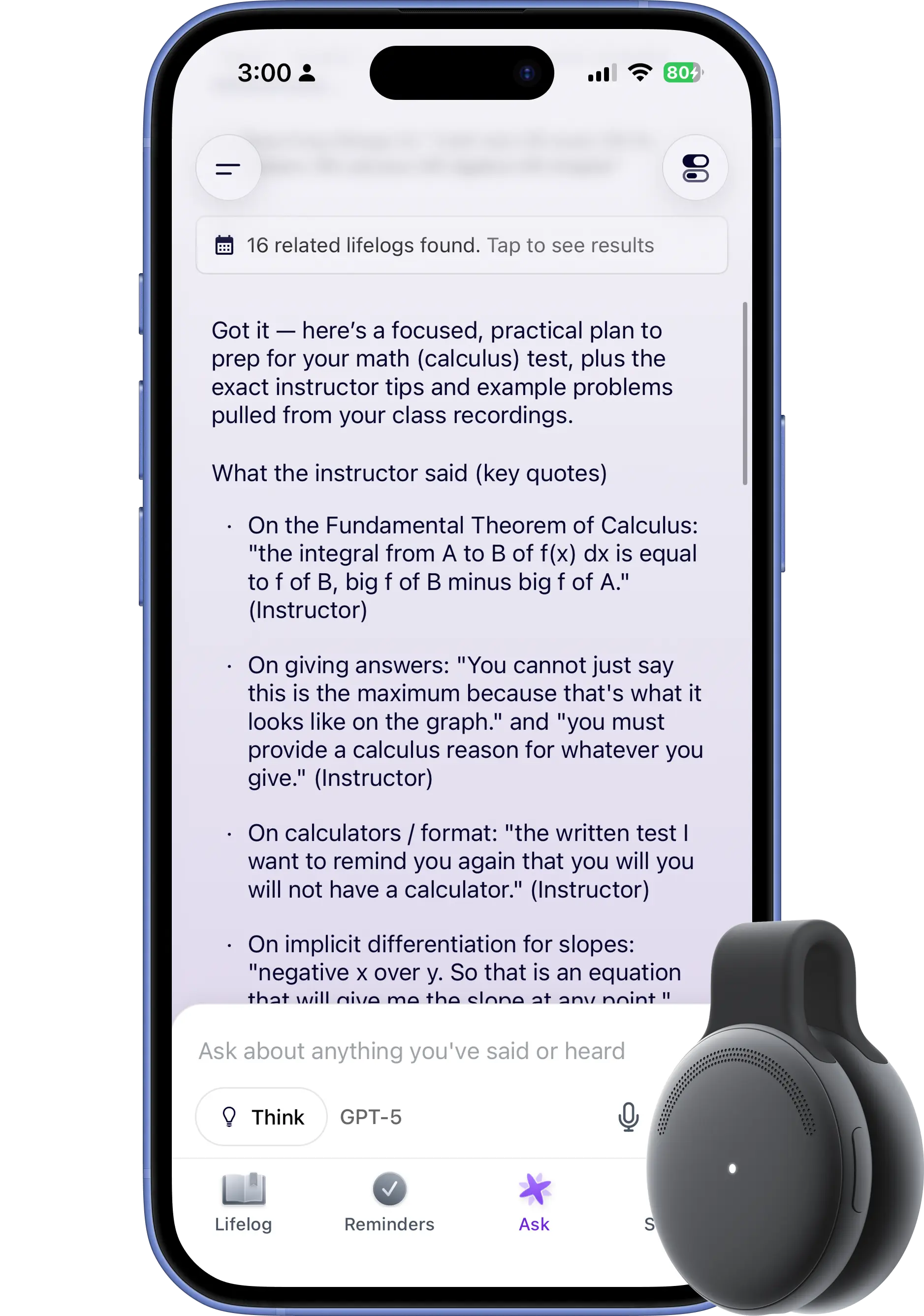
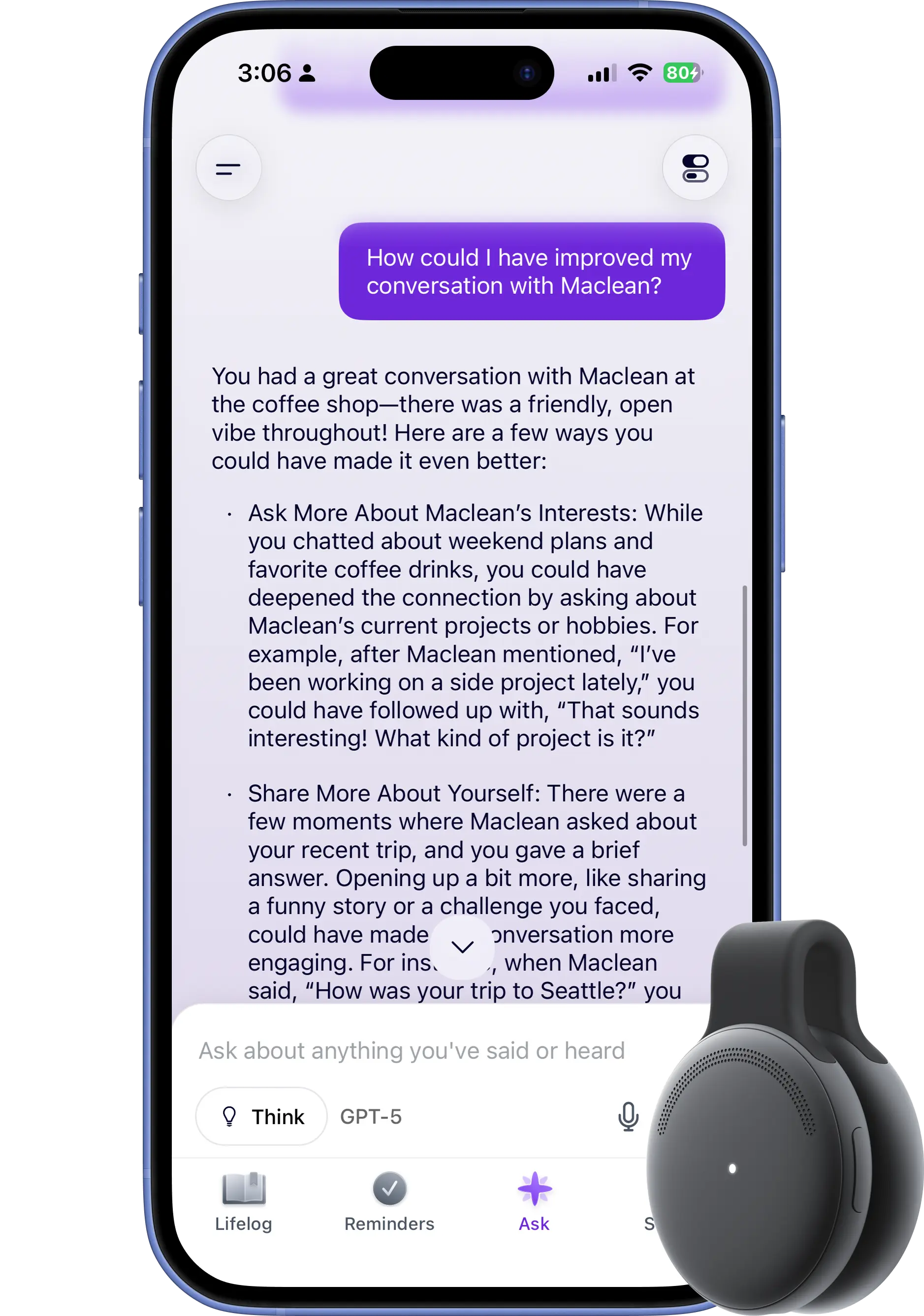
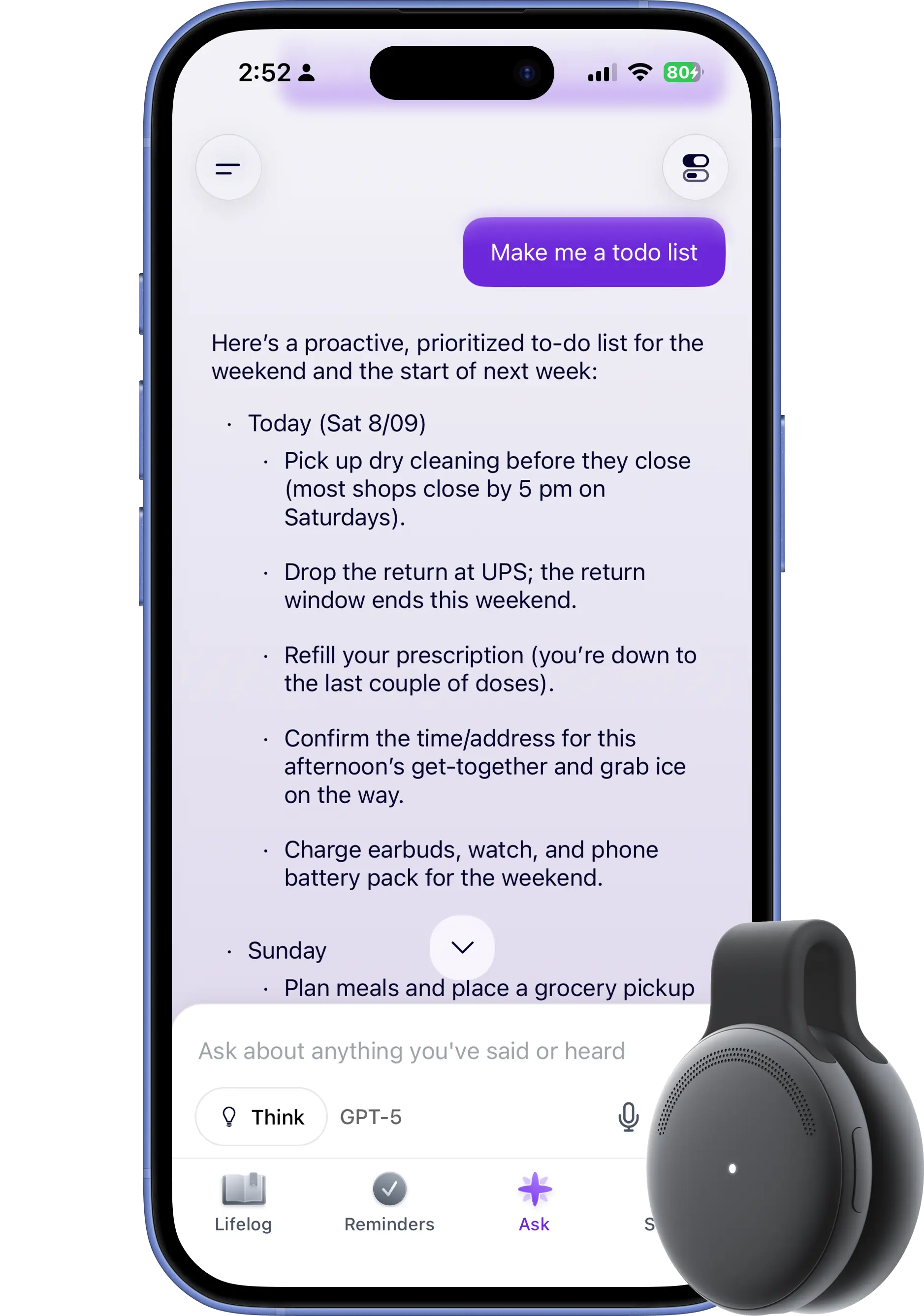
The Pendant listened for voices, synced through the phone and turned the audio into a chronological lifelog. Each chunk could carry a transcript, summary and speaker labels. Search handled exact words. Ask AI handled fuzzy human questions. Daily notifications surfaced recaps and unfinished tasks. Owners could create a recurring daily question, which turns “What did I forget?” into a scheduled prompt instead of a small evening panic.
The mobile app could edit transcripts and speakers, play or download audio, share selected transcripts and export summaries in several formats. Saved Voices learned future speaker labels after at least 20 seconds of manually labeled audio. The custom dictionary helped with names and specialist jargon. This was thoughtful plumbing, the unglamorous work that makes a memory tool dependable.
Dependable did not mean flawless. User reports repeatedly mention weak speaker separation, poor transcription in noisy rooms and summaries polluted by television or music. The app and desktop clients also had mismatched abilities. Ask AI worked with Pendant lifelogs, while several editing and sharing controls were mobile-only. A recorder that hears everything still has to decide what matters, and sometimes it gives the radio a speaking role in your biography.
“The best part: I don't take notes anymore.”A three-month owner review on Reddit
A good object with a complicated social life
The hardware had restraint. It could be clipped to a collar or worn on its included necklace, recorded while charging and survived splashes under an IP54 rating. A white LED stayed lit during recording and could not be dimmed. Limitless used Apple’s AccessoryKit for authentication, TLS in transit and a hardware security module backed key exchange. Audio stored on a lost Pendant remained encrypted.
Then comes the room. The company requires wearers to notify people and obtain consent before recording them. The light is a signal, but it is not permission. Laws vary by place, social comfort varies by person, and a glowing dot cannot explain that audio may become a transcript, a summary and input for third-party AI providers. A considerate owner must do that aloud, each time it matters.
The two-person product
Limitless serves the wearer, but everyone within earshot becomes part of the workflow. Ask first. Pause freely. Set the shortest useful audio-retention period. Export what you need, then delete what you do not.
Consent beats a blinking lightThe December 2025 privacy policy sharpened that concern. Limitless said information could be used to improve AI models from third parties and affiliates, while owners could choose to retain recordings indefinitely. The service offers deletion, data export and audio retention choices ranging from a day to forever. Those controls matter, though the essential judgment still sits with the wearer.
The reviews: liberation meets friction
“It is an external brain.”
An App Store reviewer praised next-day summaries, to-do lists and specific recall, while noting that speaker recognition needed work. Read the reviews.
“Premium build, but disappointing software.”
Another reviewer liked the sturdy hardware but found the software and subscription hard to justify. Other owners reported battery lives ranging from roughly a workday to more than a day.
Both reactions can be true. The job of wearing and capturing was wonderfully simple. The job of interpreting an unedited life was difficult. People who used the Pendant deliberately for meetings, verbal notes and reminders tended to describe clear gains. People who expected perfect, continuous autobiography ran into noise, mislabeled voices and battery anxiety.
Limitless claimed a full day of continuous recording and recommended nightly charging. Its earliest announcement mentioned a 100-hour target, a reminder that preorder promises and shipped behavior deserve separate columns. There was another charming hardware catch: owners were warned not to use a USB Power Delivery charger because it could permanently damage the Pendant. The future of memory preferred an old-fashioned charger block.
How it compares, now that the shelf is empty
| Option | Best fit | Capture style | The question to ask |
|---|---|---|---|
| Limitless | Existing supported owners | Ambient wearable lifelog | What happens after 2026? |
| Plaud NotePin | Meeting and interview notes | Wearable, deliberate sessions | Which features need a plan? |
| Omi | Tinkerers and extensibility | Open-source leaning wearable ecosystem | How much setup will you tolerate? |
| Bee | Consumer daily recaps | Ambient wearable | How does Amazon handle your data? |
| Granola / Otter | Desk-bound meetings | Computer or meeting software | Do you need all-day capture at all? |
A replacement should be chosen by workflow, not by resemblance. If you only need Zoom notes, a wearable adds charging, consent rituals and another cloud. If ideas arrive during walks, site visits or face-to-face work, a wearable earns its keep. If you need a long-lived personal archive, prioritize raw audio and transcript export over the cleverness of today’s summary model.
From Rewind to a reality-lab ending
Scribe becomes Rewind
Dan Siroker and Brett Bejcek pursued searchable personal memory on the Mac. The company later said it began five years before the 2025 acquisition.
Limitless arrives
Rewind rebranded and unveiled a $99 Pendant. More than 10,000 preorders were announced alongside web, Mac and Windows meeting software.
The product fills in
Mobile lifelogs gained Ask AI, transcript editing, reminders, saved voices, sharing and Android support. Owners finally had the fuller system the hardware implied.
Meta buys the company
Sales ended. Existing owners got free Unlimited access. Rewind capture shut down, and service left the EU, UK and several other regions.
The idea circles back
TechCrunch reported that Meta was developing an AI pendant, possibly building on Limitless. Meta did not confirm the report.
The acquisition price was not disclosed. The company had raised more than $33 million from Andreessen Horowitz, First Round Capital, NEA, Sam Altman and others. Its team joined Meta’s Reality Labs wearables organization. That makes strategic sense: the hard part of personal AI is context, and spoken life produces an ocean of it.
The customer guide for a product you cannot buy
Current owners should export now rather than waiting for a final notice. Download transcripts and audio you value, confirm that the files open, shorten retention for casual recordings and keep the app updated only if your region remains supported. Do not assume an unlimited plan means unlimited time. The company’s public promise has a calendar attached.
Secondhand buyers should pass unless they are comfortable purchasing unsupported hardware with an uncertain activation path. The old $99 price is irrelevant when the service is closed to new customers. Collectors may enjoy the object. Anyone seeking a working second brain should buy a current service.
For the rest of us, Limitless leaves a useful test. An AI wearable succeeds when it gives back more attention than it demands, when retrieval is better than recording, and when the people around it understand the bargain. Limitless reached that feeling often enough to matter. Its disappearance makes the final lesson hard to forget: memory needs an exit plan.
Questions people ask
Can I still buy a Limitless Pendant?
No. Direct sales ended on December 5, 2025. A secondhand device may not have a supported activation or service path.
How long will existing Pendants work?
Limitless promised support throughout 2026. It has not made a public guarantee beyond that period.
Is there still a subscription?
Continuing supported customers were moved to Unlimited at no charge after the acquisition. Earlier free, Pro and Unlimited prices are historical.
Does it record without a phone nearby?
Yes. It can buffer up to 35 hours of detected speech locally, then sync through the mobile app later.
Do people have to consent?
Limitless requires wearers to notify people and obtain consent. Recording laws differ by location, so owners must understand the rules where they use it.