Clockwise was built for the particular misery of a workday that looks free from a distance and becomes useless on inspection. A status meeting at 10, a check-in at 11:30, something “quick” at two, and your ambitious project squeezed into the crumbs. The app’s answer was practical: decide which events could move, learn when people preferred to work, then shuffle the movable pieces until long blocks reappeared. It was for managers, engineers, designers, executive assistants, product teams, and anybody whose calendar had become a communal whiteboard.
There is an awkward fact to put first in any customer guide: you cannot become a Clockwise customer now. The service ended on March 27, 2026. Its team joined Salesforce, the Chrome extension was marked deprecated, and the company said customer data would be deleted rather than transferred. This review is therefore part product autopsy, part buying guide for people trying to recreate a workflow that vanished. Clockwise still matters because it framed the calendar correctly. Shared time is a network problem. Every meeting moved for you may move somebody else’s day with it.
Who it was really for
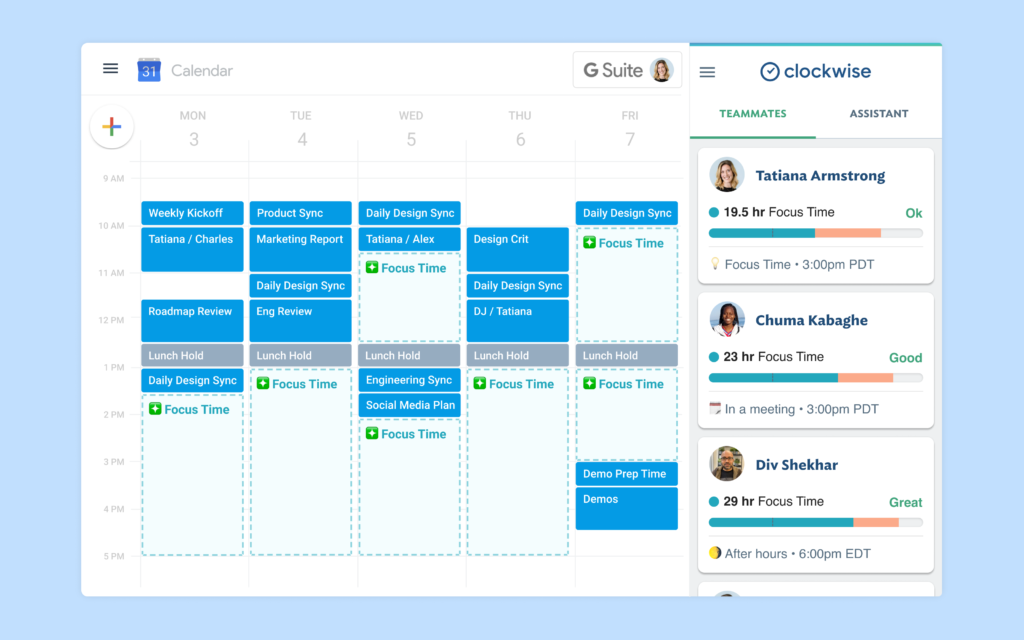
Clockwise made the strongest case inside a meeting-heavy company where several colleagues used it together. A solo user could still get lunch holds, personal-calendar sync, meeting breaks, booking links, and defended Focus Time. The cleverer behavior appeared when coworkers marked recurring meetings as flexible. Clockwise could bunch those meetings together, look across attendee preferences, and open a clean afternoon for someone who needed to make, write, debug, or think.
That also explains who did not need it. If your schedule was mostly appointments with outside clients, a booking tool could cover the main job. If your larger pain was turning a task list into a daily plan, Motion or another task-first planner was closer to the brief. If your team would not let software move recurring meetings, Clockwise lost much of its advantage. One Reddit user described it neatly as being better for “corporate use-cases.” The product grew more useful as coworkers joined, but getting coworkers to change calendar behavior was part of the price.
How the little green sparkle worked
The original product lived as a layer on Google Calendar, later adding Microsoft 365 support. Users set working hours, lunch preferences, Focus Time targets, travel buffers, meeting breaks, and which events were flexible. A daily optimization pass could then rearrange eligible events. Personal calendar sync placed private commitments on a work calendar as busy time without broadcasting the details. Slack could update a person’s status, expose team availability, and eventually accept scheduling requests.
Its signature move was called “schedule by moving.” Ordinary calendar tools search for visible white space. Clockwise could propose a time that was currently occupied if the blocking event was movable. Later versions chained these decisions: Meeting A could take Meeting B’s slot, B could move into C’s slot, and C could land in a genuinely open space. That sounds like office Tetris because it was. The difference was that each piece came attached to humans, time zones, working hours, and preferences.
| Job to do | Clockwise’s approach | The catch |
|---|---|---|
| Protect deep work | Dynamic Focus Time holds adjusted as meetings arrived. | A block protected time, but did not decide what work belonged inside it. |
| Fix fragmented days | Flexible meetings were clustered into less disruptive periods. | Useful movement depended on organizer permissions and teammate adoption. |
| Book people | Individual, group, one-time, and round-robin links respected preferences. | Links died with the service and had to be replaced everywhere they appeared. |
| Plan by chat | Natural language created, moved, cleared, and bulk-scheduled events. | Complex requests still needed review before committing calendar chaos. |
Prism put a chat box on the week
In 2023 Clockwise began using GPT-4 to translate everyday scheduling requests into operations for its scheduling engine. The company did not simply give a language model the keys to a calendar API. The model interpreted intent; Clockwise’s older optimization machinery handled the constraints. That separation became visible in Prism, launched in August 2024 and renamed Clockwise Calendar in June 2025.
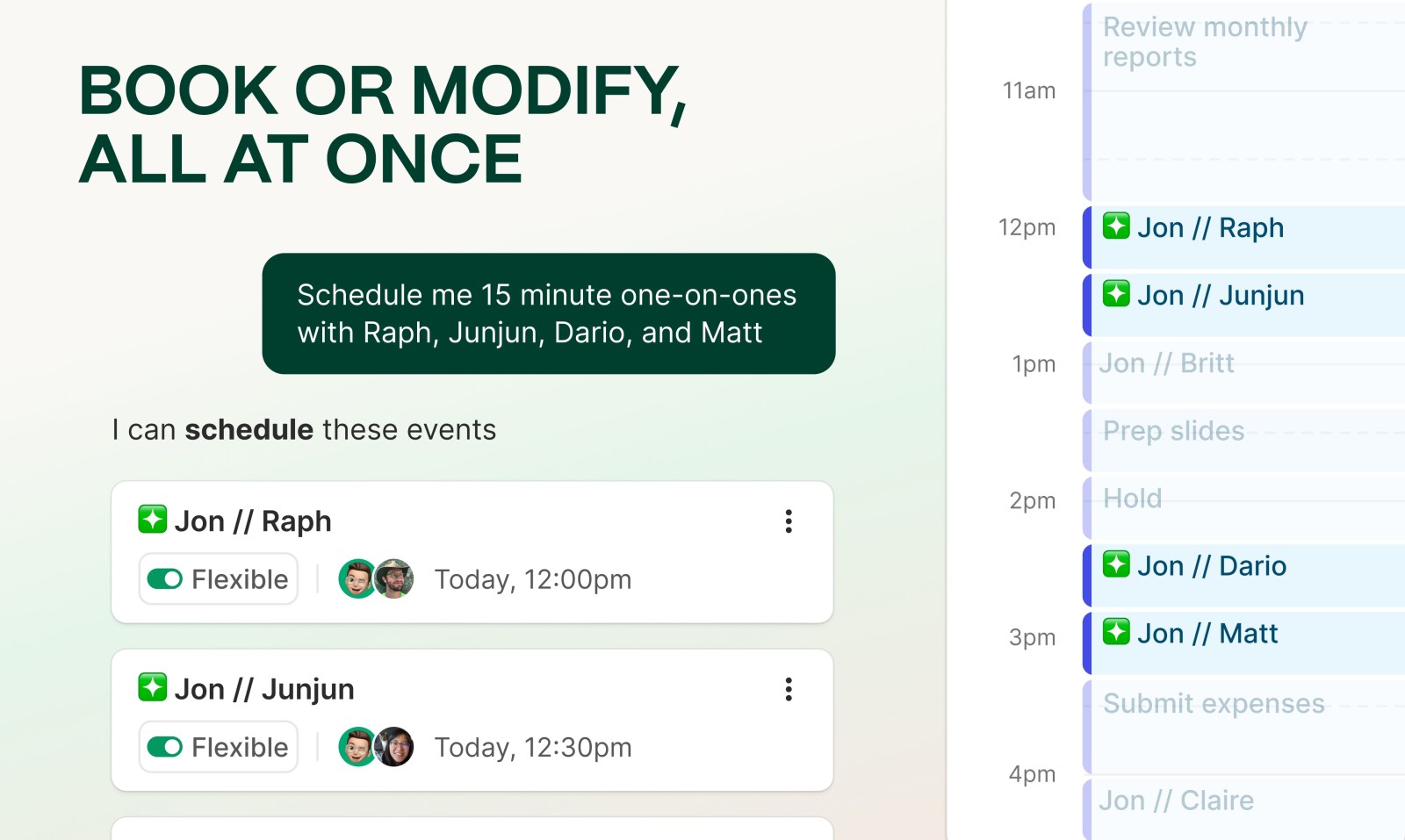
Prism accepted requests such as scheduling a run of one-on-ones, clearing a morning, turning to-dos into flexible tasks, or finding room for an urgent meeting even when no obvious slot existed. Users could drag an event and see how the move affected attendees. Proposals could be shared for approval. Clockwise said the underlying algorithms considered about 160 million calendar events on an average day, alongside availability and preferences. By September 2025, Clockwise MCP let compatible assistants including Claude and Cursor inspect a week, suggest changes, and act through the same rules.
Good reviews, specific grumbles
The public ratings were unusually steady for software allowed to rearrange people’s days. G2 listed 4.7 out of 5 from 74 reviews; Capterra listed 4.7 from 53. Reviewers repeatedly praised automatic Focus Time, easy rescheduling, and Slack or calendar integrations. A 2025 G2 reviewer called it the scheduling assistant they could not live without and liked using Flexible Holds for walks and end-of-day routines. A Product Hunt reviewer praised automatic time blocking and the way lunch moved when conflicts appeared.
The complaints were equally instructive. A three-star G2 reviewer liked the Focus Time but did not trust the product to prioritize every conflict correctly. Others wanted more granular tasks inside focus blocks, better Asana planning, or broader personal-calendar support. On Reddit, one manager summarized the cost problem bluntly: Clockwise felt expensive when the visible result was mainly a focus block. Another longtime user said the analytics told them little beyond how many hours were spent in meetings. Automation can remove chores, but it cannot make weak meetings necessary or turn an unlabeled block into a plan.
The old buying verdict
Clockwise made sense for teams with movable internal meetings, expensive interruption, and enough shared adoption to let the optimizer work. It was less persuasive for solo task planning, mixed personal calendar systems, or organizations unwilling to grant calendar access and flexibility.
A short history of borrowed time
The shutdown, without the soft-focus language
Clockwise announced that its team was joining Salesforce to work on agentic enterprise software. This was a team transition, not a promise that the Clockwise product would continue under a larger roof. The product stopped working on March 27, 2026. The farewell arrived with striking lifetime counters - more than 8 million hours of Focus Time and 23 million meetings moved - and a very short runway for customers.
The operational details mattered more than the corporate phrasing. Clockwise said Smart Holds such as Focus Time, Travel Time, Meeting Breaks, and synced personal events would be removed. Flexible Meetings would stop moving. Scheduling Links would stop resolving. User preferences, links, and other data would be deleted shortly after access ended, with no transfer to Salesforce. Unused subscription time was to be refunded. Clockwise pointed customers toward Reclaim.ai for replacement links, and the deprecated Chrome listing now tells users to uninstall it.
If you miss Clockwise, replace the workflow
Shopping for “a Clockwise alternative” is too vague. The old product bundled four different jobs: defending focus, rearranging team meetings, publishing booking links, and translating tasks or sentences into calendar blocks. Write down which two saved you time. Then test those with real calendars for a week. A demo containing three tidy events will not reveal how an optimizer handles a recurring staff meeting, an out-of-office day, and the colleague who works six hours ahead.
Reclaim.ai is the direct place to begin because Clockwise named it in the shutdown notice and linked migration guidance. Motion deserves a look when automatic task planning matters more than team meeting geometry. Calendly remains oriented around people choosing bookable times. Vimcal focuses on a fast calendar experience. Google Calendar and Outlook continue adding native scheduling features and may be enough if reducing vendors matters more than advanced optimization. Compare outcomes, not the number of AI buttons.
Clockwise’s lasting contribution was a modest change in office etiquette. It made concentration visible and gave it a moving bodyguard. The green sparkle on a hold told colleagues that the blank space had a purpose. The company did not defeat meeting culture, and the product could irritate people when a familiar recurring event wandered around the week. Still, it proved that calendars can negotiate instead of merely record. That idea is now scattered across rivals and platform assistants. Clockwise ran out of time; the argument it started is still on everyone’s schedule.