The most revealing thing about Clio Duo is the work its early users praised. They did not rave about a robot arguing before the Supreme Court. They talked about finding a phone number, comparing monthly billing, catching up on a matter, drafting a client email, and remembering to enter time. This is the clerical sediment of legal practice: small jobs that gather until a lawyer's afternoon disappears beneath them.
Clio put generative AI inside Clio Manage, the system where a firm's matters, contacts, documents, calendars, communications, and bills already lived. That made Duo less glamorous than a general chatbot and much easier to explain. Ask it what happened in the Smith matter. Ask for the newest documents. Ask it to create tomorrow's follow-up task. The context was already in the room.
For a firm already running on Clio, this remains the strongest reason to care. For everyone else, Duo was never a standalone destination. In 2025, Clio retired the name and expanded the feature into Manage AI. Think of this review as an examination of the original product and a buying guide to its living descendant.
Who is this actually for?
The cleanest fit is a solo, small, or mid-sized firm whose operational memory sits in Clio Manage. Attorneys can use it to catch up before a call. Paralegals can pull dates from a file and start a client update. Administrators can query firm activity without constructing a report. Billing staff can chase missing time and move draft invoices toward approval.
It is a weaker fit if your documents are scattered across local drives, your team barely maintains matter records, or your main need is case-law research. An assistant grounded in thin or messy data becomes a very fast tour guide to a poorly labeled warehouse. Original Duo handled practice data and routine workflow; Clio now points research and legal analysis buyers toward Clio Work.

The case for boring AI
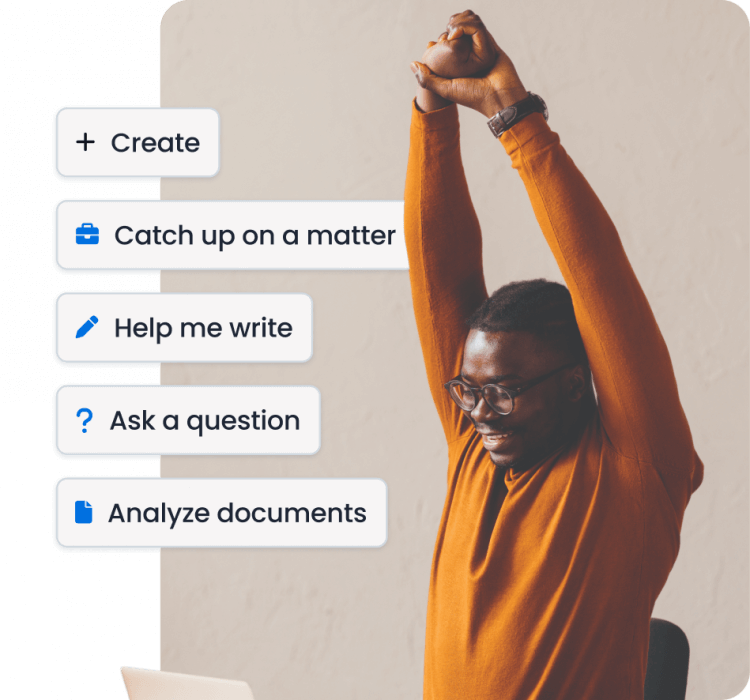
At launch in October 2024, Duo could retrieve matter and client details, summarize text documents, extract cited details, recommend priorities, create tasks and calendar events, draft messages, and show an audit log of its actions. It could return answers as prose or tables. The point was not a dazzling conversation. The point was completing the next dull step without leaving the page.
That placement solves the nuisance called context switching, but the more important gain is context itself. A blank chatbot needs a user to paste the history, explain the actors, and remove confidential details. Duo begins with the matter selected in Clio and follows the signed-in user's permissions. From inside a case, “summarize this matter” has an object. From the main dashboard, the same prompt can be vague. Clio's own prompt guide is candid about the difference.
The useful legal AI is not the one with the grandest vocabulary. It is the one that knows which John Doe you mean.
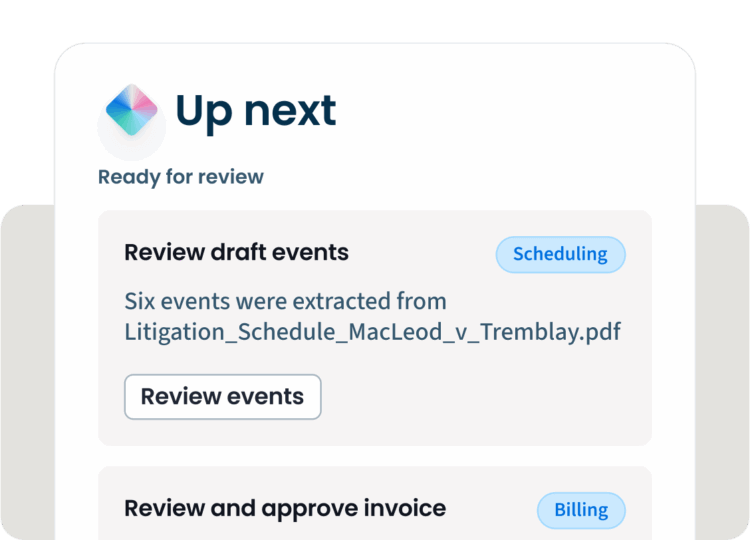
There is a good product lesson hiding here. The chat box is only the front door. The valuable machinery is retrieval, permissions, citations, and the ability to turn an answer into a record. Duo could create the task after discussing it. Current Manage AI goes further, extracting deadlines from court documents, placing proposed events beside their source, generating draft bills, and routing work for approval.
What it does well
| Job | Why it helps | Keep a human on |
|---|---|---|
| Matter catch-up | Condenses notes, activities, communications, and documents before a call or handoff. | Confirm the summary against the file when stakes are high. |
| Client drafts | Starts emails, texts, and portal messages using recent matter activity. | Tone, privilege, promises, and the final send. |
| Admin actions | Creates tasks, notes, events, expenses, and time entries through chat. | Dates, amounts, assignees, and billing judgment. |
| Firm questions | Surfaces counts, balances, and activity without a custom report. | Financial interpretation and decisions. |
| Document extraction | Finds names, dates, and details, then points back to sources. | Legal effect and completeness. |
Early-access feedback backs the ordinary-use thesis. Taylor Sellitto, a paralegal at Legler, Murphy & Battaglia, said Duo helped her “save up to 5 hours a week.” Other launch users singled out billing comparisons, instant data retrieval, and quicker client responses. These are vendor-selected testimonials, so treat the number as an example, not a benchmark. Still, the specificity is more persuasive than a vague claim about transformation.
The guardrails matter more than the sparkle
Legal software gets no free pass on confidentiality. Clio says its AI follows existing Manage permissions, does not use customer data to train external models, encrypts data in transit and at rest, and preserves regional storage. The event log gives administrators a record of actions. Current documentation says the log covers the preceding 90 days.
That is a serious baseline, not a reason to stop asking questions. Clio's current subprocessor list names several AI providers for Clio Manage, including AWS Bedrock, Anthropic, OpenAI, Google Vertex AI, and Microsoft Azure Foundry. A buyer should confirm which services touch its region and features, how prompts and outputs are retained, and whether client engagement terms need updating. The answers may differ from the stack behind the original 2024 release.
Clio also tells users to verify generated answers, especially before sending material to clients. Good. A citation is a route back to evidence, not a notarized guarantee. An automatically created deadline or time entry still needs review. The workflow is best understood as proposal, source check, approval.
Buy the context, not the chatbot
If your firm already keeps clean, current matters in Clio, Manage AI can remove genuine administrative drag. If your main problem is legal research, deep contract review, or live meeting transcription, buy for that job instead. Duo's native advantage does not magically make it every kind of legal AI.
How to get a useful answer
Duo rewards prompts that resemble good delegation. Name the matter, name the record type, set a time window, and request one result at a time. Clio advises breaking “summarize this case and draft a reply” into two steps. That sounds less futuristic, but it makes review easier and reduces ambiguity.
Start with read-only retrieval before allowing actions. Test ten representative matters, including an awkward one with restricted permissions. Have users record incorrect, incomplete, and surprisingly useful answers. Then decide which jobs deserve a repeatable prompt and which remain faster by hand. The goal is a dependable habit, not a launch-day demo.
Duo versus the crowded courtroom
Competitor lists often lump legal AI into one pile, but the jobs differ. MyCase IQ and Smokeball Archie are the closest idea: intelligence embedded in another practice-management home. CoCounsel and Lexis+ AI lean harder into research and professional work. Harvey targets larger legal teams with broad enterprise workflows. Spellbook meets lawyers in Microsoft Word for contract drafting and review.
The decision is less “Which AI is smartest?” and more “Where is the trusted record, and what happens after the answer?” A Clio firm may still pair Manage AI with a research or drafting specialist. A firm on another practice platform should count migration cost before being seduced by an embedded assistant.
A short, busy life under one name
Clio previews Duo at ClioCon and promises availability in 2024.
Duo launches publicly at ClioCon in Austin with matter chat, summaries, drafting, actions, and audit logging.
The assistant reaches APAC after early access in the region.
Clio unveils Manage AI, a broader workflow engine built from Duo's foundation.
AI becomes native to most Clio Manage plans, while Clio documents more scheduling, billing, and proactive actions.
Price and purchase checklist
The old Duo add-on is no longer the clean buying unit. Current Clio pricing starts at US$49 per user per month for Starter, while AI features are listed on Core and above. Clio asks buyers to request pricing for those plans, and regional packaging varies. Budget for implementation time as well as seats: permissions, matter hygiene, billing rules, and staff training decide whether the assistant saves five hours or merely creates five new things to inspect.
Before signing, ask for a feature-by-feature plan matrix; data processing and retention terms; the AI providers used in your region; admin controls; export and deletion behavior; and a demonstration using a workflow close to yours. Then ask the blunt question: who will own review when the proposed date, bill, or message is wrong?
Clio Duo's legacy is refreshingly concrete. It did not need to pretend to be a lawyer. It needed to remember what the lawyers had already put in Clio, fetch it quickly, and help move the file one sensible step forward. The new name is plainer. The idea remains sound.