The least cinematic moment in litigation arrives early. A complaint lands. Someone reads it line by line, finds the allegations, checks the court, hunts for approved language, copies old objections, formats an answer and starts the first round of discovery. It is exacting work. It is also the sort of work that can make a trained lawyer feel like an unusually expensive mail merge.
LegalMation built a company around that mismatch. Give its software the incoming document and the customer's own legal playbook; it produces a set of responsive drafts in minutes. The attorney still reviews, edits and owns the result. The machine simply makes sure the first move does not begin with a blinking cursor.
That distinction matters. Plenty of legal AI arrives as a chat window waiting for a clever question. LegalMation arrives as a production line. Its products cover complaint responses, written discovery, subpoenas, demand letters, matter profiling, case summaries, data analytics and deposition analysis. Each has an input, a known set of rules and an expected work product. The promise is not omniscience. It is throughput.
Three litigators went looking for leverage
James M. Lee came to the idea after leaving Quinn Emanuel and helping run a litigation boutique. Against larger firms, he has said, technology let the smaller shop operate like commandos while rivals brought armies. He founded LegalMation with fellow lawyers Thomas Suh and Enoch H. Liang in Los Angeles in 2017. Their advantage was not that they knew AI better than every engineer. It was that they knew which parts of a case made lawyers groan.
Early complaint response was the clean opening. In the company's 2018 Walmart announcement, the old process took six to ten hours. LegalMation said a PDF upload could yield a draft answer plus targeted requests for production, form interrogatories and special interrogatories in less than two minutes. That does not turn two minutes into a filed pleading; review remains essential. It does turn hours of assembly into a review task.
“Technology was a force multiplier for us.”James M. Lee, co-founder and CEO
A complaint, discovery request, demand letter, subpoena or transcript enters the workflow.
The system identifies claims, parties, requests and matter-specific details.
Jurisdictional rules and the customer's approved language shape the output.
A legal professional checks, edits and approves the draft before it travels.
Not a robot lawyer - a repeatable handoff
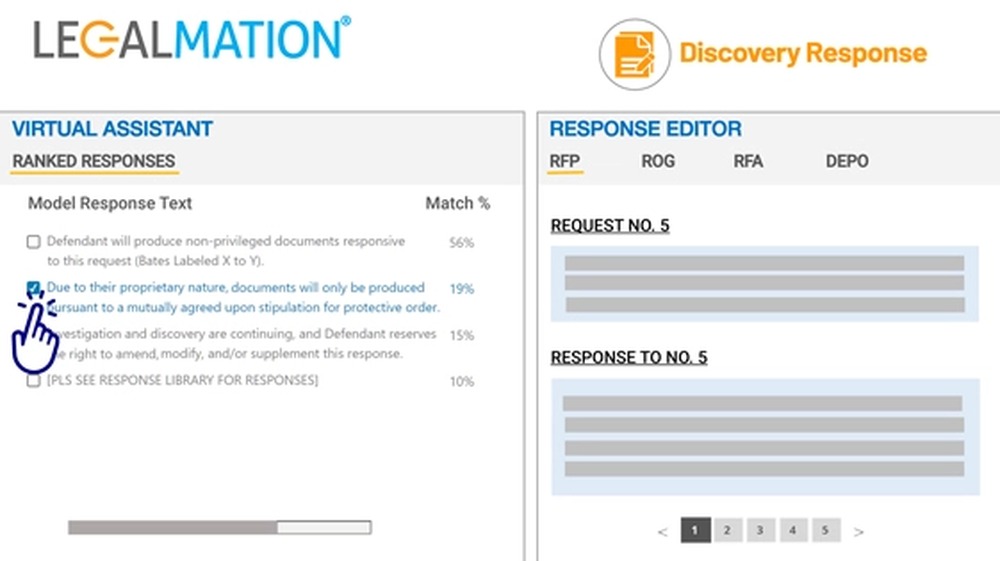
The core product, Response Creator, reads incoming litigation documents and assembles outgoing ones. Discovery Response handles interrogatories, document requests and admissions. Matter Profiling turns messy documents into categorized fields. Deposition Assistant synthesizes testimony across transcripts. Newer tools prepare demand-letter responses, including employment matters that begin with EEOC complaints. Analytics connects facts found in pleadings to billing and outcome data, making the archive useful for estimating cost and risk.
The customer is usually not a solo lawyer with one eccentric case. It is an insurance carrier defending similar accidents in dozens of states, a retailer receiving recurring claims, a manufacturer facing a wave of warranty matters, or a law firm expected to deliver consistent work across offices. LegalMation says it processes more than 100,000 matters each year. In 2023, customers used the platform to answer more than 1.1 million discovery requests across more than 30 state and federal jurisdictions.
Why the old work matters more than the new model
LegalMation began in the IBM Watson era and now discusses GPT-4 and model-agnostic systems. The model changed; the product thesis did not. Its defensible ingredient is the customer's institutional memory: previously approved responses, drafting preferences, matter facts, jurisdictional requirements and outcomes. A broad assistant can make a plausible paragraph. A workflow product must know which paragraph this insurer uses in this court, where it belongs and what document should come next.
That is the company's argument against the “GPT wrapper.” LegalMation is deliberately narrow and operational. It is designed around the artifact that leaves the system, not the conversation that happens inside it. Its competitor is therefore as much Microsoft Word, a shared drive and a junior associate's evening as it is Harvey, CoCounsel, Lexis+ AI, Alexi or Clearbrief.
The business model follows enterprise software logic: demonstrations, tailored implementation and recurring use by legal departments, carriers and firms. Pricing is negotiated, while the public sales case is framed in saved hours and avoided fees. Walmart reported up to 80 percent savings on outside-counsel fees for selected early-stage drafting. A top-five property and casualty carrier reported time savings of up to 80 percent after rolling Complaint Response across motor-vehicle litigation in more than 33 states.
Those numbers describe targeted workflows, not the entire legal budget. Still, they explain the $15 million Series A led by Aquiline Capital Partners in October 2023. Investors were paying for expansion into more workflows and more customers. LegalMation's website now advertises up to ten-times return on investment and forecasts more than $100 million in client savings in a year. Those are company claims, but they are usefully falsifiable claims. A buyer can count documents, time the before-and-after process and inspect the edits.
Volume exposes the copy-and-paste economy
The first failure in a claims surge is rarely a dazzling question of law. It is capacity. Intake stacks up. Secretaries and paralegals work overtime. Outside counsel recreate documents that the client has effectively paid for before. Style varies by firm. Deadlines get closer while experienced lawyers spend attention on assembly instead of judgment.
A public LegalMation example makes the pressure concrete: when California Lemon Law volume doubled for a major global automaker in 2024, the company used automated discovery responses and reduced response time to thousands of requests by at least half. The change of mind did not come from an abstract faith in AI. It came from a queue that people could no longer economically outrun.
Legal teams tolerate manual work when volume is stable. They reconsider when the next spike implies more headcount, more outside-counsel spend or less consistency. LegalMation sells readiness for that spike.
Walmart offers the cleanest picture of the organizational change. In selected matters, an in-house paralegal runs a new complaint through LegalMation and sends the resulting packet to outside counsel. Counsel starts with review and strategy, not document creation. One piece of software has changed the handoff - and therefore changed which hours are valuable enough to bill.
Partners carry the workflow through the building
Enterprise software does not implement itself, especially when the output can affect a lawsuit. LegalMation has used partnerships to bridge the distance between a working demo and an operating department. UnitedLex launched Digital First Draft powered by LegalMation in 2023, combining software with professional drafting services. In 2025, Consilio partnered with the company to identify repeatable workflows, redesign them, staff the transition and eventually hand a more efficient process back to the client.
Other relationships widened the product's reach: a RelativityOne-compatible fact-import app, an analytics collaboration involving Fisher Phillips and Thomson Reuters, and deployments with firms including Ogletree Deakins. The pattern is sensible. LegalMation brings the engine; a services or data partner helps map the tracks.
Recognition helped, too. LegalMation won the startup category at the inaugural American Legal Technology Awards in 2020. The Los Angeles City Attorney's Office adopted its document automation in 2021. Each reference account reduced a particular kind of risk for the next buyer: Will lawyers use it? Can government use it? Can it travel across states? Can it fit a large service operation?
Find a profession's least valuable expensive hour
The lesson for founders is not merely “add AI.” Start with a task whose input and output are recognizable. Gather the customer's approved examples. Encode the local rules. Automate the full handoff, including formatting and data extraction, instead of stopping at generated prose. Put a qualified human at the approval gate. Then measure minutes, edits, error rates and avoided spend.
There is also a sales lesson: lead with the bottleneck, not the model. LegalMation's strongest pitch is a complaint going in and a review-ready packet coming out. Buyers do not need to admire the architecture to understand the queue disappearing.
Where it clicks
- Large numbers of similar matters
- Reusable, approved work product
- Stable rules and document formats
- A lawyer available to review
Where it strains
- Novel, one-off disputes
- Scattered or poor-quality precedents
- No process owner or review capacity
- Work that depends on fresh advocacy
Under the wrong conditions, the economics weaken quickly. A bespoke case with little precedent offers less repetition to harvest. A firm with inconsistent templates has no clean institutional voice to reproduce. A team that treats generated text as final creates risk rather than leverage. And a low-volume practice may never save enough hours to justify an enterprise rollout.
LegalMation fits a specific corner of the legal AI market: defense-side workflow automation for organizations that can count their matters in hundreds or thousands. Its bet is that the future of legal work will not arrive as one all-knowing machine. It will arrive as a collection of disciplined systems, each taking an expensive routine off the desk and returning something a professional can judge.
That is less glamorous than a robot attorney. It is also much easier to put on a spreadsheet.