01 / A Philadelphia beginning
Priya Bhutani brought an idea to a startup weekend in Philadelphia in 2014. The useful part of the weekend was what came back: people who understood the problem wanted to sign up for the solution. Before there was much of a platform, there was a queue of interested potential users. For a business built around paperwork, that was a pleasing reversal of the usual arrangement.
She had been thinking about the idea before the event. Her work had taken her through product development and regulatory consulting, where a company’s plans for international expansion met a succession of local requirements. Each market brought another set of questions. Finding somebody who knew the answers could become a project in itself. Bhutani wanted to make that knowledge easier to reach.
Positive feedback encouraged her to pursue RegDesk. A beta version followed. Later that year she joined the DreamIt accelerator in Philadelphia, putting the young company into a setting where customer discovery was part of the daily work. Its early customers’ difficulties were concrete: delayed market entry, and the task of finding someone in another country who understood both the rules and the language.
By December 2014, she was describing a business that had started with four clients and roughly 50 users. She said it was providing services in 140 countries, with clients in Latin America and China and work involving consultants in Saudi Arabia. These were early figures, belonging to that moment in the company’s life. They show how quickly her question had acquired an international address book.
RegDesk stayed in the Philadelphia office where the accelerator had operated. Bhutani, then living in Bear, Delaware, after time in Chicago, was building a company whose geography stretched much further than its working space. The contrast is part of the appeal of this origin: a local weekend helped test an idea about a problem that kept crossing borders.
Beta launch · DreamIt
Renewal tools in development
machine learning
and AI workflows
Milestones in the idea’s development, rather than a company growth chart.
An engineer moves closer to the customer
Bhutani’s education gave her more than one way to look at a product. She earned a bachelor’s degree in biomedical engineering at the University of Illinois Urbana-Champaign, followed by a master’s in biomedical engineering from the University of Illinois, with honors. At Northwestern University, she completed another master’s, in quality assurance and regulatory sciences, and received a Distinguished Thesis Award.
Her career began as a product design engineer at Baxter. Engineering offered a view of how something gets made. She later moved toward marketing and sales because she wanted more contact with customers. That preference matters to the story: it moved her attention beyond the object being developed to the people trying to make a business around it.
She also served as a director of new business development, then spent five years as a global regulatory consultant before founding RegDesk. Across those roles, she encountered the distance between having a finished product and being ready to introduce it into another market. A development team could complete its work while the commercial plan still depended on information held elsewhere.
There is a familiar temptation in accounts of founders to make every earlier job look like a carefully placed stepping stone. Bhutani’s own explanation is more useful. She had seen the difficulties directly, and consulting showed her that they persisted across company sizes. Experience gave her a recurring problem to work on. Customers gave her a reason to keep working on it.
Her degrees and jobs connect two kinds of precision: making a product, and understanding the conditions under which a company can take it abroad. RegDesk emerged where those disciplines meet. The paperwork was already part of the business; she began asking whether the business could handle it differently.
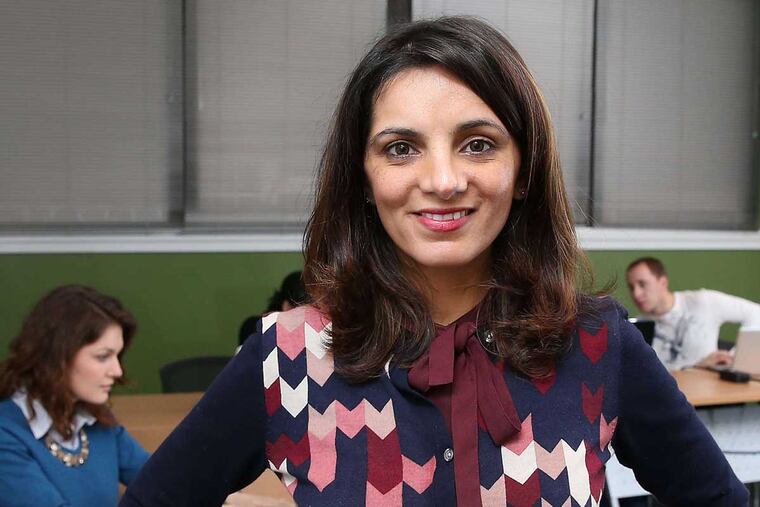
Opening the black box
In the early version of RegDesk, companies could find and hire local specialists through a web platform. Bhutani described the conventional search through personal networks as slow and expensive. “We bring speed and certainty,” she said in 2014. The promise addressed an awkward commercial experience: paying for advice while waiting to discover whether it would actually move a project forward.
The company soon began adding machinery around that exchange. In April 2015, it was preparing a product to automate license renewals. By the beginning of 2016, RegDesk offered a marketplace, intelligence from vetted experts, and alerts about changes affecting clients’ products and target markets. A five-person operations and development team was working from the University City Science Center.
That combination explains the shape of her ambition. An introduction to an expert could answer a question today. Alerts could tell a team when yesterday’s answer needed another look. Renewal tools could help the team act on deadlines. Bhutani was working her way from access to knowledge toward the repeated tasks that made the knowledge valuable.
She could be candid about the glamour quotient. In 2016, she called the venture “a very unsexy idea.” It is an excellent description for a company whose usefulness depends on matters that rarely receive applause. A renewal completed on time has limited theatrical potential. A missed one has rather more, usually of the expensive variety.
The harder task was persuading customers to change established habits. Elliot Menschik, who had led DreamIt’s Philadelphia program, pointed to that challenge in the company’s early years. Knowing a field well could win an investor’s confidence; adoption would require customers to trust a different way of working. Bhutani’s problem had a human component as well as a technical one.
“We bring speed and certainty.”Priya Bhutani, 2014
Philadelphia supplied more than office space
The company’s early support came with people attached. Bhutani was selected as one of the Alliance of Women Entrepreneurs’ three 2015 fellows, alongside Allison Berliner of PopInShop and Senem Guney of NarrativeDx. All three had been through DreamIt. The fellowship offered mentoring and coaching, adding another circle around the work of building a software company.
The Science Center became another important connection. Bhutani has described the difficulty of getting an initial meeting with a large company. When RegDesk was preparing to knock on doors and make cold calls, it received a slot to present at a Science Center event hosted by a large industry company. The opportunity put the young business in front of people it wanted to reach.
Her appreciation for Eamon Gallagher, associated with the ic@3401 incubator, was similarly specific. He helped create introductions to the wider business community. Quorum, the nearby events and networking space, brought RegDesk into contact with potential industry connections. She valued these encounters for their direct usefulness, rather than treating community as a pleasant decoration around the serious business.
By 2019, RegDesk was described as an ic@3401 company, a graduate of the Science Center’s third Digital Health Accelerator cohort, and a participant in its first Global Startup Accelerator. Those affiliations chart a period of development through Philadelphia’s startup institutions. They also keep the founder story honest: building alone makes for a tidy legend, while introductions make for actual meetings.
A company promising to organize faraway expertise was itself benefiting from a nearby network. The symmetry is instructive. Bhutani understood that finding the right person could change the pace of work. She was trying to give customers a more repeatable version of something that had helped her own business.
The answer needs another pair of eyes
By 2017, Bhutani was making a distinction between introducing companies to consultants and producing intelligence they could use. RegDesk’s approach drew on multiple specialists within a country and used peer review. The aim was to check an answer before passing it along, with visibility into the experts who contributed.
She said recruiting an expert community had been less difficult than ensuring its members knew the relevant product area. The observation is refreshingly practical. An impressive directory can be full of people who are impressive in the wrong specialty. Matching knowledge to a particular question is where a directory has to become a working system.
Machine learning was already part of her description of RegDesk at that time. Her stated ambition was to make it a trusted platform for intelligence and help companies anticipate risks as they planned market entry. The technology could change, but the requirement for useful, checked information would remain. Confidence had to come from how an answer was assembled.
This is also a way of reading her career. Engineering, customer contact, consulting, and company building each brought her closer to the point where information becomes a decision. She was interested in the handoff: who knows, who checks, who needs to act. A software platform has to make those relationships work repeatedly, after the first helpful conversation is over.
Specialists in the relevant market and product area
Multiple contributors and peer review
Information a team can use in planning
A conceptual view of the approach Bhutani described in 2017.
A different job for the information
In May 2026, Bhutani discussed RegDesk’s development on the SourceForge podcast with Beau Hamilton. The conversation returned to familiar terrain: manual work, fragmented information, and the effort of preparing submissions for different markets. She described the work in four parts: plan, build, track, and maintain. The sequence gives the company’s software a job beyond storing documents.
Her recent public writing also asks what happens before a submission reaches an authority. Disconnected teams, repeated tasks, manual processes, and information that is difficult to find can consume time inside the company. It is a pointed question for a founder who began by helping customers find expertise elsewhere: how much delay is being manufactured at home?
She advocates reusing submission content, making information more consistent across markets, and keeping regulatory professionals in control of the final output when AI assists the work. Her emphasis on human review fits the earlier interest in peer review. Assistance is useful when the people responsible can still examine what the system has produced.
Bhutani now appears publicly as Priya Paul (Bhutani) on LinkedIn, while her RegDesk author biography uses Priya Bhutani. The professional thread is continuous: founder and CEO, still explaining why the work deserves better tools. Her current argument gives regulatory teams a larger place in business decisions about growth, resources, timelines, and risk.
There is an appealing lack of ornament in the original proposition. People knew things. Other people needed to know them. Too much time disappeared between the two. A weekend supplied enough encouragement to begin, and the years that followed added colleagues, introductions, checks, alerts, and software. Bhutani’s subject may be paperwork, but her recurring question is about people: what would let them get on with the work?