At 5:30 in the afternoon, a presentation can become a very expensive object. The analysis is finished. The meeting is tomorrow. Someone still has to make the charts legible, tame the bullet points and persuade the fonts to behave. PREZENTIUM built a company around this awkward hour. Its proposition is wonderfully literal: hand over the draft, sleep, open the finished slides in the morning.
- The promise: overnight presentation design, with a published guarantee for up to 20 slides.
- The customer: enterprise teams, especially in life sciences, healthcare and technology.
- The turn: Prezent acquired its services partner in October 2025, combining AI with human expertise.
The deadline is the product
The revealing detail lives in the FAQ. Submit by 5:30 p.m. Pacific and receive polished slides by 9:30 a.m. the next business day. More than 20 slides may require another business day. There is something reassuring about the limit. A promise becomes easier to buy when you can see its edges.
That gives PREZENTIUM a specific place in the presentation market. A template offers a starting point. A designer offers craft. This service also offers a handoff with a clock attached. The customer can budget an evening around it. For a manager with a morning review, that predictability is part of the purchase.
The company describes its work as a combination of business understanding, visual design and data science. Its examples include corporate priorities, workshop notes, sales meetings and all-hands presentations. These are recurring jobs inside large organizations. A quarterly update needs attention even when nobody would describe it as a creative project.
The problem arrived before the software
Founder Deepti Juturu knew that routine from life sciences. Her background includes Genentech, McKinsey and ZS Associates. In her account of starting PREZENTIUM, she recalled the pressure of executive reviews, launch-readiness reviews and town halls. Agencies felt slow and expensive; internal teams and occasional contractors were stretched and inconsistent. Those were the shortcomings she set out to address.
The origin matters because the customer’s difficulty was already visible. There was work to finish, a deadline to meet and inadequate help. PREZENTIUM could begin by doing the job, then learn which parts kept repeating. Business directories and its LinkedIn profile list a 2016 founding; Juturu’s later recollection describes early customers arriving in 2017.

Her husband and co-founder, Rajat Mishra, later described the services business as a way to test whether communication help was something enterprises would actually pay for. In a 2024 interview, he said its customer relationships gave the newly founded Prezent access to enterprise feedback while testing more than 20 software prototypes in 2021. The workbench came with customers.
The humans got acquired
On October 13, 2025, Prezent announced that it had acquired PREZENTIUM in a cash-plus-equity transaction. The companies had already worked together as go-to-market partners. The stated direction was to join presentation expertise with AI, extending the overnight service and developing additional services.
“We have been GTM partners for a while and share the same customer obsession.”
Deepti Juturu · acquisition announcement, October 2025
Read as a business decision, the deal puts value on relationships and delivery experience alongside software. That is an interpretation of the combination, rather than a claim that automation had failed. Enterprise buyers already had people handling their presentations. An AI platform could join that relationship and help deliver the work.
The financial distinction is useful. Prezent announced $30 million in financing alongside the acquisition. That was funding for the acquirer. It was neither PREZENTIUM’s disclosed purchase price nor a funding round for the services company. The announcement described how ownership changed without putting a public dollar figure on the transaction.
What you are actually buying
PREZENTIUM’s public pricing page describes annual membership per person, with services billed by the hour. Its offer reaches beyond overnight polishing. Presentation specialists can attend meetings, turn notes into slides, discuss ideas one-to-one and develop templates. A team that needs help deciding what to say can therefore buy a more involved engagement.
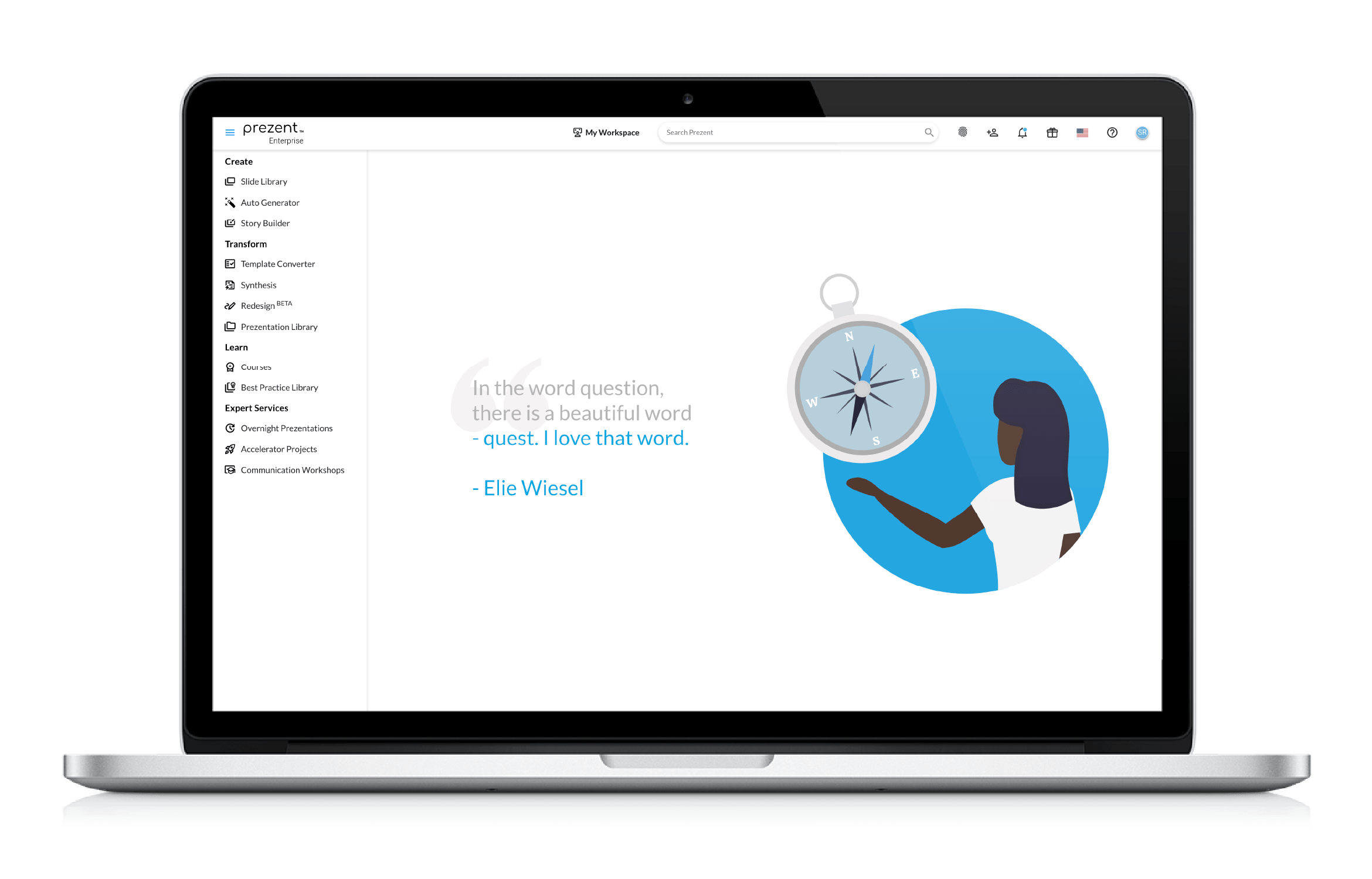
Zenith Learning addresses another part of the job. Its catalog lists four skill areas and 12 courses, spanning problem definition, structured analysis, storytelling, data visualization and delivery. There is even a course called “Be Effortlessly Cool Like Clooney.” An ambitious syllabus for anyone whose last presentation began with an apology for the projector.
The company reports more than two million slides, 50,000 presentations and 50 Fortune 200 customers. Those are company figures. They describe an enterprise production business with repeated demand. Its alternatives include presentation agencies such as 24Slides, SlideGenius and BrightCarbon, as well as internal teams. The buying decision turns on how much support the brief requires and when the work must return.
There is operational work behind the promise, too. The FAQ describes a two-month employee training program that includes confidentiality, and a process for retaining customer brand guidelines. Those details help explain the difference between assigning one deck and building a repeatable service. Each new request should require less explanation of the same house rules. For the buyer, the useful question is whether the supplier understands the company well enough to reduce supervision over time. Speed has less value if every morning begins with another round of basic corrections.
A better brief, a quieter evening
There is a practical lesson here even for readers who never become customers. Separate the argument from its production. Establish the decision the audience needs to make. Supply the evidence, brand guidelines and instructions. Then give the person doing the design a defined deliverable and enough time to finish it.
The limits follow from that workflow. A disputed recommendation still needs an owner. A large deck needs a different schedule. PREZENTIUM asks for brand guidelines or an example with the first request; someone must provide them. These are reasons to prepare the handoff carefully, or involve a specialist earlier, rather than expect overnight design to settle every open question.
There is also a second measure of output. Through Presentations with Heart, PREZENTIUM says it donates $1 per slide to children’s charity, naming partners in Uganda, India and the United States. The unit is suitably concrete. A business built around finishing the next slide has made that same slide count toward another purpose.