Before Prescott Nasser helped build a company for finding companies, he was helping people find their way around a software project. In February 2011, an Apache Lucene.Net issue recorded two website-layout files he had uploaded. By early March, the issue was marked resolved. A small piece of housekeeping, preserved with the solemn precision that software gives to everything, including housekeeping.
There is something useful about starting there. The later résumé has founders, chief executives, investment firms and an acquisition. The earlier record has a person fixing the entrance. Lucene.Net brings text-search technology to the .NET world. Even a search engine needs a website people can navigate. Someone has to attend to the unglamorous parts before the impressive parts become useful.
Nasser’s career offers several variations on that problem. Private companies leave clues in awkward places. Bond offerings arrive through different channels. Investment teams accumulate information that needs cleaning before anyone can sensibly act on it. His businesses have worked on making such material easier to find, compare and use. Read across those projects, and the apparent collection of jobs begins to resemble a sustained interest.
A search engineer before the search business
The Lucene.Net incubation proposal described Nasser as a product manager and lead software developer working on back-office workflow and process automation at a major American financial institution. It also recorded contributions of patches, documentation and website improvements. That is an unusually concrete early portrait: code, instructions and the practical question of how work moves through an organization.
In 2012, Lucene.Net graduated from Apache’s incubator to become a top-level project. Nasser discussed its development plans, including the relationship between the .NET releases and their Java counterparts. The engineering questions were about compatibility, conventions and what a smaller contributor community could maintain. Ambition had to fit the available hands.
His education supplied another strand. He earned a bachelor’s degree in cognitive science at the University of California, Berkeley. An earlier professional biography describes an emphasis on artificial intelligence and work at Charles Schwab on internal process optimization, followed by engineering leadership at Prosper Marketplace. Finance and software were already sharing the same desk.
The financial side was substantial enough to come with examinations. His public professional record includes Series 7, 24, 27 and 66 qualifications. Coit Capital Securities describes him as an engineer with a financial-services bent and lists him as a managing director. The phrasing is economical. It also explains why he could recognize a workflow problem as both a technical assignment and a business opportunity.
A childhood friend, an overlooked list
The Sourcescrub problem began with Tyler Fair. In 2014, while building business development at Serent Capital, Fair needed information about private businesses that had grown without outside investment. He organized researchers to assemble it, then connected with Nasser, a childhood friend with investment-banking experience. Together they put a technology platform around the research. Sourcescrub dates its founding to 2015.
Their observation concerned the moment at which a business became visible. Investment databases could acquire information when a company raised money or changed hands. A company that had done neither could still be operating, hiring and attending industry events. The transaction had not happened; the business plainly had.
Trade-show exhibitor lists, buyers’ guides and industry publications offered another route in. They were records made for other purposes, carrying evidence that an investment professional might find useful. Sourcescrub combined technology with human checking to organize that evidence. Its own early years were bootstrapped, an appropriate arrangement for a company helping investors discover other bootstrapped businesses.
The distinction has consequences beyond a database. A list reflects the event that caused someone to make it. Change the event, and a different set of companies appears. Fair and Nasser built around that change of perspective. A conference roster, usually destined for a tote bag, could become the beginning of a research assignment.
Buyers’ guides
Industry publications
human validation
and track companies
The customer who stayed for the equity
Mainsail Partners began using Sourcescrub in 2015. In November 2019, the customer became a growth-equity investor. Nasser was identified then as co-founder and CTO. He described Mainsail as an early, intensive user whose feedback had helped shape the product. Several years of use preceded the investment decision.
At that point, Sourcescrub served hundreds of customers. Its tools let users prepare research before conferences and move company records into customer-relationship systems. The capital was intended to support product work, customer success and expansion. These were ordinary operating needs, which is rather the point: a promising research idea had become a business with customers expecting it to work on Monday.
Francisco Partners announced a further growth investment in September 2021. Nasser’s title in that announcement was co-founder and president. The company reported coverage of 1.7 million businesses and more than 160 million private-company data points. Existing investor Mainsail, the founders and management were to retain significant equity interests.
The numbers describe the platform at a particular date. The more revealing detail is how the data was assembled: conference lists sat alongside job postings, classifications and other records. Expanding the collection meant keeping that assortment useful. More information creates more things to reconcile, as anyone who has ever combined two address books will appreciate.
Meanwhile, there were bonds
Sourcescrub was one part of Nasser’s working life. He also co-founded 280 CapMarkets in 2016. In August 2017, the company announced him as chief technology officer, responsible for the cloud software and network design behind its technology operation. The stated objectives were better bond-price transparency and trade execution for wealth advisers.
The resemblance to his other business is an editorial reading of the work: both projects brought scattered financial information into a form a professional could use. The underlying markets were different. So were the transactions. The recurring task was to make a fragmented view more usable before a decision had to be made.
At FinovateSpring in 2018, Nasser was listed among the presenters for BondNav, alongside co-founders Gurinder Ahluwalia and Dave Rudd. The platform brought multiple sources of bond data onto one screen. It combined pre-trade information with post-trade documentation and access to a capital-markets team. The product description joined software and human service in the same offering.
In July 2021, Incapital and 280 CapMarkets completed their merger into InspereX. Nasser became CTO of the combined firm. That placed him on the technology side of a merger while Sourcescrub was approaching another investment. His career chronology has overlapping lines; a single neat ladder would make a poor diagram.
- 2015Sourcescrub is founded
- 2016280 CapMarkets is founded
- 2021InspereX merger completes; Francisco Partners invests in Sourcescrub
- 2024Nasser returns as Sourcescrub CEO
- 2025Datasite announces the Sourcescrub acquisition
- 2026Nasser joins Mainsail as CTO-in-Residence
Coffee, skepticism and the return to the chair
The personal details fit that overlapping schedule. In a 2024 founder conversation, Nasser recalled reconnecting with his co-founder on public transportation. He described himself as practical, approachable and a fast learner. He also remembered standing coffee hours where employees could talk freely with him. Titles, in that account, were less interesting than conversation.
He spoke of reading, skiing around Tahoe and coding with television in the background. His approach to founding businesses had allowed him to keep several responsibilities rather than make one sudden leap. This is a more particular picture than the customary founder portrait: a commuter encounter, an open coffee hour, a television sharing attention with code.
September 2024 brought a return to a full-time operating role at Sourcescrub, this time as CEO. Nasser succeeded Jim Obsitnik, who had been appointed in January 2023. The company was introducing new products, including conference-planning capabilities. The appointment put a co-founder back in charge of a business whose original raw material included conference lists.
There was a certain circularity to that moment. The technical co-founder had worked across product, finance and another company’s integration. Now he returned to run the organization built with his childhood friend. A familiar problem had acquired more customers, more data and a larger set of responsibilities.
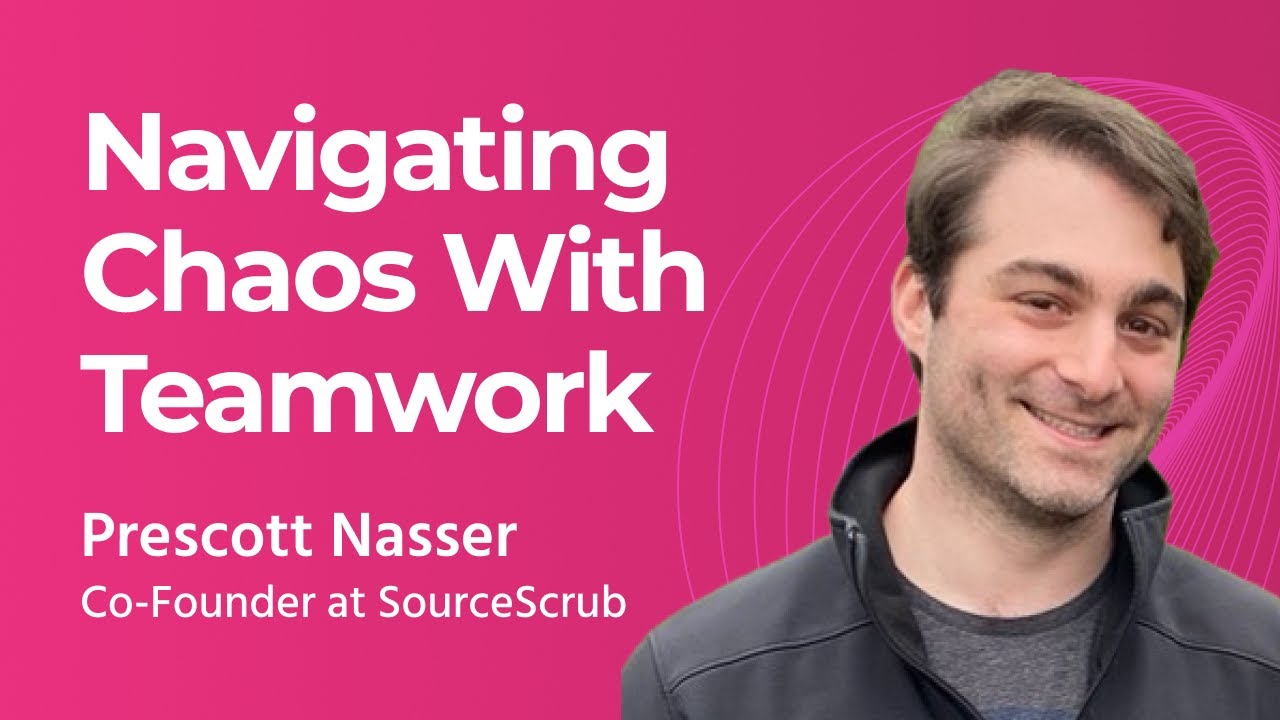 WATCH THE CONVERSATION ↗
The data still needs washing
By May 2025, Nasser was discussing AI in deal sourcing with Filament Syfter’s Martin Pomeroy. His emphasis was on the underlying information: providers still needed to clean and aggregate data before other systems could use it. Sourcescrub had already used machine learning behind the scenes for years. A more conversational interface did not remove the preparation.
That position follows naturally from the work. A system can answer quickly while answering from a poor record. It can summarize a mistaken company description with impeccable grammar. For an investment team, the useful question remains whether the information supports the next decision. Speed makes that question more urgent because errors can travel faster, too.
Nasser also defended the role of personal contact in choosing a business partner. His argument gave technology plenty to do while leaving a consequential judgment with people: how someone feels about the person across the table. Discovery and relationship-building occupy different parts of a deal, even when software connects them.
“It’s quality and quality out.”
Prescott Nasser · May 2025
An old customer becomes the next workplace
On August 8, 2025, Datasite announced its acquisition of Sourcescrub from Francisco Partners and plans to integrate its data and capabilities into Grata. The announcement described Sourcescrub as drawing on more than 220,000 information sources for insights on 16 million companies. Nasser welcomed the combination’s potential to improve the customer experience, dataset and network.
For him, the next documented chapter arrived in 2026 at Mainsail Partners as CTO-in-Residence. His remit includes internal technology and AI, along with helping portfolio technology, product and executive leaders build their engineering and product functions. Mainsail lists Zephyr Cove, Nevada, as his home base and Texo among his current board responsibilities.
The relationship has now passed through three forms: customer, investor and workplace. Each involved seeing the same operation from a different seat. That continuity is a useful ending for a career so often occupied with making connections between things that already existed.
Back in 2011, the task was a website layout. Later it was the private business missing from a familiar database, or the bond offering an adviser needed to compare. The scale changed. The practical invitation survived: look again, arrange what you find, and make the next person’s work a little easier.