George Gould knew the sort of company he wanted. Finding it was another matter. At Azul, the Java software business, an acquisition search could begin with something specific: developer productivity, perhaps, or continuous integration. A web search produced names. Then came the searches after the search: LinkedIn for employees, Crunchbase for funding, another website for context. A promising lead arrived with homework attached.
- Grata helps deal teams find and screen private companies.
- Its advantage is putting scattered information into a usable search.
- Under Datasite, it is expanding from discovery into deal workflows.
In Grata’s Azul case study, Gould describes wanting to shrink hundreds of possibilities into a handful worth investigating. Grata combined company descriptions with size and funding filters. Azul says that avoided a sourcing hire, framed in the case study as $120,000 a year. Treat that as one customer’s account of an avoided cost. The interesting part is the task: eliminate unsuitable companies before they consume everyone else’s attention.
The search after the search
Grata sells private-market intelligence to people whose work begins with a deceptively simple question: which businesses should we approach? Private equity investors need acquisition targets. Investment bankers need prospective clients and buyers. Corporate development teams need businesses that complement a product line. Consultants need a defensible picture of an industry. They all need names, but names alone leave most of the work undone.
A category such as software can contain thousands of irrelevant candidates. Descriptions of what a business actually does are more revealing. Grata uses web acquisition technology, machine learning, and natural language processing to turn unstructured company information into searchable profiles. Users can explore keywords and similar companies, then narrow by attributes such as ownership, geography, and size. Its newer Agentic Search lets them describe a thesis in ordinary language and refine the search through conversation.
There is a second problem underneath discovery: deciding whether two records describe the same business, whether a headcount is stale, and which source deserves confidence. Grata describes a process of standardization, cleaning, anomaly detection, and reconciliation, with human reviewers checking inconsistencies. That is part of the product’s expertise. Search needs information that can be compared, rather than merely collected.
The valuable thing was already public
Harvard classmates Andrew Bocskocsky and Nevin Raj launched Grata in 2016 after encountering the research problem in their own work. Early customers received prospect lists. Eventually, customers could run searches themselves. By the October 2020 seed announcement, the founders said they had bootstrapped the business to more than 100 customers. A $3.2 million round led by Bling Capital would help expand the technology and team.
Raj’s account of the early thinking is more instructive than the financing. He initially believed the business needed information nobody else possessed. In a 2022 Think Like an Owner interview, he explained that collecting and organizing public material could be valuable enough. Customers were paying to get a job done. A company’s website could be public while the useful answer remained difficult to assemble.
“You just need to collect, organize, and distill information for people to help them get a job done.”
Nevin Raj · Think Like an Owner · 2022
That insight gives Grata a place among company databases and research tools. PitchBook, Capital IQ, Crunchbase, and manual web research overlap with pieces of the job. Grata’s proposition centers on discovering private businesses and moving quickly into screening. The distinction matters most when an investment idea describes a narrow activity that a broad industry label handles badly.

A shortlist with somewhere to go
Copley Equity Partners supplies another useful detail. Its team wanted to spend less time hunting for companies and more time talking to them. Grata’s case study says feedback from Copley and other customers helped prompt a DealCloud integration. The search result needed somewhere to go. Putting company information inside the relationship system reduced another handoff.
Today, the offering stretches across market mapping, transaction comparisons, executive contacts, conference research, buyer lists, and pipeline management. API, data warehouse, and MCP connections bring information into other systems. The business model is subscription software and data access: Growth, Scale, and Alpha packages, sold through a demo and quotation process, with optional modules.
Grata’s stated values include transparency, growth, excellence, and community. More concrete is the anniversary account of a company-wide logo contest and small office upgrades. Those details suggest a team finding its shape while the product found its audience. In February 2022, a $25 million Series A led by Craft Ventures brought reported total funding to $35 million.
Follow the deal, not just the data
Datasite acquired Grata in June 2025. Alongside the announcement, controlling shareholder CapVest outlined an intended $500 million investment in Datasite’s intelligence expansion. That figure describes a broader commitment, including acquisitions and organic growth. It should not be read as Grata’s purchase price.
The subsequent acquisitions explain the direction. Blueflame added agentic AI. Sourcescrub brought sourcing research and workflows for integration into Grata. Valu8 added European company intelligence. By July 2026, Grata reported coverage exceeding 23 million companies and customer organizations in 26 countries. These are company-reported measures of reach, rather than proof that every record answers every question.
On October 15, 2026, Grata introduced Grata Intelligence, connecting its market data with firm knowledge, virtual data room content, and Blueflame 5.1. Research, monitoring, projects, and repeatable tasks could share more context. The commercial logic is clear: after helping a team identify an opportunity, remain useful as the team investigates it.
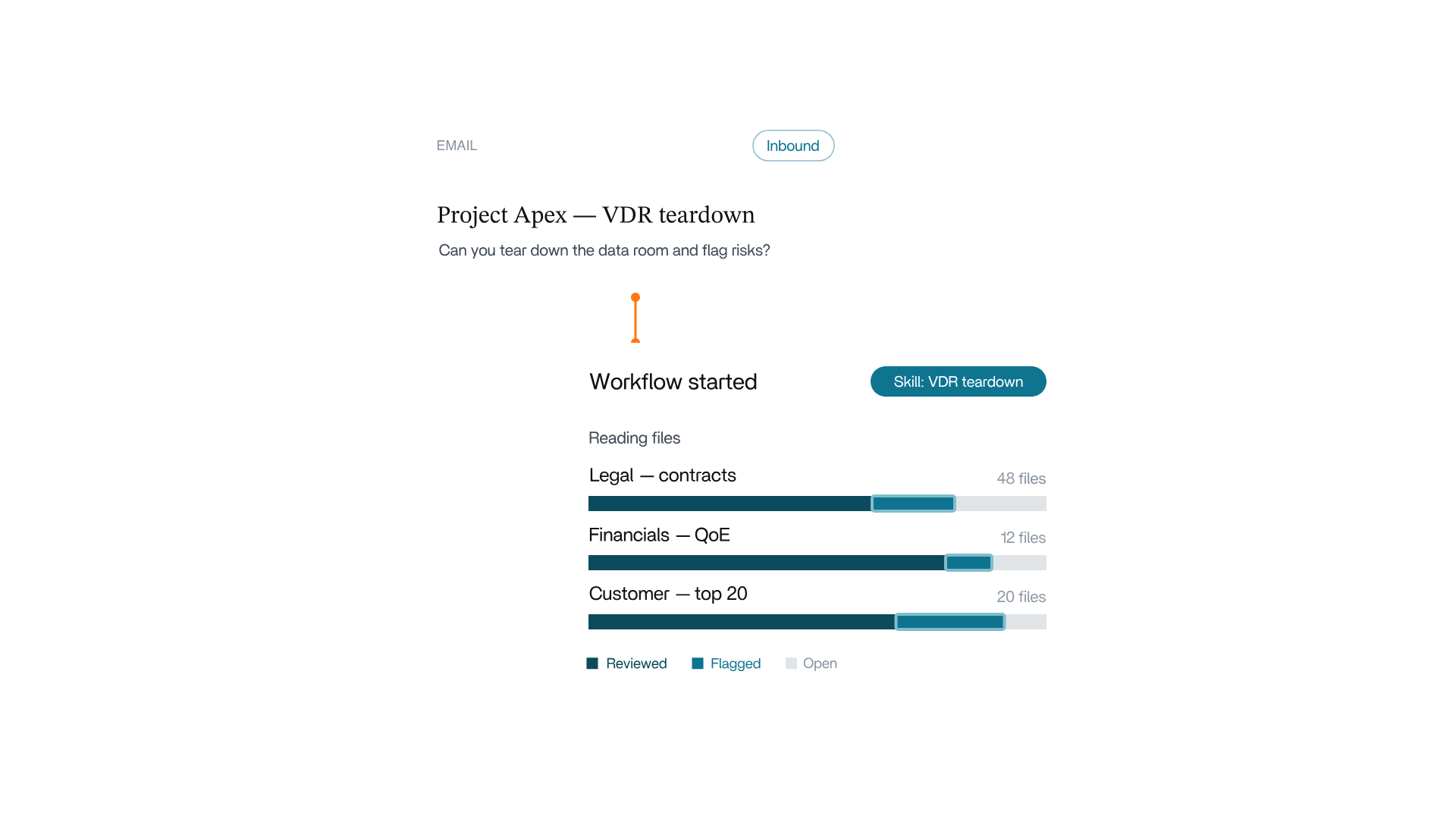
Consider the difference between a company profile and an active mandate. The first describes a business; the second concerns an actual transaction opportunity. Grata offers both company discovery and a network of mandates, alongside seller-intent signals. A team can use those tools for different stages of sourcing. Mixing them up would make a large database look like a queue of willing sellers, which it is not.
The useful part you can copy
Begin with the criteria that would make a company worth a conversation. Use discovery to test those criteria. Check the evidence, connect the shortlist to the relationship system, and revise it as conditions change. More records help only if the next decision becomes easier.
There are limits. Grata describes inferring some financial information because private companies often disclose little. An estimate helps screen; accounts and diligence must carry the investment decision. A relevant business may have no interest in selling. The useful result is a better-informed first conversation. Gould’s original problem ends there: with fewer tabs open, and a more worthwhile question to ask.