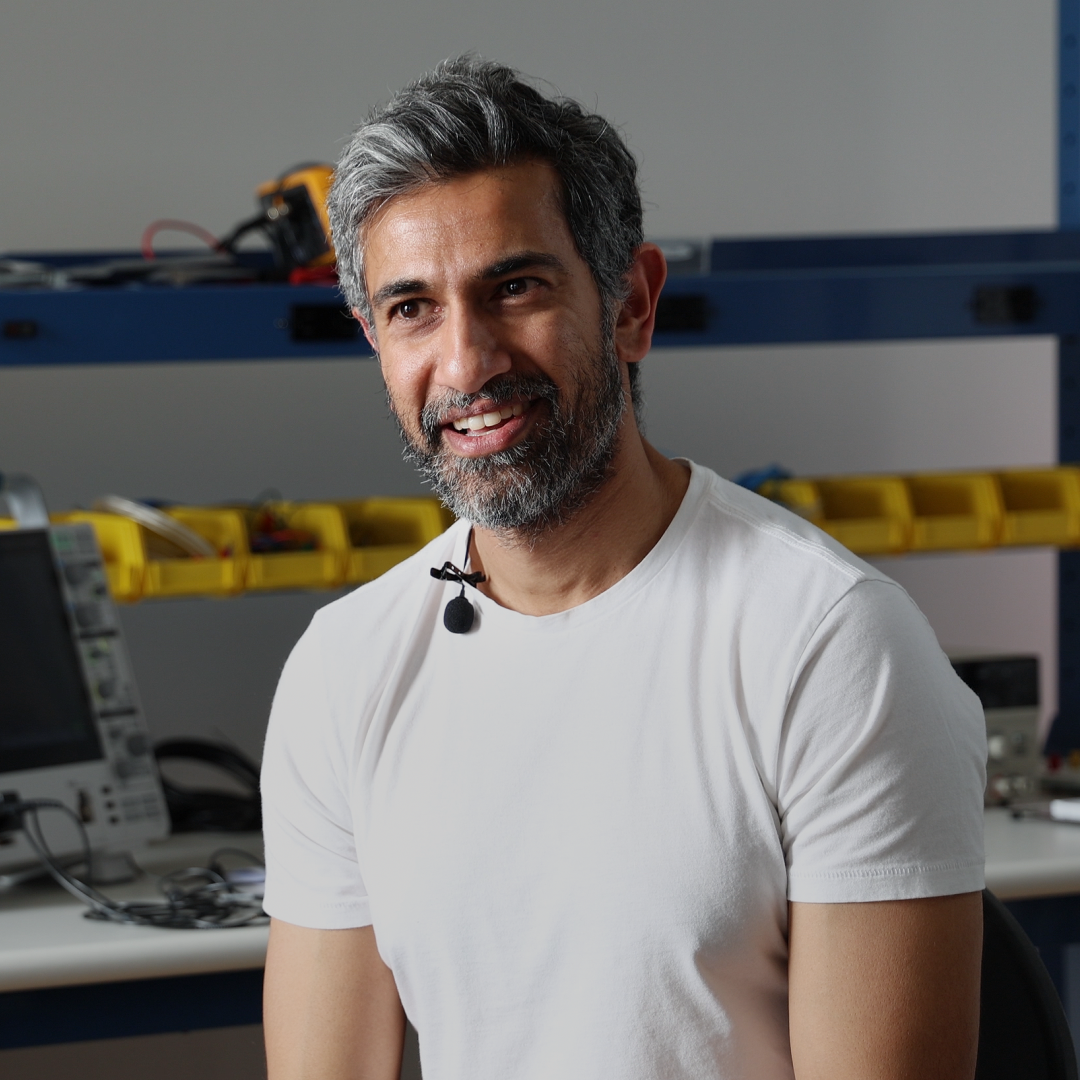
Teaching a machine to wrestle electrons
Atlas reads a schematic the way a senior engineer does — and then it argues with you. Point it at a circuit board and it will tell you how the thing should behave, run a thousand simulations across conditions you would never have time to try by hand, write the test plan, and pull in the readings from oscilloscopes, logic analyzers and thermal cameras. That is the product Pratap Ranade has spent the last five years building at Arena. He calls it an AI hardware engineer, and he means it almost literally.
The pitch is not abstract. Arena says teams using Atlas cut engineering person-hours by roughly a third, ship 65% faster, and squeeze a few points of quality out of products that already work. AMD piloted it in 2023 to test Radeon GPUs. Bausch + Lomb uses it. So do defense and aerospace shops — the company spent years embedded in the guts of complex machines at places like Anduril and Sivers Semiconductors before it ever said the word "launch" out loud.
What makes Ranade interesting is where the idea came from. Most AI founders are software people who discovered a market. He is a physicist who discovered that the tools physicists and hardware engineers actually use are stuck in another era — and that the people doing the hardest engineering on the planet are still, in his words, wrestling electrons at a raw level with old software.
"Most programmers are using a language that's abstracted away so much of the hard stuff, they're not even dealing with how the computer works. On the hardware side, you literally have people wrestling with electrons at a pretty raw level with old tools."
The bad experimental physicist
Ranade studied physics at Stanford, then went to Columbia for a master's and a doctorate. He was deep into a PhD when he walked away. The reason he gives is unusually honest: the experiments demanded that he be a good electrical engineer, a good mechanical engineer, and, he jokes, a good plumber — and he was none of those things. The physics was the easy part. The hardware was the wall.
That frustration sat in the back of his head for over a decade while he did other things. He went to McKinsey and made associate partner. He co-founded Kimono Labs, an AI and data company that grew to 130,000 users on backing from Peter Thiel, Sam Altman, Max Levchin and Y Combinator — and got acquired by Palantir. At Palantir he met the co-founder he would later start Arena with. Then he ran engineering and machine learning at Enigma, rebuilding the team to around 75 people and launching its flagship product.
"Arena is finally solving problems that I had as an experimental physicist. I spent most of my time building physical hardware and I was bad at it."
So Arena is less a pivot than a return. Every job in between — the consulting, the data startup, the Palantir acquisition, the machine-learning team at Enigma — reads in hindsight like preparation for the company he founded in 2020 to go fix the thing that beat him in graduate school.
From enterprise decisions to electromagnetic superintelligence
Arena began as a broader idea — applying machine learning to the messy physical world and to enterprise decision-making. Over time it narrowed and sharpened into something far more specific and far more ambitious: an AI that builds genuine intuition for electromagnetism. The company now frames its mission, under the Arena Physica banner, as "electromagnetic superintelligence," with a beta product called Atlas RF Studio aimed squarely at radio-frequency design.
Ranade is careful about how the AI learns. The advances in large language models, he says, give Atlas a starting point — the accumulated body of electrical-engineering knowledge, the schematics, the manuals — but not a finish line. The real value comes from the system interacting with the physical test environment and learning from it, the way a person at a bench does. Start from the literature; finish in the lab.
"You can take the body of knowledge we have around electrical engineering, all of the schematics, and start from somewhere. But that's not where you finish. That gives us the starting point."
The April 2025 Series B — $30 million led by Initialized, Fifth Down Capital and Goldcrest Capital, with Founders Fund, Shield Capital and Garuda Ventures along for the ride — was the moment Arena stopped being quiet. The cap table tells you who believes the physical world is the next frontier for AI: Peter Thiel (again), Ryan Petersen, and General David Petraeus among them. The next chapter Ranade has hinted at is Atlas Edge: putting the model directly onto machines so they can diagnose and, eventually, repair themselves.
It is a strange and specific ambition — an AI that understands derating curves and tolerance stacks and the way a board warms up under load. But strange and specific is the point. Ranade is not trying to write another chatbot. He is trying to give a few thousand of the world's best engineers the assistant he wishes he'd had at a Columbia lab bench, back when the electrons kept winning.
Footnotes
Both of his startups attracted Peter Thiel as a backer. Lightning, it turns out, can strike a cap table twice.
Kimono Labs sold to Palantir — and Palantir is where he met the co-founder he'd later build Arena with. The exit was also a hiring event.
He left a Columbia physics PhD for McKinsey, then left McKinsey to start companies. The straight line was never the plan.
Arena's stack runs from oscilloscopes and thermal cameras on one end to large language models on the other — the very physical talking to the very abstract.