The machine at the center of Power Support Partners' business is designed to do nothing most of the time. A standby generator waits beside a house through ordinary Tuesdays, then starts itself when the grid stops. The company around it has the opposite assignment: stay busy every day. Find the homeowner. Size the load. Plan the fuel. Pull the permit. Recruit the electrician. Install the transfer switch. Answer the phone. Return for maintenance. Be ready before the forecast turns ugly.
That contradiction explains the Atlanta company's strategy. Power Support Partners buys and operates local generator and electrical-service businesses across the Southeast, then gives them a central team for the work that is easy to neglect and expensive to rebuild in every market. The field brands remain regional: Premier Generators serves Georgia and Tennessee; Bo's Generators operates in Florida. Behind them sits a support center covering operations, marketing, recruiting, training, finance, accounting, technology, shared knowledge and business analytics.
This is a roll-up, but not the kind that exists mainly as a spreadsheet. Its employees climb into homes, inspect panels, pour pads, route fuel lines, wire automatic transfer switches and service engines. Its Florida operation also appears in public purchasing records for generator maintenance and repair. The pitch to local operators is scale made useful - more technicians, cleaner systems, stronger lead generation and a wider bench when a storm puts the network under pressure.
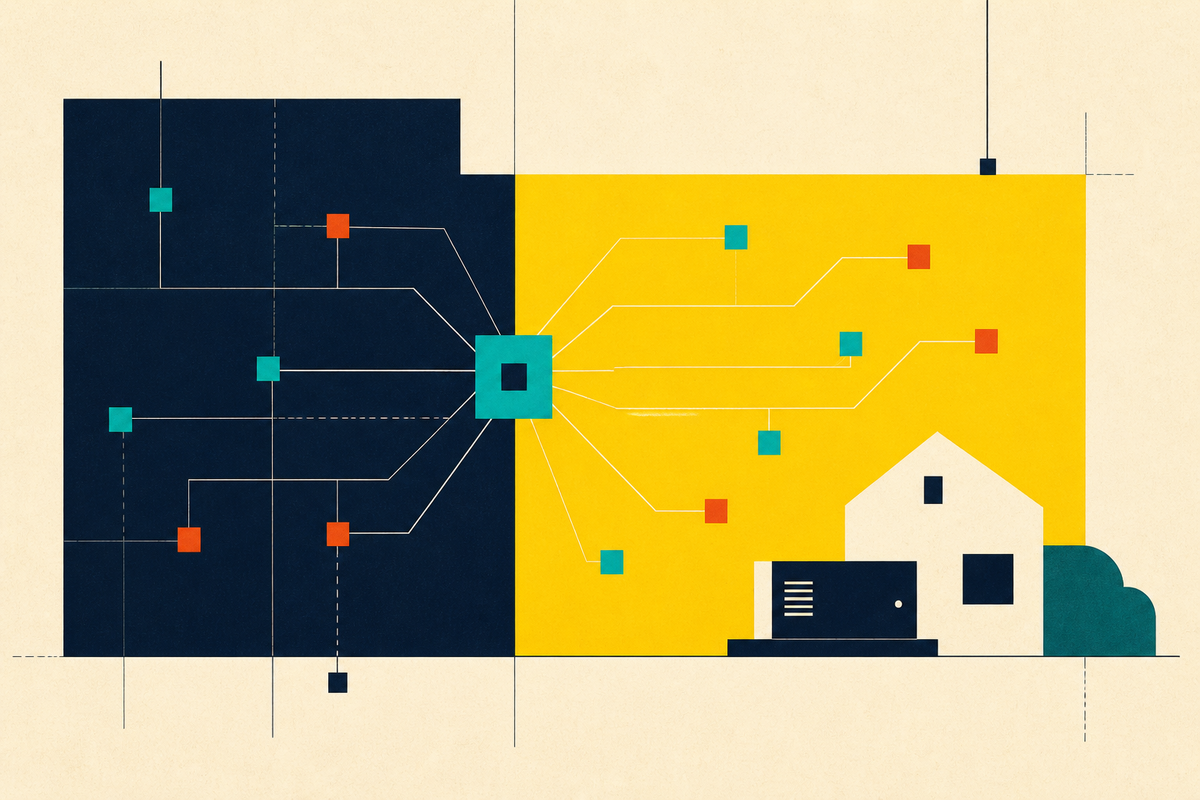
The local truck, the central nervous system
Home services are stubbornly local. A homeowner does not hire an abstract platform to work beside the gas line. They hire a name they have seen on a neighbor's lawn sign, a technician who knows the county's inspection habits and a crew that can return when the orange cone is gone. Power Support Partners' structure acknowledges that reality. It does not market every job under the corporate parent's name. It puts Premier or Bo's at the front door and the shared-services organization behind the appointment.
The arrangement is a practical answer to a familiar small-business ceiling. An owner may be excellent at installation and still lack a full recruiting function, a marketing studio, an analytics team or automated accounting. Hiring each specialty locally is costly; leaving it undone makes growth erratic. The central office can spread those capabilities across markets, while the local operation keeps the knowledge that cannot be centralized - the neighborhoods, codes, weather patterns and customer expectations.
The company lists eight support disciplines, and the list is more revealing than a generic promise of “resources.” Marketing is expected to acquire customers and produce more service contracts. Recruiting is supposed to staff technicians and office roles. Training helps crews broaden and sharpen their work. Finance automates record keeping. Technology makes the local office easier to run. Analytics tracks operating metrics. The shared knowledge base is where one location's hard-won fix can become another location's standard procedure.
One support center / eight operating levers
A high-trust sale for a bad day
The customer is usually a homeowner planning for an outage. The purchase is neither an impulse buy nor a box dropped at the curb. A field consultant assesses the house, estimates its electrical load, considers fuel supply and placement, and explains the tradeoffs of a professionally installed whole-home system. Once sold, the job moves through permitting, logistics, electrical work, fuel connections, testing and inspection. Maintenance and repair continue after installation.
That full journey matters because the generator is an assurance product embodied in hardware. The homeowner cannot easily grade the work on a sunny afternoon. Trust is tested later, perhaps during a hurricane, an ice storm or a routine utility failure. A missed follow-up or sloppy installation does more than waste one lead. It weakens the promise that justified the purchase.
The generator is the visible product. Repeatability is the product hiding behind it.
Power Support Partners tries to make that repeatability portable. Job descriptions show the choreography in plain language: site evaluation, safety, manufacturer specifications, local electrical codes, load balancing, collaboration and customer satisfaction. Public postings also describe a lead engine that schedules in-home consultations and expects sales staff to keep the customer record current. This is not glamorous infrastructure. It is exactly the infrastructure that makes a multi-market service business possible.
Weather creates urgency. Service creates a company.
Generator demand can lurch with the weather. The days before a named storm can overwhelm phones and warehouses; a mild season can reveal how much of the sales plan depended on fear. Power Support Partners' broader model offers several cushions. It operates across multiple states. It sells planned installations rather than only emergency fixes. It maintains installed systems. It pursues service contracts. And a regional network can move people where the need is greatest.
That last advantage became visible before Hurricane Milton in 2024, when the company said Premier Generators technicians traveled from Tennessee to help the Florida sister operation. It was a small public glimpse of the network thesis: capacity does not have to stop at a branch boundary. A technician, playbook or customer-service process can travel.
A generator installation is a project. Maintenance, repair and service agreements can turn the installed base into an ongoing relationship - and give crews useful work between major weather events.
The same logic applies to inventory and data. A support center seeing demand across markets can make better decisions than a single office staring at its own recent jobs. Common systems can expose the lead that did not receive a call, the permit that stopped moving or the maintenance customer who is due for attention. Scale is not merely more branches. It is a wider field of view.
Where the model has to prove itself
Centralization introduces its own risks. Home services punish distance. A process designed in Atlanta can become friction in Fort Myers if it ignores licensing, storm schedules or the practical judgment of a veteran installer. Growth also makes staffing uneven. Public employee-review sites present a mixed but useful picture: positive aggregate ratings and praise for colleagues sit beside comments about fast-changing priorities, turnover and the strain of a young organization. Those are not unusual growing pains, but in electrical work the cost of operational confusion is higher than an untidy dashboard.
The brand structure requires discipline, too. Keeping local names preserves recognition, but customers should experience the same reliability across them. The company must standardize what should be standard - safety, response, records, installation quality - without flattening what makes a local crew effective. Its stated culture tries to supply a common language. The acronym LITE stands for Love People, Improving Always, Together We Win and Execute With Excellence. It is earnest, easy to remember and unusually on-theme for a backup-power business.
There is also competition at every layer. Independent dealers offer local relationships. Large home-services groups offer capital and central systems. Manufacturer networks provide trusted equipment. Batteries paired with solar offer a different approach to household resilience. Portable generators remain cheaper. Power Support Partners' distinction is not a proprietary engine. It is the attempt to combine the neighborhood credibility of a specialist with the recruiting, marketing and operating muscle of a regional platform.
The market hiding beside the house
Power Support Partners was registered in Florida as a Delaware foreign corporation in October 2022; public records list Hamilton Powell as chief executive. Powell had already built Crown & Caliber, a marketplace for pre-owned luxury watches, and earlier worked in private equity. The category change is almost comic: from watches that measure time to machines that keep the microwave clock from blinking. The connective tissue is less strange. Both businesses depend on trust, operational detail and turning a fragmented market into a consistent customer experience.
The company has not publicly disclosed funding, revenue or valuation. What is visible is its operating footprint. Bo's Electric records show a change of ownership in February 2023. Corporate and contractor registrations remain active. Premier Generators appears under Power Support Partners in a 2025 Cobb County business listing. Current recruiting pages seek installers and service technicians in Kennesaw, Crossville, Nashville, Chattanooga and West Palm Beach. The map is regional and still being filled in.
For an owner considering a sale, the proposition is straightforward: keep participating in a business you understand, but stop building every administrative function alone. For a technician, it can mean more formal training and a larger network of peers. For the homeowner, the hoped-for benefit is simpler: one accountable organization from the first assessment through the night the utility goes dark.
The clever part of the model is its respect for the unphotogenic work. Generator ads show a neat box beside a pristine house. Growth lives elsewhere - in call response, clean estimates, licensed crews, inventory, permits, service reminders and the quiet transfer of knowledge from one branch to another. Power Support Partners is buying local companies, but the thing it is really assembling is a method. Whether that method can travel without losing local judgment will decide how far the platform goes.