The first thing to fail was not the cloud. It was the dashboard. During the handoff of cybersecurity company IntSights to Rapid7, three executives found what many enterprise teams eventually find: the bill could show which service consumed money, yet still leave them guessing why it was expensive, who owned the offending architecture and whether changing it would break something important. Alon Arvatz, Gal Ben David and Amir Hozez had sold IntSights for roughly $350 million. In January 2023, they started PointFive to chase a less glamorous quarry - infrastructure waste.
Their timing was convenient. Cloud spending kept climbing, engineering estates sprawled across accounts and clusters, and FinOps became a formal discipline. The market filled with allocation tools, forecasting dashboards and rate-negotiation products. PointFive’s founders decided the missing layer looked more like cybersecurity: continuously map the estate, detect a risky pattern, attach context, identify an owner and follow the remediation until the posture improves.
This is the useful distinction. PointFive does not merely ask, “What did AWS cost last month?” It asks whether 142 terabytes in an S3 bucket belong in a cheaper storage tier, whether a Snowflake warehouse forgot to auto-suspend, or whether a Lambda function has six times the memory it needs. It then supplies savings, effort and risk estimates, routes the work into Jira, Slack or ServiceNow, and checks production afterward. A recommendation is not booked as a victory until the bill moves.
The founders brought a threat hunter to an accounting fight
The founding move was intellectual recycling of the good kind. Security posture products build graphs of assets and relationships because a vulnerable machine means little without its exposure, dependencies and business context. PointFive’s InfraFabric applies the same logic to economics. Its read-only connection ingests configuration, telemetry, billing and ownership signals across AWS, Azure, GCP, Kubernetes, Snowflake, Databricks and BigQuery. The company says setup can take about 14 minutes and does not require software on production hosts or data-plane access.

DeepWaste, the detection engine sitting on that graph, looks for the “long tail” beyond obvious idle machines and elementary rightsizing. The product spans network architecture, storage configuration, Kubernetes, data platforms, GPU infrastructure and managed AI services. PointFive says there are more than 500 detection types. That breadth matters because the last 20 percent of a complex bill is rarely sitting in one neat pile. It is scattered among forgotten snapshots, over-provisioned databases, cross-region traffic and thousands of small decisions nobody revisits.
The operating loop
Nubank’s ten-day receipt changed the pitch
The sharpest evidence comes from a customer that was not a FinOps novice. Nubank had an internal cost-transparency platform, chargeback and cost champions across more than 45 business units. What failed was not visibility but root cause. PointFive says its proof of concept surfaced more than 200 types of AWS waste and paid back the full annual contract within ten days. The bank later connected PointFive’s GraphQL API to an internal automation pipeline and executed more than 3,000 DynamoDB remediations without ongoing engineer involvement.
“It took us 10 days to get full ROI on our partnership with PointFive.”Nubank customer case study
That result clarifies both the cost and the value. PointFive sells enterprise software through demos, cloud marketplaces and partners; it does not advertise a public menu price. Nubank’s exact contract value is not the important number in the public case. The useful number is the payback period: ten days. PointFive targets organizations spending at least $1 million a year on cloud and AI, where a narrow percentage improvement can finance a specialist platform.
Fanatics Commerce offers a more ordinary version of the same problem. Its FinOps practice already had reporting, but engineers spent hours assembling recommendations from scattered tools. Shared EKS clusters made attribution difficult. PointFive consolidated findings across EC2, S3, RDS and EKS, attached ownership and put prioritized actions in front of engineers. The glamorous innovation was a shorter scavenger hunt.
Then the bill escaped the cloud account
By 2026, PointFive’s original category had started to mutate. AI spend could appear in Bedrock, Azure OpenAI, Vertex AI, an Anthropic invoice, a GPU cluster or a developer’s coding-agent subscription. A traditional cloud bill might flatten a model endpoint into one line item. Management still wanted unit economics: cost per inference, customer, feature, model, team or repository.
PointFive responded with DeepWaste AI, broader data-platform coverage and, in June, an “AI Efficiency OS.” The new interface lets teams question cost data in plain language, run remediation agents and build internal apps on the company’s intelligence layer. TokenShift extends the system to Claude Code, Codex, Cursor, Copilot and Windsurf. Its job is attribution and governance at the developer endpoint - which agent used which model, for which team and repo, under which budget policy.
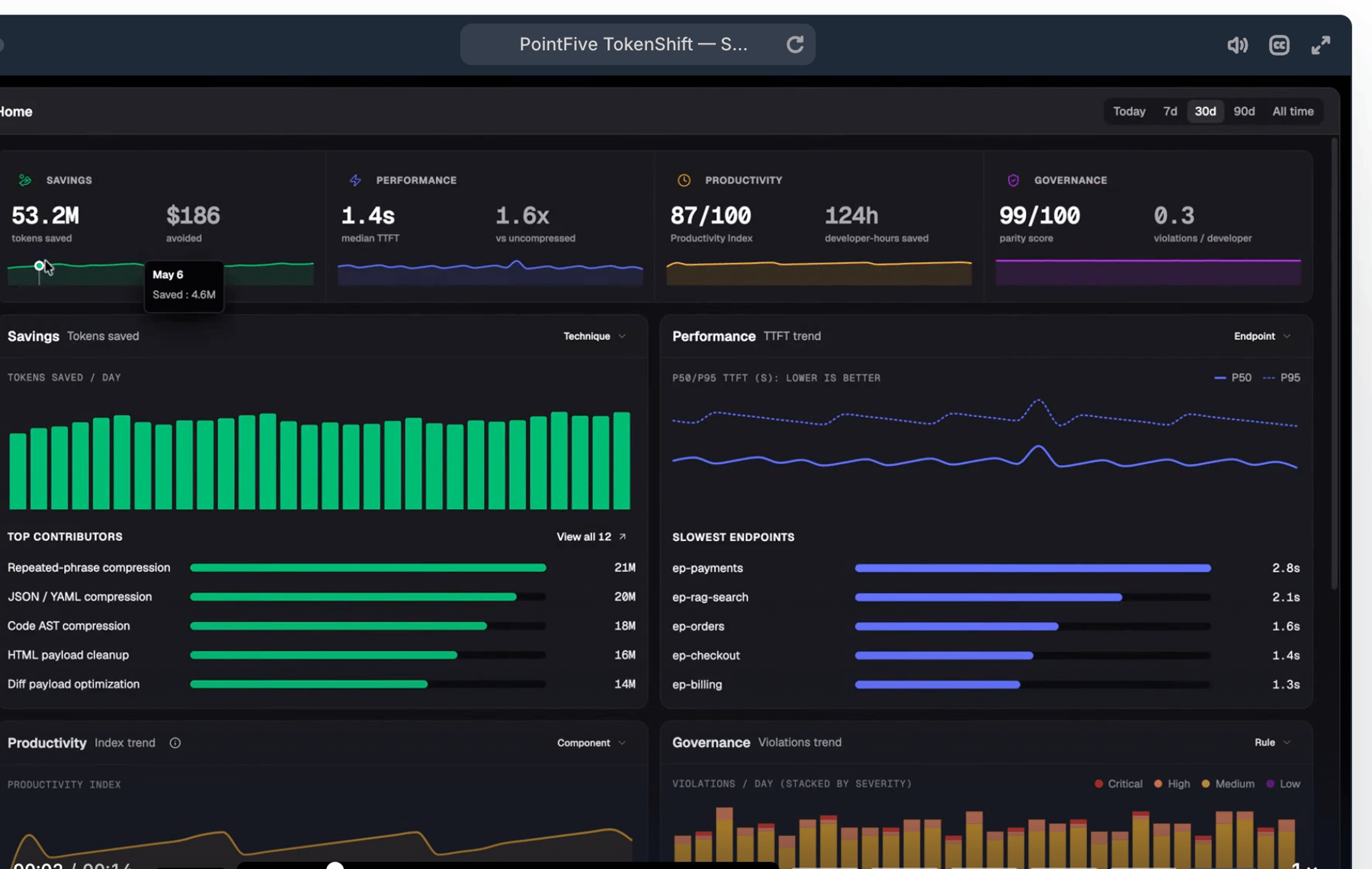
The pivot did not replace the original product so much as stretch its map. Cloud infrastructure, data warehouses, production models and coding agents now form one cost chain. PointFive’s claim is that an efficiency system must follow that chain from the finance ledger to the engineer’s editor. The risk is equally clear: “AI Efficiency OS” is a large label, and each new surface brings established rivals, native provider controls and different buyers.
Ninety-six million dollars buys a larger arena
PointFive came out of stealth in June 2024 with a $16 million seed led by Index Ventures. Salesforce Ventures led a $20 million Series A five months later, when the product was still primarily AWS-focused. According to Salesforce Ventures, the relationship also helped land one of PointFive’s largest customers and supported the push into a multi-cloud go-to-market operation. In June 2026, Accel led a $60 million Series B after the company reported sixfold annual recurring revenue growth from 2024 to 2025.
The company now employs more than 100 people across Tel Aviv, London and the United States. Its named customers include Nubank, E.ON, Hertz, Fanatics, Swiss Post, NICE, Blackhawk Network, Net Health and PwC. It sells directly, through AWS and Microsoft marketplaces, and through referral, reseller and strategic partners. Competitors range from Apptio Cloudability and CloudHealth to CloudZero, Finout, Vantage, ProsperOps, nOps and the native cost tools bundled by hyperscalers.
Its public culture reads like a useful checksum on the product: prioritize efficiency, raise the bar, stay humble, love customers, trust one another and enjoy the ride. The list is conventional until “prioritize efficiency,” which gives the company nowhere to hide. A vendor lecturing engineers about waste cannot afford a bloated implementation or an army of consultants behind every recommendation. PointFive’s partner program acknowledges the other half of that tension. Referrers, resellers and strategic service firms can wrap assessments and managed optimization around the software, while the core platform is supposed to make those teams faster rather than permanently dependent. That channel matters in a market where the hard part is often organizational. A detector may identify an idle database in seconds; getting its owner, finance partner and reliability lead to agree on a safe change can take a quarter.
The differentiation has to survive a skeptical reading. Every cost platform claims deeper savings. PointFive’s defensible position is narrower: a contextual infrastructure graph, security-inspired detections, workflow delivery and verification form one loop. Its customer claims - more than $50 million in identified savings and average ROI above 1,200 percent - come from the company and its published cases. The independent signal is institutional: AWS co-sell membership, Microsoft marketplace availability, FOCUS support and FinOps Foundation platform certification.
What an operator can copy on Monday
The software is proprietary, but the operating method is not. First, stop treating a cost recommendation as a completed task. Give every finding a named owner, dollar impact, effort estimate and risk score. Second, deliver it where engineers already work. A recommendation that lives in a finance dashboard is homework with no due date. Third, connect cost to architecture. Tags help allocation, but dependencies explain why a “simple” deletion might take down a service. Finally, measure realized savings after the change, and record whether the improvement persisted.
There are conditions where this playbook will disappoint. A small, simple estate may not contain enough long-tail waste to justify enterprise software. A company without reliable ownership data or a functioning change process can generate a handsome backlog and little else. Read-only discovery reduces deployment risk, but remediation still needs engineers willing and authorized to act. And autonomous fixes demand guardrails, review and rollback practices proportional to production risk.
PointFive’s best insight is almost annoyingly practical. Cloud waste is not an abstract finance leak. It is a collection of technical decisions, each with a dependency, an owner and a reason it has survived. Make those four things visible together, then close the loop. The dashboard was never the destination. It was merely where the clues accumulated.