The least glamorous emergency in a small company is a ringing phone. The owner is under a sink, in court, beside a patient or halfway through frosting a wedding cake. A prospect calls. Nobody answers. A few minutes later, that prospect calls somebody else. Phone.com built a business around preventing that tiny leak.
Its software gives a company a proper business number and decides what happens next: ring several people, play a menu, forward after hours, turn voicemail into text, send an SMS, record a call, start a video meeting, receive a fax or hand the caller to a receptionist. It runs in a browser, on mobile apps, on desk phones and, with its ProSIM add-on, through a compatible smartphone's native dialer. The trick is not any one feature. It is letting a nine-person company behave like a ninety-person company without installing a beige PBX in a closet.
01 / The originThe domain was the first sales hire
Domain entrepreneur Michael Mann acquired Phone.com to build a phone company, not to flip the address. In 2007, TechCrunch noticed that the famous name had returned: an earlier Phone.com had become part of Openwave after a giant dot-com-era merger, and the category domain was back in play. Mann paired it with telecom operator Ari Rabban, who became co-founder and CEO.
The name worked almost too well. Rabban later recalled that people found beta.phone.com while the service was still a beta. The system happened to work, including the credit-card processing, so they became customers before the formal launch. That is the sort of anecdote domain investors frame above the fireplace. But a memorable address only rents attention. Phone.com still had to carry calls reliably enough that lawyers, clinics and contractors would trust it with their livelihoods.

The rare telecom executive willing to say that customers do not care whether the receptionist is called AI.
The original enemy was not another app. It was the enterprise PBX: expensive equipment, technical setup and rigid office geography. Phone.com aimed at small offices, home businesses and mobile workers who wanted the surface effects of a large company - extensions, greetings, toll-free numbers and smart routing - at a fraction of the bother. By 2012 it ranked No. 262 on the Inc. 500, reporting 1,373 percent sales growth over three years. A $2 million investment led by ff Venture Capital with support from New Jersey's economic development authority followed in 2013.
“There is no IT to ask.”Ari Rabban, describing the reality inside Phone.com's smallest customers
02 / The productA switchboard that keeps losing its wires
The core subscription now combines voice, text, video, fax and administration. A bakery can choose a local number, a national retailer can add toll-free lines, and a law firm can keep its old number through porting. Incoming calls can follow schedules, ring groups, enter queues or land in voicemail. Employees use the same business identity across a laptop and phone without publishing personal mobile numbers.
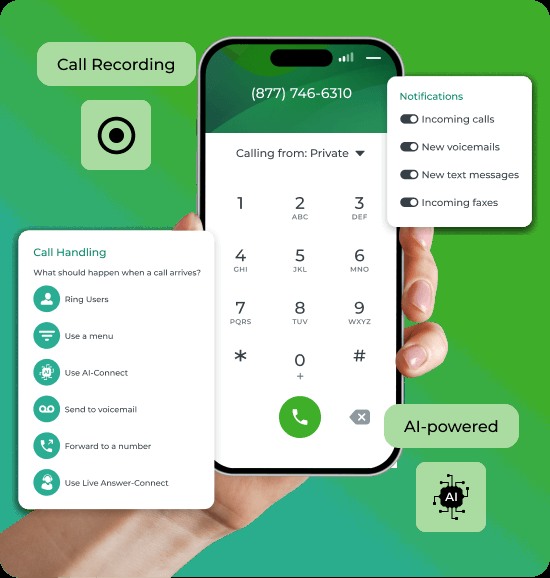
One incoming call, three useful outcomes
Phone.com differentiates itself less by inventing a new category than by arranging a crowded one for buyers with little time. RingCentral and 8x8 lean toward broader enterprise deployments. Microsoft Teams and Zoom Phone attach calling to collaboration suites. Dialpad sells an AI-forward communications stack. OpenPhone has a crisp startup feel. Nextiva, Vonage, Grasshopper and Ooma circle many of the same customers. Phone.com's pitch is narrower: lots of professional behavior, mixed plans for different users, online signup and humans available around the clock when configuration gets weird.
That support matters because telecom has sharp edges. Emergency calling, number porting, carrier registration for business texts, international fraud controls and local taxes do not disappear just because the interface has cheerful buttons. The base service starts at $18 per user each month, with a 17 percent discount for annual billing. But the real invoice can include taxes, regulatory recovery, texting registration, premium numbers, hardware and add-ons. The company offers a 30-day money-back guarantee on user fees, not on every purchase.
When the recipe fails: Phone.com is less convincing for a global enterprise that needs a deeply customized contact center, for a consumer who only needs a personal line, or for a team whose required integrations and call volumes exceed the selected plan. It also depends on broadband for its VoIP experience; ProSIM narrows that weakness, but only on compatible, unlocked phones with an existing primary carrier.
03 / The changeAI was translated into chores
What failed first was the old assumption that professional call handling required a desk, a phone cabinet and someone sitting beside it. Cloud software broke the cabinet. Remote work broke the desk. Then customer expectations broke the idea that voicemail after closing time was good enough.
Phone.com's response was to keep climbing the call. Live Answer-Connect supplies US-based receptionists who answer in a customer's name, transfer callers, take messages and schedule appointments. In May 2024 the company launched AI-Connect, which uses conversational voice software to answer routine questions, route calls and book time through Google or Outlook calendars. A customer can use the human and automated services together.
“Our customers don't really need to know it's AI. They need to know that they have a new tool that can help them with productivity.”Ari Rabban at ITExpo, 2025
That sentence is the company's best product brief. The useful unit is not “an AI agent.” It is an appointment made while a stylist has both hands occupied. AI-Connect currently adds $29.99 a month for 100 included minutes on top of an active Phone.com plan. It can work after hours and answer simultaneous calls. It is also HIPAA compliant, a meaningful condition for clinics that cannot casually feed patient conversations into any new bot with a pleasant voice.
Mobility prompted the next move. Rabban said in early 2025 that cloud communications and mobile service could be integrated better. ProSIM answered with an eSIM line that uses the cellular voice network and the phone's native dialer for $10 a month. It is a small product with a clear argument: an app can imitate a phone, but the phone already has an excellent phone app. The catch is compatibility - newer Apple, Google and Samsung devices, an unlocked handset and an existing primary carrier are required.
04 / The businessRecurring revenue, ordinary gravity
Phone.com earns recurring subscription revenue per user, then expands the account with numbers, usage, receptionist minutes, hardware, AI, eSIMs and integrations. Most customers arrive online. IT providers and other channel partners can also register clients while Phone.com handles the underlying service and support. Zoho CRM puts call controls near customer records; Zapier automates workflows; the public REST API and webhooks let developers connect calls and messages to billing, support and other software.
In November 2025, Ooma agreed to acquire the company for approximately $23.2 million in cash. It expected Phone.com to contribute $22 million to $23 million in annual revenue and $1 million to $1.5 million in adjusted EBITDA before synergies, plus roughly 87,000 users. The deal closed on December 26. Ooma's later filing recorded gross cash consideration of $22.585 million after the deal's accounting moved from announcement to fact.
The purchase price was roughly one times revenue. That is not a software fairy tale. It is the market applying ordinary gravity to a mature, competitive service business with modest profitability. Phone.com's name, customers and proprietary platform mattered. So did the cost of operating telecom infrastructure, supporting users at all hours and competing against bundles from much larger companies. Durability produced value, but durability alone did not produce a fashionable multiple.
Ooma bought a known brand, an SMB customer base and another piece for its growing business communications portfolio. It had already acquired cloud platform 2600Hz and, weeks before Phone.com, completed a separate acquisition of FluentStream. For Phone.com customers, the practical test is unromantic: whether Ooma can preserve the simple service while gaining efficiencies behind it.
05 / The copySteal the constraint, not the phone company
The tempting lesson is “buy a perfect domain.” Fine, if one is available and the seller has missed the last twenty years of internet pricing. The more useful lesson is to find a capable technology that has been packaged for the wrong buyer. Small companies wanted enterprise outcomes but could not absorb enterprise administration. Phone.com made that mismatch its market.
The Phone.com playbook
- Name the problem in language the buyer already uses.
- Package an expensive enterprise behavior as self-serve software.
- Design for the missing employee - in this case, the IT administrator.
- Keep a human support layer for the ugly edge cases.
- Add adjacent products only when they complete the same job.
This works when the customer has recurring pain, the underlying service can be standardized and the support burden does not swallow the subscription. It works especially well when reliability compounds trust: once a business number appears on vans, cards, court filings and search results, changing providers feels risky. It works badly when every customer needs a bespoke deployment, when the base infrastructure is outside the vendor's control or when a platform owner can include the same capability at negligible extra cost.
Phone.com did not kill the business phone. It made the phrase mean software, then kept revising what the software should do. First it followed workers out of the office. Then it learned to text, meet, transcribe and answer. Finally it moved back into the native dialer and into Ooma's portfolio. The amusing part is that the product spent 18 years escaping the telephone while the company never escaped the usefulness of being called Phone.com.