He taught machines to mix concrete. The result: producers cut carbon by up to 35% and roughly double their margins, one truck at a time.
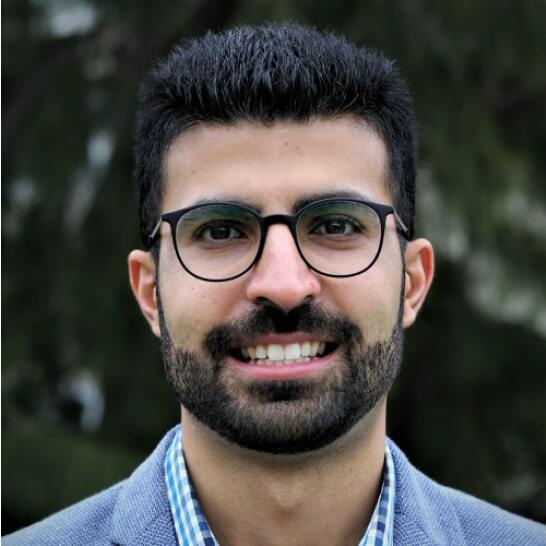
Concrete is the second most-consumed substance on the planet, behind water. We pour more than 13 billion cubic yards of it a year. It is also responsible for somewhere between 8 and 10 percent of global carbon emissions - over 4 billion tons, annually. Parham Aghdasi looked at the most boring material on Earth and saw the biggest climate problem nobody was talking about.
His company, AICrete, does something deceptively small. It uses artificial intelligence to optimize the recipe - the precise blend of cement, aggregate, water, and additives that goes into every batch - and then follows that batch through batching, dispatch, and the truck itself. Cheaper concrete. Lower carbon. Same strength. The pitch fits on a business card. The science took a decade.
"We like to say AICreteOS gives our customers sustainable concrete superpowers."
Founder & CEO, AICrete Corp.
Richmond, California. Founded 2020. 15-person team backed by climate and AI investors.
A decade at UC Berkeley and UT Arlington designing concrete for earthquake-resistant structures and ultra-high-speed train tunnels in Japan.
Aghdasi was born in Iran and started out studying atomic physics. Then he was expelled - not for grades, but for his Baha'i faith, which the state bars from higher education. That should have been the end of the academic story.
It wasn't. He enrolled at BIHE, the Baha'i Institute for Higher Education, an underground university that operates in living rooms and over correspondence because the alternative is no university at all. In 2011 he finished a BS in Civil Engineering there, and became the institution's first F-1 student to go straight from those informal classrooms to a US graduate program.
He arrived with about $6,000. Through scholarships and research assistantships, he earned a master's at the University of Texas at Arlington and then a PhD in structural materials at UC Berkeley - without taking on debt. Ten years of his life went into concrete composites: heat-transfer optimization of building facades, 3D-printed polymer lattices, plate-reinforced concrete for deep tunnel supports, and the tension-stiffening behavior of green ultra-high-performance fiber-reinforced concrete. The kind of work that does not trend, but holds buildings up.
Earns BS in Civil Engineering from BIHE, Iran's underground Baha'i university.
Graduate researcher, then postdoc at UC Berkeley. Concrete for facades, tunnels, earthquakes.
Founds AICrete Corp.
$4M seed round, led by CLEAR Ventures and VoLo Earth Ventures.
Launches the AICreteOS mobile app; raises another $5M. Total tops $9M.
The concrete industry is at a crossroads that requires it to innovate and optimize. AICrete's mission is to hasten the coming of age of predictable, cost-effective, durable, and sustainable concrete in real time.
For a trillion-dollar industry, concrete has gone strangely un-optimized. The recipe is often guesswork built on tradition and over-engineering - pour in extra cement to be safe, and the carbon and the cost both climb. AICrete's software, AICreteOS, treats every mix as a data problem.
The AI proposes and validates recipes in real time, then tracks the concrete through its early life: batch plant, dispatch system, and the rotating drum of the truck. Quality-control managers get full traceability - a feedback loop where what happens on the job site teaches the next mix. The 2024 plan added an AI-powered hardware sensor to read the concrete directly during production.
The results aren't theoretical. Across 40 projects, AICreteOS cut 36,852 tons of CO2 in a year. Precast manufacturer Clark Pacific reported a mix that saved 4 to 5 percent per cubic yard and shaved 17 percent off its carbon footprint.
FIG. 1 - Selected AICrete outcomes and the emissions backdrop. Bar widths are illustrative.
Led the 2022 seed round. Partner Vijay Reddy joined the board.
Co-lead investor. Managing Partner Kareem Dabbagh took a board seat.
Plus a Fortune 500 building-materials maker - a customer voting with its wallet.
AICrete's advisory bench leans heavily technical: it includes Pieter Abbeel, the UC Berkeley professor and co-director of the Berkeley AI Research (BAIR) Lab, alongside decades-deep concrete-industry veterans. A founder who can speak both the language of reinforcement learning and the language of a batch plant is a rare bilingual.
"Through the use of AI, we're able to reduce emissions by up to 35% and at least double profit margins."
"It is time to provide this dedicated sector with innovative tools powered by AI that enable them to work more efficiently, cost-effectively, and sustainably."
"AICreteOS gives our customers sustainable concrete superpowers."
Twice now, Aghdasi has been handed a system that said no. Iran said he couldn't study. The concrete industry, for a century, said the recipe was good enough.
Both times the answer was the same: find the workaround, then make it the new normal. An underground university became a Berkeley PhD. A trade built on tradition became a real-time data problem. The materials change. The move doesn't.
What he's chasing isn't a better startup. It's making AI-optimized, low-carbon concrete the default - so ordinary, so cheap, so obviously better that nobody pours the old way again. The most boring material on Earth, quietly decarbonized.