Paolo Fidanza grew up around businesses where the owner was never an abstract figure. His mother worked in fashion retail. His father ran ventures including bars, restaurants and construction businesses. In Rome, helping his parents meant seeing enterprise close enough to notice the effort, as well as the takings. The shopkeeper’s problem would eventually become his own: how to keep a business moving when money insists on arriving late.
He took a rather elaborate route to an answer. There was an aerospace engineering degree, a job at Lotus in Britain, an electric-car venture in America and a succession of technology companies. Then came KEO World, founded in 2020, which applied digital payments and inventory finance to the gap between buying something and getting paid for it. For a person trained in engineering, the attractions of removing a persistent obstruction are easy to appreciate.
A Lotus job, then a very expensive education
Fidanza studied at Rome’s Sapienza university before starting his career at Group Lotus in the United Kingdom. His training concerned flight; his work concerned cars. The combination gives a biography a pleasing turn, though the practical connection is less mysterious: both demand attention to systems, constraints and what happens when the parts fail to cooperate.
In 2001, he left to start a utility electric-car company in the United States. He later described losing the financing after September 11 and returning to Britain without his savings. His next venture, an IT school, depended on a partner borrowing $20,000. It is an unusually concrete detail in a founder’s account of resilience. The next beginning required somebody else’s willingness to sign for the money.
He went on to build businesses in telecommunications and technology, moving between countries and industries. The restless geography matters less than the recurring choice: he kept approaching established activities as systems that could be redesigned. A conventional career might have offered him a tidier biography. It would also have left him with fewer opportunities to discover how untidy a business can become.
“trade the idea of luck for hard work.”
Paolo Fidanza, 2022
Before credit, a question of feeling
One of those detours was Opinit, a social platform he co-founded in 2014. It organised the sharing and discovery of content around emotions. The premise was that people might want their online reading to acknowledge how they felt, a more particular ambition than simply presenting another endless feed. Even before finance became his focus, he was interested in the information that conventional systems missed.
Fundamental Applications announced the acquisition of Opinit in 2016. Its plans involved connecting Opinit’s content tools with its other student-facing applications, including the Foro marketplace. Fidanza appeared in the announcement as a co-founder welcoming that combination. Here was a familiar technology calculation: a useful product could gain another life when joined to somebody else’s distribution.
That same year, he co-founded MO Technologies with Veronica Crisafulli. Their starting point was access to small loans for people without a formal credit history. Crisafulli brought experience in strategy consulting across technology, telecommunications and financial services. Fidanza brought years of building technology businesses. The pairing put a commercial problem beside an engineering one: how could a lender assess somebody its usual records barely described?
MO developed credit-scoring and loan-management technology using artificial intelligence and machine learning. It began operating in Colombia and expanded into other markets. Fidanza’s explanation of the business emphasised adapting the technology to customers’ behaviour. This is a useful distinction in emphasis. The customer already has a life; the software is the party expected to learn something.
What useful information does the existing system fail to see?
From emotional discovery at Opinit to credit decisions at MO.The trouble with waiting to be paid
With KEO World, Fidanza turned toward business credit and payments. Buyers needed supplies before the proceeds of their own sales arrived. Suppliers wanted to sell without becoming unwilling lenders. The interval between those needs was KEO’s working territory. An invoice may look admirably decisive on paper; unfortunately, its due date cannot be used to pay another invoice.
Workeo, KEO’s inventory-financing product, connected business credit with digital payments. In Mexico, the American Express relationship supplied a route into transactions that businesses were already making. Fidanza discussed the alliance in 2022 as a way to support business purchasing across markets and currencies. The aim was to make financing available within the transaction, reducing the distance between arranging credit and actually using it.
By 2023, the product’s design allowed individual transactions to have their own terms, rather than treating every purchase as part of a single conventional card cycle. Businesses could manage supplier payments and collections through Amex Business Link. That detail says more about Fidanza’s approach than a general promise of convenience: he was trying to fit the financial tool around the rhythm of the purchase.
The mechanics carry the argument. A retailer can have customers and still lack the cash to replenish stock. A supplier can have orders and still wait for payment. Financing that interval can give both sides more room to operate. KEO’s proposition put those ordinary business constraints at the centre of a technology product.
Five hundred million, with an important qualification
In early 2022, KEO arranged a seven-year debt facility from Hayfin Capital Management of up to $500 million. Alantra, which advised on the transaction, recorded it in its results presentation. The qualification matters: a facility describes available borrowing under an agreement. It does not mean a founder received a cheque for the headline amount, or that the company was valued at that figure.
The money was intended to expand supply financing in Mexico through Workeo. It gave the operating model a funding arrangement suited to extending business credit. For Fidanza, the challenge had moved beyond developing a way to process transactions. The business also needed the financial capacity to support the purchases its technology made possible.
Seven-year Hayfin debt facility for KEO’s expansion in Mexico.
The company’s later history records expansion into Canada and Brazil. Its December 2024 Brazil announcement described an agreement with BTG Pactual and the use of Amex Business Link for Workeo. The same buyer-and-supplier problem had travelled; its delivery required local relationships. International expansion in payments involves rather more than translating the buttons.
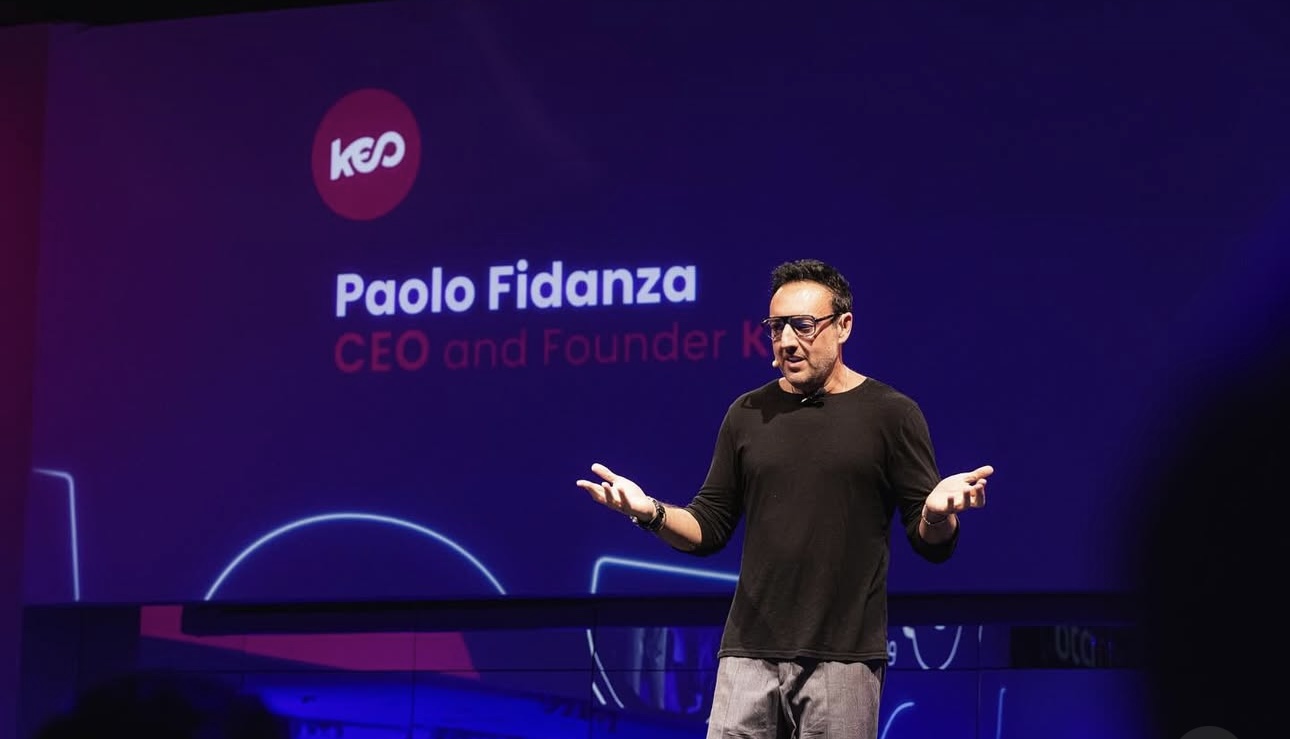
The offer he left on the table
Fidanza’s willingness to raise money had a limit. In a 2025 account, he described turning down a proposed $200 million investment at a $400 million valuation because accepting it would have meant surrendering control. The company was under pressure, and the decision divided his team. Large numbers have a habit of making the conditions beneath them look like small print. Those conditions were what concerned him.
The episode helps explain his view of KEO. He regarded lending as a way to establish that the underlying technology worked, with bank partnerships offering a route to wider distribution. Holding control preserved his ability to pursue that direction. Rejecting the proposal did not remove the company’s need for capital; it left him responsible for finding another way forward.
April’s deal, September’s departure
On April 2, 2026, Maha Capital announced that it had completed its acquisition of KEO World. The transaction brought the business into a company listed in Stockholm. Maha also reported capital raises totalling $27 million in connection with the closing. This was a new ownership structure, distinct from the investment proposal Fidanza had previously rejected.
Fidanza subsequently said he had stepped down as KEO’s chief executive and chairman, handing over day-to-day responsibilities. He welcomed the opportunity to contribute at a broader strategic level. By June, he was participating in Maha’s investor presentation as chairman, alongside chief executive Roberto Marchiori. His role had moved from running the original company to helping direct its listed parent.
That chairmanship was brief. On September 12, 2026, KEO Capital announced his immediate departure from its board and the appointment of Jay Heller as interim chairman. The distinction belongs in any account of his career: Fidanza founded KEO World and led it through its early development; those facts endure without requiring the executive title to endure with them.
The habit that travels
Across those changes, Fidanza’s stated ambition has remained close to the businesses he knew as a child: helping owners obtain the means to operate, expand and employ people. He has described listening and observation as useful habits, acquired over a life spent in several countries. For somebody whose work so often involves presenting an idea, there is a certain charm in recommending that others speak less.
The continuity is visible in what he chose to work on. Opinit questioned how people discovered content. MO questioned how borrowers became legible to lenders. KEO questioned how purchases and payments could be timed. Each venture approached an existing arrangement with an engineer’s impatience for the awkward parts. The small-business owner in the family shop might recognise the objective immediately: make tomorrow’s work a little easier to begin.
Follow the story
Conversations, company announcements and a video appearance.