On April 30, 2024, someone at Calgary Public Library borrowed Crafty Birds, a book by Kristy Conlin. An ordinary transaction, involving unordinary birds. It was also the four-billionth title checked out through OverDrive. A company that once distributed digital books on floppy disks had arrived at a scale best understood through a small, pleasingly peculiar act: somebody wanted to make something.
- The reader gets Libby. The library buys the digital collection behind it.
- The phone removes the journey. Licensing still determines who can borrow what.
- The scale is institutional. OverDrive reported 820.5 million digital checkouts in 2025.
That is a useful place to begin with OverDrive, because its business can disappear behind its products. You know Libby, the library reading app. Perhaps your child knows Sora. Your film-loving friend knows Kanopy. Behind these different doors sits a company coordinating publishers, institutional buyers and people who would rather get on with reading.
The library inside the phone
Steve Potash founded OverDrive in 1986. Its early work included digitizing law books and distributing ebooks on diskettes. Internet distribution followed in 2000; the library lending platform arrived in 2003. OverDrive was working on digital content before carrying an entire library in your pocket seemed like an ordinary expectation.
Libby, introduced in June 2017, gives that history a friendly face. Find a participating library, add your card, borrow an ebook or audiobook. Download it in the mobile app before a journey and it can travel without a connection. Loans return automatically. There is no subscription bill for the reader and no late fee waiting at the end.
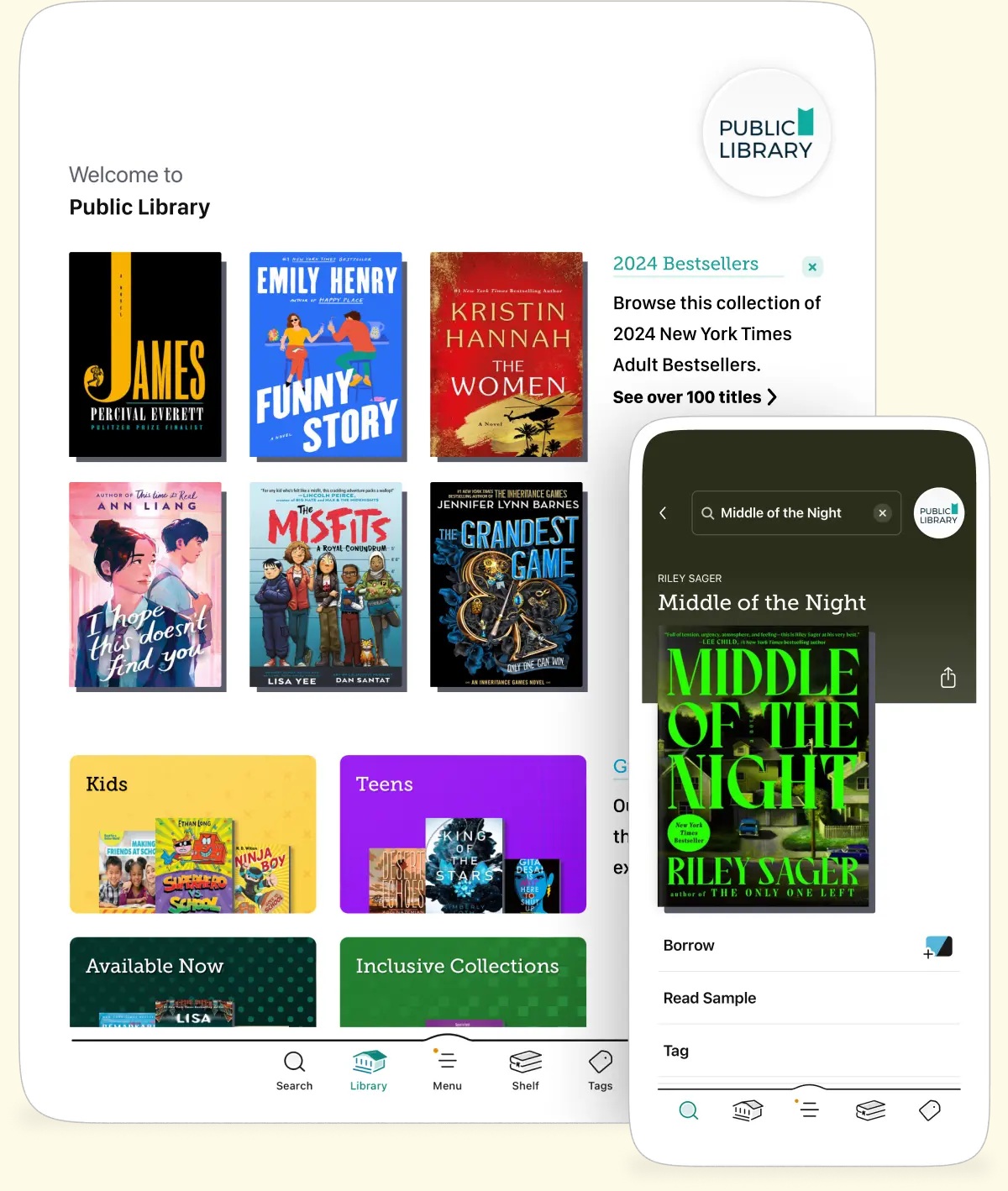
The institution gets a different instrument: OverDrive Marketplace. Staff select content, purchase licenses, curate shelves and examine use. Publishers supply the titles and establish their lending terms. OverDrive’s expertise sits in connecting those jobs, from content distribution to the interface a sleepy commuter can operate.
Sora takes the reading experience into schools, including assigned and self-selected books. TeachingBooks adds interviews and classroom resources; Kanopy supplies films for public and academic libraries. OverDrive acquired both businesses in 2021. These purchases broadened what the company could sell to institutions already buying access to culture and learning.
The customer list extends beyond the neighborhood branch: universities, businesses and law libraries also need digital collections. OverDrive’s current company page reports more than 92,000 libraries and schools across 115 countries. Its 2024 responsibility report describes a Marketplace catalog of 6.4 million titles in 168 languages. That catalog is a purchasing opportunity; each institution decides which part reaches its readers.
The price behind “free”
Here comes the apparent absurdity. A digital file can be copied, yet a reader may still have to wait for a book. The missing variable is the license. A library is paying for permission to lend under specified conditions. The file’s technical abundance and the collection’s contractual availability are different things.
One-copy/one-user titles serve one borrower at a time without expiring from the collection. Metered licenses expire after a period or a number of checkouts. Cost-per-circulation titles charge when borrowed and permit simultaneous users, subject to institutional budgets and limits. Subscription titles allow simultaneous borrowing for a flat fee, usually over a defined period.
For a librarian, the decision resembles stocking a shop whose most requested item keeps changing. Buy more copies of the hit, or preserve money for the quieter books? OverDrive Max offers another option: bundles of checkouts without an expiration date. Its economics depend on the loans actually being used. Cheap capacity that sits untouched is still money spent.
“Libby is fast, fun and friendly.”
Lisa Tattersall, Washington County Cooperative Library, at Libby’s 2017 launch
OverDrive therefore competes on more than a pleasant app. It combines institutional purchasing tools, publisher relationships and several reader-facing services. Libraries also use alternatives such as hoopla and cloudLibrary. The Palace Project complicates any neat rivalry: it can bring eligible OverDrive content into a different reading app alongside other suppliers.
For someone who needs a particular title tonight, the local collection may be the decisive limitation. Another library’s shelf is not automatically yours to borrow. Even a cost-per-circulation collection can stop lending when its monthly budget is exhausted. These restrictions explain why a library-funded service can coexist with paid bookshops and subscriptions: access depends on what the institution can provide.
Retiring your own name
By May 2023, OverDrive had discontinued its namesake app and directed readers toward Libby. Its explanation was practical: simplify promotion, staff training and support. The transition included marketing kits and training, with existing loans, holds and wish-list items available in Libby. Changing an interface also meant helping librarians explain the change.
The useful product lesson is in that unglamorous work. A library employee becomes part of the customer experience whenever someone cannot find their book. In 2025, OverDrive described new cost-per-circulation budgeting and price-comparison features developed with its Partner Advisory Group. Reader convenience requires administrative convenience behind it. For institutions, collection management remains an editorial decision, with budgets and reader demand pulling staff in different directions every day.
Digital checkouts in 2025 across the Libby and Sora network
A new chapter, the same counterparty
Ownership has changed along the way. Rakuten announced a $410 million cash acquisition in 2015. KKR completed its purchase from Rakuten in June 2020, without disclosing financial terms. In June 2026, Marc DeBevoise became CEO and Potash became chairman.

The company has been a Certified B Corporation since 2017, and its stated mission is “a world enlightened by reading.” That purpose operates inside ordinary commercial constraints. A reader needs an eligible institutional connection; the library needs money and appropriate rights. A polished app cannot conjure a license the collection does not have.
Readers can copy one habit immediately: check their library’s digital shelves before buying their next book. Product builders can borrow a harder lesson: serve the person using the product and the person responsible for paying for it. OverDrive’s borrower in Calgary probably had no reason to consider any of this. There were birds to make.