Otis Chandler went into a friend’s apartment and found himself at the bookshelf. There were questions to ask. Had his friend liked this one? What was that one about? He left with five or six books he wanted to read, and the outline of a problem he knew how to tackle. Getting a good recommendation had required being in the room. Perhaps the room could be put online.
A bookshelf is unusually generous personal information. It tells a visitor what has occupied your evenings without requiring an account of every evening. It can reveal an enthusiasm, an abandoned ambition, a school assignment that survived three moves. The owner may insist that the unread books are there for a reason. Usually, the reason is optimism.
Chandler’s idea became Goodreads, the company he co-founded with Elizabeth Khuri Chandler in 2006. Its basic invitation carried the friendliness of that apartment visit: show people your books, see theirs, and talk about what you might read next. The software made the visit repeatable. The readers supplied the reasons to return.
The engineer who wanted to build cars
Chandler’s route to books ran through machines. As a child, he took things apart; his mother knew to pass him a broken VCR rather than discard it. He studied mechanical engineering at Stanford and graduated in 2000. He had imagined building cars. The internet, meanwhile, offered projects he could make himself and watch people use almost immediately.
At Tickle, he worked as a software engineer and later a product manager. The company’s personality tests, dating service and social products gave him an education in participation. People needed something they wanted to share, and an easy way to share it. The technical work and the human response were inseparable. A feature could function perfectly and still give nobody a reason to tell a friend.
James Currier, who hired him, remembered a colleague who learned by reading and asking questions. Currier’s public recommendation describes Chandler as calm, trusted and well liked. That portrait fits a founder whose early work involved a great deal of coding and relatively little ceremony. There is room in internet history for the person who listens, opens a book and figures something out.
The books had been there all along. His childhood reading included the Hardy Boys. Later, the wish to find more good books met the skills he had acquired at work. He understood how people connected around photographs and shared interests. Reading offered its own abundant supply of things to discuss. Each title could open another conversation.
“I built it to be used by everybody, but I also built it for myself because I wanted it to exist.”
Otis Chandler, 2009
An editor joins the experiment
Chandler wrote the early site while learning Ruby on Rails. The initial address was Goodreadz.com, with a z. He bought Goodreads.com and changed the name. A community devoted to written language was probably well served by the purchase; a stray z has a way of making even a quiet reading room sound like a nightclub.
Elizabeth was central to making the room welcoming. A Stanford English graduate and a former Los Angeles Times journalist, she brought experience with words, readers and publication. She became a collaborator on the site’s language and its presentation, then handled public relations, branding and marketing through its first five years. The wording received her close attention.
That contribution belongs alongside the code. Readers encounter a product through its invitations and instructions: what to add, where to put it, how to respond. A bookselling database and a place to discuss books may contain the same titles, yet feel very different. The Chandlers were working on the feeling as well as the functions.
They married in 2008 and went on their honeymoon with a suitcase of books. Elizabeth later recalled that Otis enjoyed making Goodreads into something she would want to use. It is a pleasingly practical test for a reading product: can it satisfy the reader whose judgments you hear at home? The answers were close at hand, and unlikely to arrive wrapped in corporate politeness.
The family connection to publishing adds another turn. Chandler’s grandfather and namesake had been publisher of the Los Angeles Times; Elizabeth had worked at the paper. Their own company would give readers space to publish judgments about books. The relationship to the written word continued, with a different set of people doing the choosing.
A book is a reason to meet
Goodreads publicly launched in January 2007. Invitations to friends helped bring in its first members. Book bloggers found a place where their discussions could gather around individual titles, with readers who had read the same things. A book page offered a meeting point that a scattered set of personal blogs could struggle to provide.
The appeal extended beyond finding the next purchase. Keeping a record of reading was useful on its own. A shelf could hold books finished, books underway and books waiting their turn. It gave an activity that happens over months and years a visible shape. A completed novel stopped disappearing into the uncertain category of things one vaguely remembers having read.
“You relive your life by doing that,” Chandler said of adding books to a personal library. The remark gives the shelves an intimacy that a product description misses. A title can bring back the age at which you read it, the room where you finished it, the person who insisted you should try it. The database stores a title. Memory supplies the rest.
The business grew around this participation. Publishers and authors could reach people whose reading interests were already visible. In 2009, Goodreads announced $2 million in funding led by True Ventures. Its announcement named advisers including Currier and Stan Chudnovsky, people Chandler knew through his earlier work. The engineer had a community of his own to consult.
Algorithms also entered the picture. Goodreads acquired Discovereads in 2011 and introduced a recommendation engine. The logic was familiar: books you liked, and books liked by people with related tastes, could point toward something new. The personal shelf became useful both to another reader browsing it and to software looking for patterns.
Chandler also studied how discovery happened. In 2012, he examined 5.75 million books added to Goodreads members’ to-read shelves during January. His argument emphasized repeated encounters. A recommendation, an author appearance and an update from a friend could each make a title more familiar. The decision to read often took several nudges.
- A reader adds a bookA private reading habit becomes visible.
- Someone else noticesA friend or fellow reader finds a reason to ask.
- The conversation continuesAnother shelf, review or recommendation opens up.
A conceptual illustration of the bookshelf idea.
Amazon, and six more years
On March 28, 2013, Chandler announced that Goodreads would join Amazon. At the time, he described more than 16 million readers worldwide. Kindle integration was part of the promise, along with keeping the Goodreads name and team. A website for discussing books would sit alongside a company with a substantial role in selling and delivering them.
The announcement brought the tension into view. Readers had made Goodreads useful by contributing their opinions. A corporate transaction changed the ownership of the place where those opinions lived. Chandler presented the deal as a way to reach more readers and build more features. The purchase price was not publicly disclosed.
He stayed as CEO for six more years. Elizabeth stayed as editor-in-chief. The acquisition therefore sits in the middle of their working history at Goodreads, with a long stretch of operating the company still ahead. A sale makes a clean milestone for a timeline. Continuing to serve the people who use the product is less tidy, and occupies far more days.
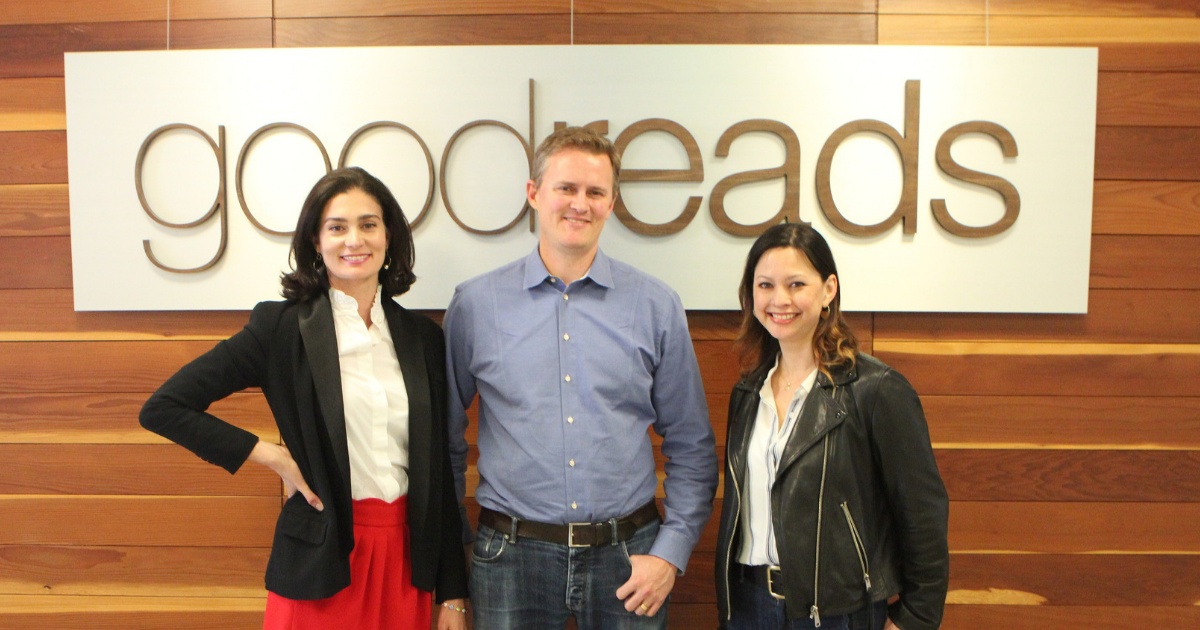
In April 2019, the founders announced that they would step back at the end of May and become advisors. Goodreads had grown to more than 90 million readers. Veronica Moss, who had led revenue and operations, would become CEO. Their letter left room for further experiments. They had spent thirteen years on the company and wanted time to explore.
The same question, a harder second act
Chandler’s next reading product reached beyond books. Smashing combined community curation with AI to help people discover articles and other online content. It entered beta in June 2024 and opened to the public that October. His launch announcement described an internet full of interesting work that had become difficult to find.
The extension made sense as an editorial problem. A reader choosing a novel and a reader choosing an article both face an allocation of attention. Recommendations can help with either. But the online reading day contains a changing mixture of subjects, formats and distractions. A useful destination has to earn another visit amid all of them.
Smashing announced its closure in April 2025 because it had not grown into a sustainable product. The same founder had encountered a different outcome. In January 2026, Chandler reflected on starting with a narrower audience and experimenting faster. His earlier success gave him experience to draw on; the second venture gave him assumptions to reconsider.
He continued to argue for the contribution of human curators. Software could scan and match material, while people supplied judgments about what made a piece interesting. His interest in reading technology remained active, including interfaces that let readers ask questions about a book. The question that drew him to a friend’s shelf had acquired new tools.
Across these efforts, Chandler keeps returning to a familiar reader’s predicament: more available to read than time to read it. A recommendation is a small act of confidence on another person’s behalf. Someone has spent the time, considered the work and decided to pass it along. Goodreads gave that act a place to accumulate. The next good book still begins, very often, with somebody saying you should try this one.
Keep browsing
Visit Otis’s Goodreads shelves, his personal profile, LinkedIn, Twitter/X, Facebook or Glasp highlights.