Somewhere between a tissue sample and a diagnosis sits a small piece of glass. It is cheap, fragile, and stubbornly local. To get a second opinion, someone may have to ship it. To let software inspect it, someone first has to turn it into a very large image. In pathology, the future has often been waiting at the purchasing department.
- OptraSCAN makes whole-slide scanners, image software, remote consultation tools, and AI-assisted analysis.
- It offers purchase, lease, subscription, and pay-per-scan arrangements to reduce the cost of starting a digital lab.
- Its OS-SiA technology combines scanning, indexing, and analysis during image capture.
- In North America, the company labels its products research use only, not for diagnostic procedures.
OptraSCAN, based in San Jose with operations in Pune, sells the equipment and software for that conversion. Its scanners capture whole-slide images. IMAGEPath stores, displays, annotates, and shares them. TELEPath lets specialists review cases from elsewhere. Analysis tools can mark regions of interest and score tissue features. The company sells these as parts of one workflow, from glass to screen to colleague.
Its more interesting invention may be a payment plan. Founder Abhi Gholap said in an OptraSCAN announcement that adopting digital pathology had typically required $300,000 to $500,000 in initial spending. That is a forbidding sum for a smaller lab, even one convinced that digital slides would improve its work. OptraSCAN's On-Demand Digital Pathology and Digital Lab as a Service offers put scanners, software, storage, and support into a service arrangement. The company advertises entry from as low as $1 per slide for its lab service, a promotional floor rather than a general price list.
A scanner is only the first handoff
Consider what a pathologist actually needs. A machine must focus on tissue, capture color and detail, and make an image a specialist can navigate. The resulting file needs a name, a location, permissions, and a route into the lab's information system. Then another person may need to see it urgently. A scanner that merely produces a file has solved the first verb in a long sentence.
OptraSCAN's portfolio spans the six-slide OS-SiX, 15-slide OS-Lite, OS-FLi for fluorescence and brightfield imaging, and the high-capacity OS-Ultra. The company specifies that OS-Ultra can scan a 15-by-15-millimeter area in 30 seconds at 20× or 60 seconds at 40×, with configurations holding 80 to 480 slides. Those are product specifications, not a guarantee of every lab's throughput: preparation, sample area, image settings, and downstream review still matter.
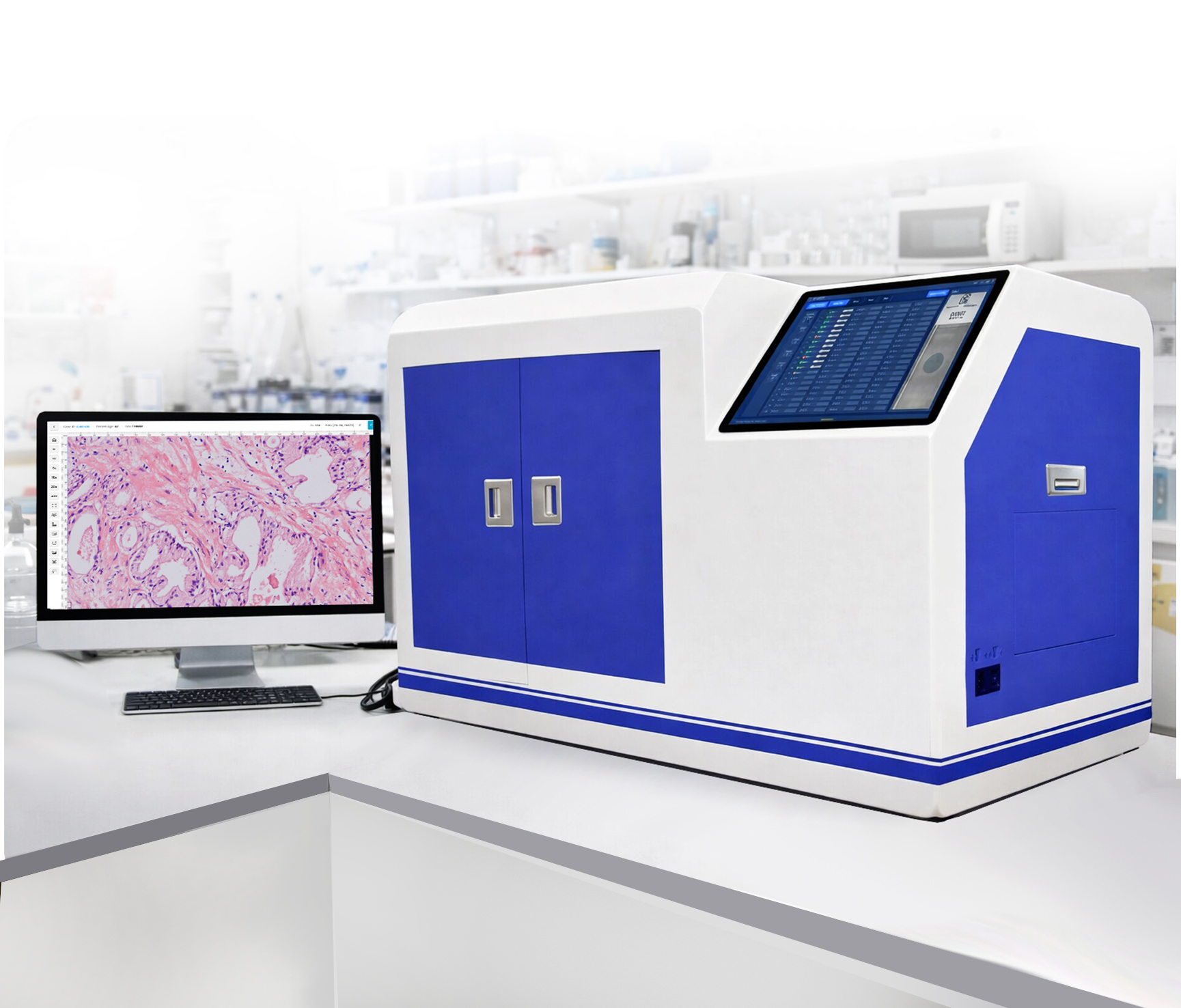
IMAGEPath is the next stop. It supports viewing, annotation, measurement, archiving, and remote access, with cloud or local deployment. OptraSCAN says it works with several image formats and connects to lab systems through APIs or HL7. TELEPath adds real-time collaboration and case sharing. A hospital can send the image to a specialist without putting the slide in a courier's bag. A training program can put the same specimen before many students. A research group can revisit and compare cases without retrieving boxes from storage.
The AI moves upstream
The usual sequence is scan first, analyze later. OptraSCAN's patented OS-SiA method tries to collapse the sequence: scan, index, and analyze while the image is being acquired. Its site describes automated tissue detection, slide-quality checks, metadata tagging, and on-device analysis. The proposed benefit is fewer waits between making the image and bringing useful clues to the reviewer.
It is a distinct position in a market crowded with excellent scanners on one side and clever algorithms on the other. OptraSCAN wants the scanner to participate in the interpretation workflow. That approach can help when a lab wants one vendor accountable for the instrument, image system, and analysis path. It also puts more weight on integration and validation: an algorithm's usefulness depends on slide preparation, staining, intended use, and the judgment of the person reading it.
The company also markets specialized suites: HistoSiA for histology and biomarker analysis, CytoSiA for cervical cytology screening, and BactoSiA for bacteriology. In a cytology workflow, for example, software can help sort slides that warrant closer attention. In immunohistochemistry, it can quantify markers that a pathologist then interprets. These are concrete tasks; “AI in pathology” becomes useful only when it names one.
“Digital pathology should not be a privilege reserved for the largest institutions.”Abhi Gholap, founder, on OptraSCAN's website
The customer who needs another pair of eyes
AIG Hospitals in India offers a better example than a product brochure. In a company account of its deployment, pathology chief Dr. Anuradha Sekaran described workload distribution, specialist opinions, remote case review, and joint tumor-board review as reasons to digitize. Those are organizational changes. The instrument matters because it permits them, not because it sits handsomely on a bench.
The customer set is broad: diagnostic laboratories, hospitals, universities, research institutes, and pharmaceutical teams. The company says more than 200 labs and institutions use its platform worldwide. It offers outright purchase as well as leasing and on-demand terms. Molbio Diagnostics led a $30 million Series B in November 2024 and described a strategic alliance aimed at expanding digital pathology access in India and beyond. OptraSCAN has also announced work with Lumea on workflow software and AI, and with Paige on digital pathology adoption.
Gholap's route here is instructive. He previously co-founded BioImagene, a digital pathology company acquired by Roche in 2010. OptraSCAN's leadership page also names Dr. Gauri Gholap as co-founder; her background spans biotechnology, cytology, imaging, and bioinformatics. The pair had seen the technology's promise and a stubborn impediment: an elegant workflow does little for a lab unable to buy its first scanner.
What changed was the question
For years, the digital pathology pitch began with the machine: its resolution, speed, capacity. OptraSCAN still competes on those specifications. But its commercial pitch begins one step earlier, with the lab manager asking, “How would we pay for the first year?” The answer is neither universal nor magical. A subscription trades an upfront purchase for an ongoing obligation. An integrated stack can simplify responsibility while narrowing choices. And no scanner repairs a poor specimen or supplies an absent specialist.
Yet that change of question is the company's useful lesson. If a technology reaches only organizations that can afford to own it, performance alone will not widen access. OptraSCAN's proposal is to sell the journey of a slide instead: capture it, organize it, move it, and make it worth reviewing. The little rectangle of glass remains. The invoice, at least, has changed shape.