Somewhere right now, a League of Legends player is about to pick a champion they have not touched in months. Before the match locks, they do the thing tens of millions of players do without thinking: they open a second browser tab and type three characters. op.gg. Runes, items, win rates, the current best build - all of it loads before the game's own loading screen finishes. Then they close the tab and play. That small, automatic gesture, repeated across 170-plus countries, is the whole business.
OP.GG is a gaming platform out of Seoul that turns the raw match data of games like League of Legends, Valorant, Teamfight Tactics, PUBG and Overwatch 2 into something a player can actually use - rankings, tier lists, builds, and a read on the current meta. By its own account it reaches roughly 55 million monthly visitors and serves around 460 million pageviews a month. It supports 19 or more titles and speaks 23-plus languages. And it started as one person's curiosity about his own rank.
The OriginThe dropout who wanted to see his own rank
The founder, Sangrak Choi, is not a first-time builder who got lucky. He started coding at 10, making fan sites for Harry Potter and StarCraft, and was freelancing as a web developer through university. In 2012 he built OP.GG as a hobby - a search tool that would look up a League of Legends player and show their stats. By 2015 the traffic told him the hobby had outgrown him. In 2016, in his third year of university, he left school to run it full time.
That is a large sentence for a stats site, but it explains the shape of everything that followed. OP.GG did not try to become a game studio or a social network. It picked one job - help a player understand the game in front of them - and kept doing it across more games, more languages, and more surfaces.
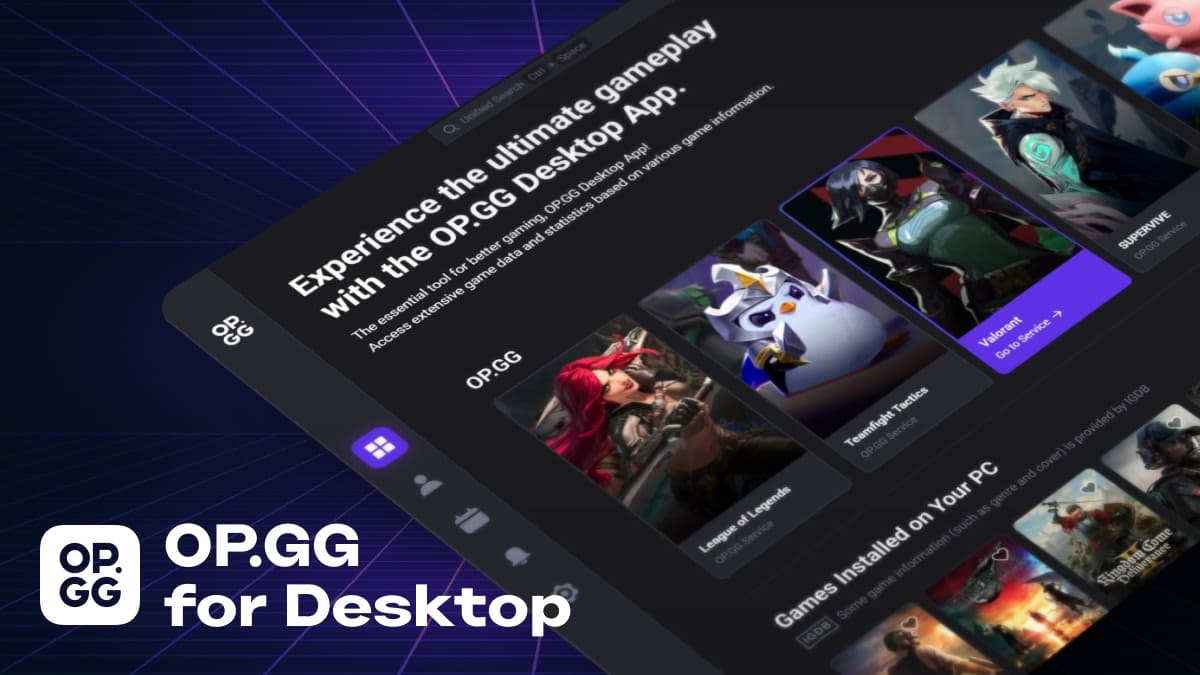
What It Actually DoesTurning three million games into one tier list
Here is the part that surprises people: OP.GG does not own the data it is famous for. The match records come from public game APIs, most notably Riot Games' API. Anyone can pull them. What OP.GG sells - for free, mostly - is interpretation. It ingests millions of ranked games, filters them by rank tier and region, and boils the noise down to a plain answer: on this champion, at this skill level, right now, this build wins most. OP.GG's own screenshots show the machine chewing through more than 3.3 million games at a time.
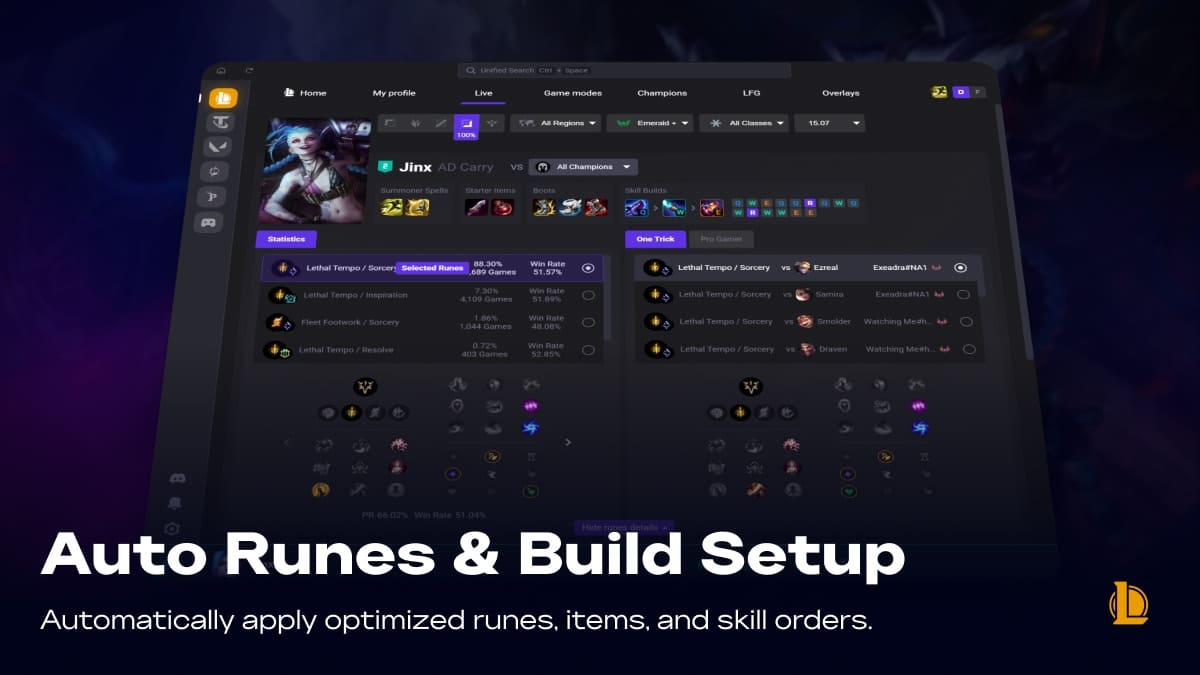
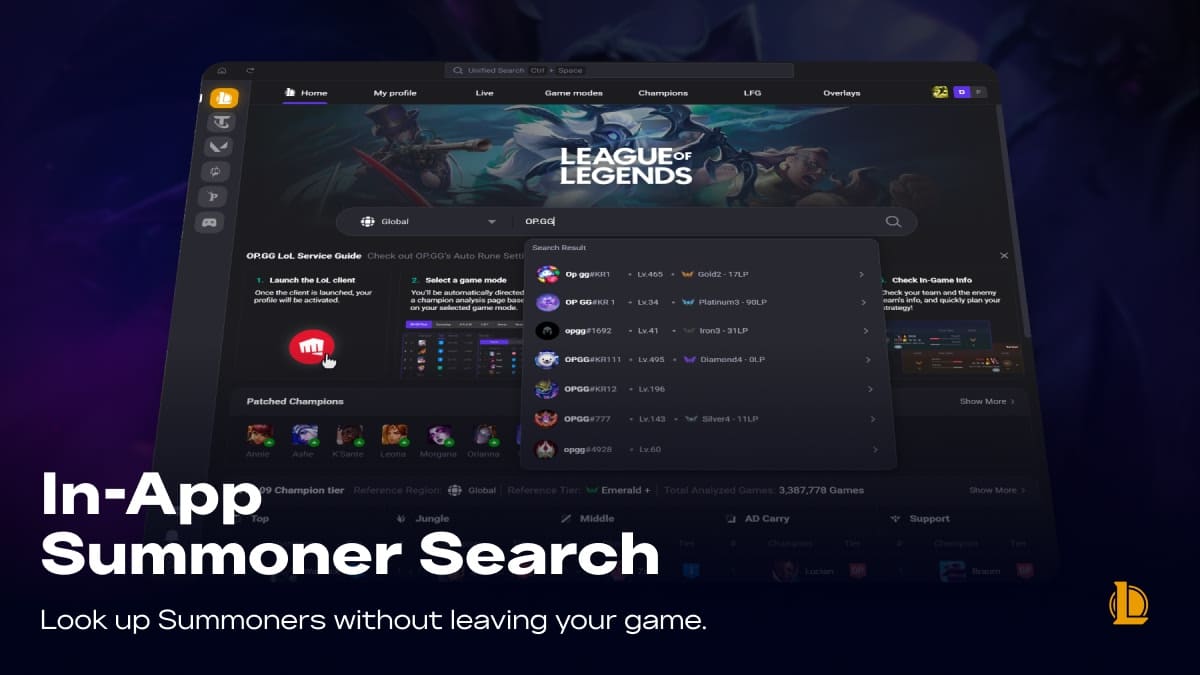
The desktop app is where the pitch gets literal. It detects your live match, applies optimized runes, items and skill orders, and lets you search another player without leaving the game. For a genre where a single misconfigured rune page can cost a match, having the answer arrive automatically is not a luxury feature. It is the reason the habit sticks.
The catalog is the other half of the story. What began with a single game now spans League of Legends, Valorant, Teamfight Tactics, PUBG and Overwatch 2, with lighter coverage that stretches into newer and beta titles as they arrive. Each game gets the same treatment - lookup, match history, tier lists, meta trends - wrapped in a consistent interface so a player who learns the tool for one game already knows how to read another. That consistency is quiet infrastructure work, and it is a large part of why a player rarely feels the need to leave.
The CompetitionSame data, different winner
If the data is public, why isn't OP.GG one of a hundred identical sites? It sort of is - U.GG, Blitz.gg, Mobalytics, MetaSRC and Tracker.gg all draw on the same underlying APIs. They compete on how they collect and filter, on interface, and on trust. Reviewers tend to hand U.GG the crown for raw statistical cleanliness and Mobalytics the edge on personalized coaching. OP.GG's advantage is narrower and, in consumer products, far more durable: it is the default. It is the tab players already have open.
Why "default" beats "best"
In a market where every competitor uses identical source data, the moat isn't the data - it's the habit. OP.GG's breadth of games, its live desktop overlay, and simple muscle memory keep users from ever comparison-shopping.
The lesson a builder can copy: win one narrow behavior so completely that switching feels like more work than it's worth.
A rough read on the field, by relative search visibility among League stats sites, looks something like this - not a market-share table so much as a sense of who owns the reflex:
Relative index of visibility and reach, approximate - illustrative, not audited market share.
The BusinessFree to you, paid by attention
OP.GG is largely free and mostly ad-supported, running standard ad infrastructure across an enormous, highly engaged, highly targetable audience of gamers. On top of that sit the desktop app, premium features, and - more recently - media. The through-line under a model that looks scattered is simple: own the player's entire day, from the pre-game lookup to the post-game review to the livestream they watch after they log off.
The audience makes that model work. OP.GG's users are not a passive readership; they are competitive and casual players who return constantly, often several times a session, because the product is tied to an activity they repeat for hours. That kind of engagement is rare and, for advertisers, valuable - which is why a free tool built on public data can support a real company. The scale is the point: roughly 55 million monthly visitors across more than 170 countries, reading in over 20 languages, is not a niche. It is a global default hiding inside a hobby.
The Surprise MoveA stats startup buys a TV channel
In 2022, OP.GG did something a data company is not supposed to do. It acquired OGN from CJ ENM - the broadcaster that, as one of the first game channels in the world, helped invent esports television over two decades. The same year, it partnered with the LCK, Korea's premier League of Legends competition, on YouTube broadcasts. On paper, a company that filters match data has no business owning a broadcast booth. In practice, it is the same land grab: if you already own the moment before and after the game, the game itself - watched, not played - is the obvious next room to walk into.
The TeamSmall company, large footprint
For its reach, OP.GG is not a giant - somewhere in the range of a few dozen to around a hundred employees, depending on how you count. Choi is known for a product obsession that goes down to design details, and for a hiring bar he keeps deliberately narrow. The company leans on employee autonomy and a flexible culture, and treats being gamers as an actual qualification rather than a perk. It is the kind of team where the founder still argues about pixels.
The Path HereFourteen years, one obsession
- 2012
A college side project: a League of Legends stats lookup. - 2016
Choi leaves university in his third year to go all in. - 2017
First institutional backing - a Series A round. - 2020
The desktop overlay app ships and reads live matches. - 2021
Series B, roughly $20M, to scale globally. - 2022
Acquires OGN; partners with the LCK on YouTube. - 2024
Coverage widens to newer titles like Palworld.
Where It FitsThe layer between you and the game
Strip away the game logos and OP.GG is a familiar kind of company: the connective layer that sits between a person and a thing they use constantly, quietly indispensable, easy to underrate because it never asks to be the main event. It doesn't make the games. It doesn't own the data. It just answers, faster and in more languages than anyone else, the one question a competitive player asks a hundred times a week - what's the meta right now? Fourteen years in, tens of millions of players have decided the answer lives at op.gg. That is a strange thing to build from a dorm room, and a hard thing to dislodge.