A kilogram of dark powder is an unimpressive thing to bring into a room. Yet in July 2024, at a plant in Moses Lake, Washington, that kilogram carried an extravagant proposition: make an electric vehicle battery go farther by changing the graphite already inside it. OneD Battery Sciences had spent more than a decade trying to make tiny silicon wires grow on the particles. In August, it announced that the pilot line was commissioned. Nine months later, news outlets reported that the line had shut. The interesting question is what survived the building.
- OneD grows silicon nanowires on EV-grade graphite for battery anodes.
- Its customers are suppliers, cell makers and car companies, not drivers.
- A $25 million Series C and a GM research pact arrived in 2022.
- After a reported pilot closure, OneD signed a 2025 deal with graphite maker Putailai.
The anode is the battery's receiving side when the car charges. Graphite is good at this job and industry knows how to buy, coat and test it. Silicon can store much more lithium by mass. It also swells as it charges. Put too much in the wrong form and the material fractures or loses useful contact. The alluring laboratory number becomes an exasperating warranty problem.
The part that swells
OneD's answer is SINANODE, a process for growing silicon nanowires directly onto commercial graphite. The wires cover surfaces and pores while remaining connected to the particle. The company says this geometry accommodates silicon's expansion and keeps lithium access open. It uses silane gas and chemical vapor deposition equipment; the result is still a graphite-based powder that can enter familiar electrode coating processes. The proposed trick is neither to abandon graphite nor to ask every cell factory to relearn how to make a battery.
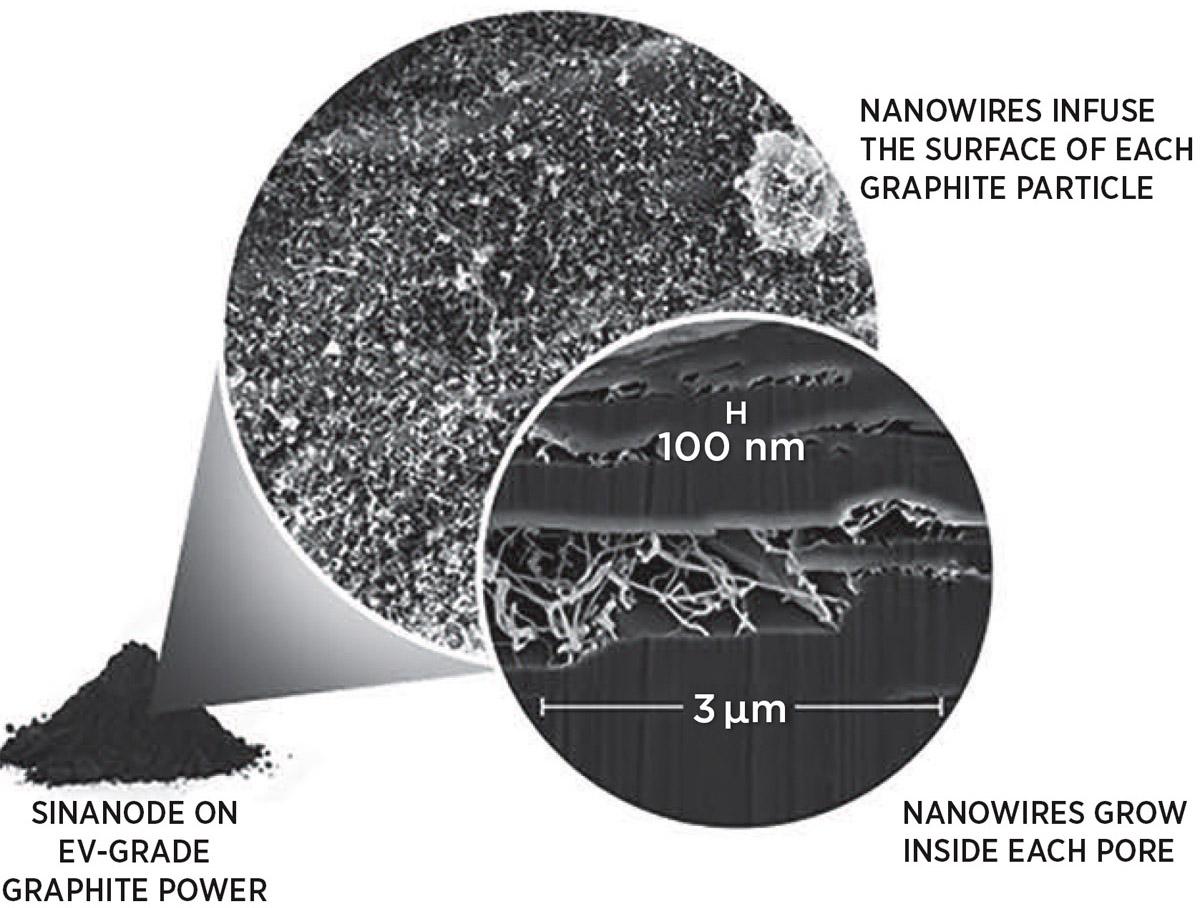
That compatibility claim is the heart of the business. OneD's rivals include silicon-anode developers such as Sila, Group14, Amprius and Nexeon, each with its own material and production route. Its quieter rival is plain graphite: cheap enough, qualified enough, and already everywhere. A better powder needs to justify its cost per unit of battery energy, survive long qualification programs and fit a customer's particular cell design. OneD advertises up to triple the anode's energy capacity, but anode capacity is only one part of a full battery. It is not a promise of triple driving range.
“The winners of the EV race will be those who can effectively add more silicon to the battery cell.”Vincent Pluvinage, OneD co-founder and former CEO, 2022
A research deal is a door, not a driveway
In 2013, OneD acquired nanowire technology and Palo Alto research activities from Nanosys. CTO and co-founder Yimin Zhu led years of work on the manufacturing process. In September 2022, General Motors signed a joint research and development agreement to study possible use of SINANODE in its battery cells. GM Ventures and Volta Energy Technologies participated in a $25 million Series C. This was a serious industrial invitation. It was not an announcement that production GM vehicles contained OneD material.
The company built a route for prospects that reads like a battery maker's escalating test: jointly tune the graphite substrate and silicon content; make enough material for cell and pack qualification; then license production to an industrial partner. Customcells agreed in 2023 to work with OneD on prototype cells for an automotive manufacturer. The partners in this story are paying attention to a problem consumers rarely see: qualification requires repeated, consistent batches, not a single heroic cell.
The expensive kilogram
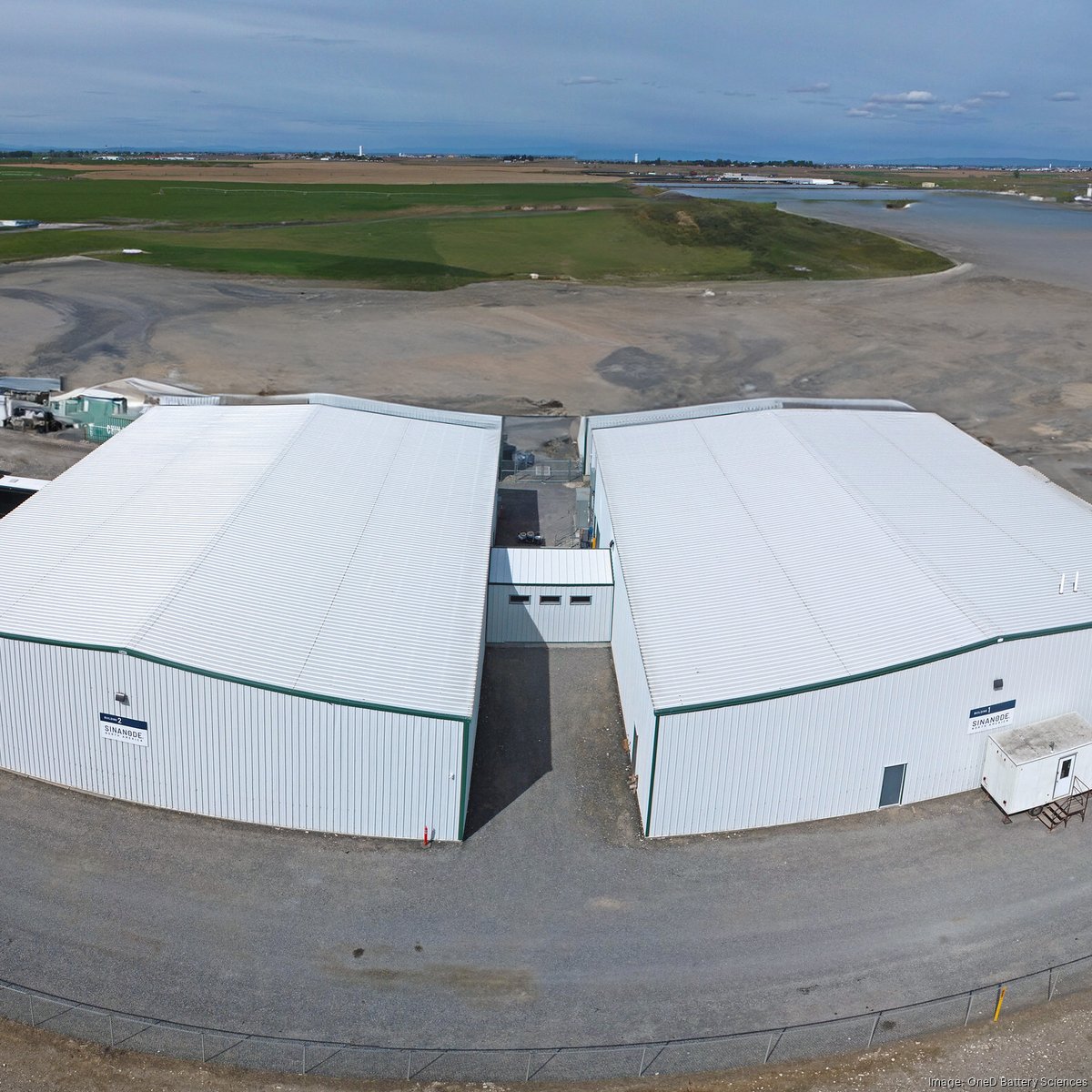
OneD's Moses Lake line was designed for roughly 100 tonnes of material a year, enough for qualification runs rather than a mass-market supply chain. The company announced its commissioning in August 2024. GeekWire later reported that OneD invested somewhere between $15 million and $20 million in the site and shut it in May 2025. Former CEO Pluvinage told The Information, as relayed by GeekWire, that tariff policy and weaker EV demand contributed to the closure. OneD's subsequent public materials do not give a detailed account of the decision.
The pilot's fate is a particularly useful reminder about the phrase “scalable chemistry.” A material may be technically possible to produce at volume and still arrive at the wrong moment for a specific factory, customer schedule or capital budget. OneD's own commercial plan had always pointed toward licensing instead of becoming a giant anode supplier. The closure made that distinction impossible to miss. The company could keep its intellectual property, process development and customer work while seeking a larger producer with plants and purchasing relationships already in place.
The recipe travels
In November 2025, OneD announced a joint development agreement with Shanghai Putailai New Energy Technology. Putailai is an established supplier of battery materials. The companies said they would finish product designs, tailor materials to customers and plan commercial scale production, with delivery through an existing anode supplier. Jeff Chamberlain, then OneD's CEO, called it the kind of arrangement the company had envisioned. The agreement marks a path, not proof that millions of cars now run on SINANODE.
A 2024 partnership with Koch Modular pointed at another bottleneck: silane, the gas used to grow the wires. Their proposed co-located plants would put silane production beside graphite processing, reducing transport and integration friction. The projected large plant was a design ambition. The known commissioned facility was the much smaller Moses Lake pilot, and that distinction matters whenever factory forecasts are turned into headlines.
OneD also commissioned a life-cycle assessment from Minviro. In 2025 the company said the assessment found that SINANODE-enhanced natural graphite, processed in North America or Europe, could reduce battery-pack carbon footprint by 35% under its modeled conditions. That is a conditional comparison, not a measurement from a fleet of finished cars. The useful feature is the unit: carbon per amount of energy storage delivered. A heavier process can still be attractive if each kilogram of material does more work, but only if the assumptions survive real production.
What another inventor can borrow
There is a modest, repeatable idea inside OneD's very specialized science. Start with a component that the customer already knows how to qualify. Change one step with a measurable benefit. Design the sales process around the customer's tests, not your laboratory calendar. Let a manufacturer with purchasing power and equipment scale the output if that manufacturer can make the economics work. OneD turned this into joint development, pilot qualification and licensing rather than a direct-to-driver product.
The limits are just as concrete. This approach depends on consistent graphite feedstock, affordable silane, controlled nanowire growth and a cell maker willing to spend time on qualification. A better anode is of little use if its cost, cycle life or factory yield disappoints. Nor can a license erase the investment required somewhere in the chain. OneD's reported pilot shutdown puts a price tag on that last sentence.
The company still has a specific proposition: improve a familiar battery ingredient while letting familiar suppliers carry it. Whether Putailai and other partners can move from joint development to qualified commercial cells remains the decisive test. For now, the most revealing object in OneD's history may be that kilogram of powder. It proved a process could leave the lab. It also showed how far a kilogram is from a car.