In January 2014, Omar Cissé opened a small shop in Parcelles Assainies, Dakar. It presented him with a peculiar inventory problem. Alongside the services a customer might want were all the separate ways of delivering them: mobile money operators, money transfers, different phones. Accepting more kinds of business meant managing more kinds of apparatus. The counter was becoming an exhibition of incompatibility.
He was already a software entrepreneur. Here was a problem with the advantage of being close enough to touch. A merchant should be able to serve a customer without conducting a small administrative expedition through several devices. Cissé set about putting those services together. InTouch was founded in 2014; its platform went into service in November 2015.
The name of the early solution, Guichet Unique, made a useful promise: a single window. From one device, a merchant could handle payments and distribute digital services. The convenience was easy to describe. Making the different systems cooperate would become the work of a company. A crowded shop counter had supplied a rather precise brief.
An engineer, then an employer
Cissé graduated in computer design engineering from Dakar’s École Supérieure Polytechnique in 2000. He later added an MBA from the Institut Supérieur de Management. Those two lines of education sit neatly beside the two recurring demands of his career: making the technology work and keeping the organisation around it in business.
In 2001, he co-founded the software engineering company 2SI. He served as its chief executive from 2005 to 2010. Long before InTouch had a network to describe, he had spent years running an engineering business. Clients, staff and delivery obligations were already part of the job. His route into payments passed through the ordinary disciplines of providing a service someone would pay for.
Computer work also ran through the family. His father was a computer engineer who became an entrepreneur, and his older brothers followed that path. Cissé has described the early web years as a time when he and his friends recognised that their skills could become something to sell. The family connection is a concrete part of his beginnings, alongside his formal training and the colleagues with whom he started building.
Helping founders, then finding their money
In 2010, Cissé moved into a different kind of construction: CTIC Dakar, an incubator for information and communication technology businesses. He helped launch it and directed it until 2013. Building an incubator required assembling an organisation around other people’s companies. Entrepreneurs needed support as well as a place on a list of promising projects.
The initiative brought together public and private participants, including the World Bank’s infoDev programme and Senegalese partners. Its practical concern was how to help technology businesses develop. For Cissé, this expanded the field of view from the fortunes of one software company to the conditions facing a group of young firms.
Money became the next question. He co-founded Teranga Capital with Olivier Furdelle, working with Investisseurs & Partenaires. By June 2015, the partners were preparing a fund intended to help small Senegalese businesses obtain capital and become better structured. Teranga Capital formally launched in March 2016.
The companies they sought to serve occupied an awkward financial interval: beyond the reach of microcredit, yet too small for conventional bank financing. Cissé explained that gap in a 2018 interview. It is an unusually unromantic description of entrepreneurship, and a useful one. A capable founder can still be the wrong size for the available cheque.
- 2001Co-founds software company 2SI
- 2010Launches and leads CTIC Dakar
- 2014Founds InTouch
- 2016Teranga Capital formally launches
A petrol station becomes a distribution channel
InTouch began with four engineers working with their own resources. By 2018, Cissé was describing a workforce approaching 200. He also described how Total first accepted the solution in its service stations and later became an investor. The sequence matters: the product had an operating use before the commercial relationship acquired an ownership component.
On July 13, 2017, Total and Worldline signed technological, commercial and financing agreements with InTouch. The initial deployment covered eight countries: Senegal, Côte d’Ivoire, Cameroon, Kenya, Mali, Burkina Faso, Guinea and Morocco. Worldline brought payment expertise and hosting infrastructure; Total brought a service-station network through which the product could travel.
For a founder building a payments business, distribution is a concrete concern. A service needs places where people can use it. A petrol station already has a counter, customers and repeated transactions. InTouch’s partnerships connected its software to an existing commercial footprint, while bringing the technical support required to operate across several markets.
The investor group widened again in 2021, when CFAO and Mobility54 joined. Cissé publicly welcomed the investment and thanked Worldline and TotalEnergies for renewed backing. His company’s growth involved a continuing relationship with industrial partners, alongside the engineering work and merchant relationships that had started the business.
Small transactions, serious bookkeeping
Ask Cissé what the company does for businesses, and he returns to the work surrounding a payment. Accepting money is only part of it. Invoicing, monitoring and reporting also matter. In his April 2024 interview, he described the difficulty of managing large numbers of small transactions across different channels. A single platform gives the business a more manageable view of that activity.
He described banks and microfinance institutions as technical partners. That choice puts InTouch alongside existing financial organisations, helping digitise their relationships with customers. For someone whose previous work included both an incubator and an investment fund, the attention to small businesses is consistent. Payment management was another obstacle he had encountered while working with entrepreneurs.
For the merchant, this brings the story back to the counter. A customer may see one transaction. The business has to account for it alongside all the others, across the methods it accepts. That everyday administrative burden is central to the problem Cissé describes, even as the company operates across more markets.
The financial discipline extended inside InTouch. In a May 2024 interview, Cissé reported a full year of positive EBITDA in 2022 and positive net income in 2023. EBITDA is an operating earnings measure; net income comes after further expenses. Those are different milestones, and he described both. The next task was to keep growing while preserving profitability.
He also called InTouch a “multi-country start-up.” The phrase captures the organisational problem he was discussing: keeping initiative alive while operating through multiple national teams. He said the company recruited entrepreneurs who could take responsibility and develop ideas. Growing the geographical footprint meant making room for other people to act.
“We hope to be by 2027.”
Omar Cissé, asked whether InTouch was a unicorn, April 2024
An ambition expressed in 2024, rather than a valuation announcement.
Milestones reported by Cissé in May 2024.
Ten thousand places to begin
In November 2020, InTouch and the Mastercard Foundation announced the 10,000 Jambaars programme. It aimed to support and mentor 10,000 young entrepreneurs in Senegal through a network distributing digital services, with particular attention to young women. The announced number was a target. The opportunity was practical: help people build an activity around services that customers already needed.
The programme linked the company’s merchant network to the work of helping new entrepreneurs start. Technology was one ingredient; support and mentoring were part of the stated design. It brought Cissé back to a familiar concern from his incubator years, this time through the distribution system of a payments company.
The physical network remains visible in InTouch’s offering. An August 2026 account described MyTouchPoint for remote payment collection, APIs connecting the company’s services to other platforms, and a bulk-payment tool for sending money to multiple recipients. It also described a network exceeding 60,000 TouchPoints. The digital business still had plenty of physical addresses.
The case for backing your neighbours
At the company’s anniversary celebrations in February 2025, Cissé asked local investors to put more money into technology businesses. He specifically urged them to diversify beyond property. Having secured financing for InTouch, he asked how many other African start-ups would get the same opportunity. His argument reached beyond the prospects of his own company.
He also supported the ambition to develop national technology champions within Senegal’s New Deal technologique strategy. He argued that emerging businesses needed an environment in which they could grow into lasting African companies, with sustained public support. The founder who had helped create an incubator and a fund was still discussing the machinery around entrepreneurship.
His comments about management are similarly concerned with foundations. He has spoken about keeping a team cohesive over time, and about making everyday decisions according to principles. It is a less theatrical subject than a financing announcement. It also has more opportunities to go wrong before lunch: hundreds of decisions, made by people who need to trust how the organisation works.
Back at the counter
In February 2025, Cissé appeared on Afrofeeling’s Afropod for a long conversation about entrepreneurship, leadership, ethics and teamwork. It offered a public view of the subjects occupying him beyond product specifications. His career gives those topics a sequence: engineer, company manager, incubator director, investment-fund co-founder, payments founder.
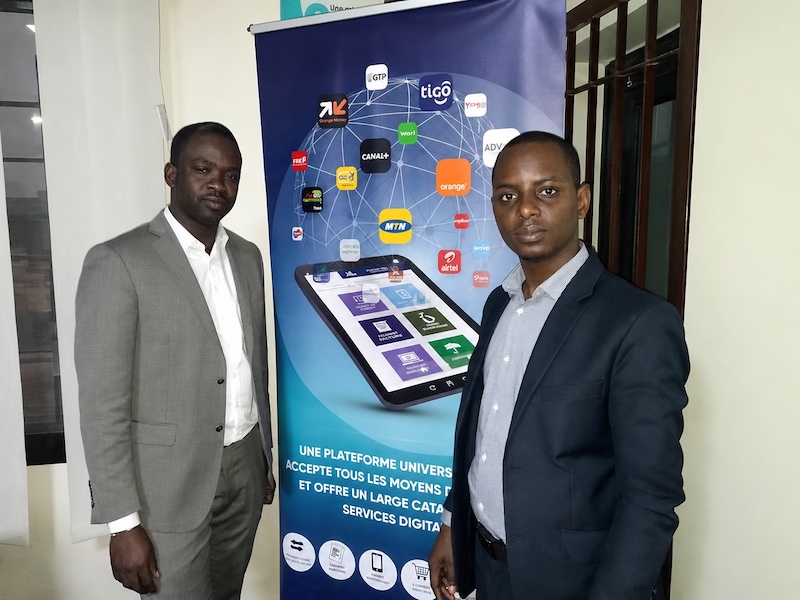
A photograph taken at InTouch in February 2019 resurfaced in a July 2026 recollection by interviewer Ousmane Gueye. Cissé stands beside him and a display connecting different payment brands to one tablet. It is a remarkably efficient explanation of the original idea. Years of engineering and partnerships, reduced to the thing a shopkeeper needed to see.
Cissé’s stated ambition is broader: make payment acceptance easier for businesses across Africa and simplify transactions between countries. Different operators, currencies and regulations make that a continuing task. The ambition has grown in geographical scope; the practical test remains familiar. A customer wants to pay. A merchant wants to get on with the day. Somewhere between them, the phones ought to agree.