An introduction is a peculiar kind of work. Do it well and two other people get the interesting story: the partnership, the job, the idea that finally found its collaborator. The person who brought them together can disappear from the telling. Oliviana Bailey has spent much of her career in that easily overlooked position, helping an industry meet itself.
One former colleague, Mick Jongeling, remembers her work at Cumulus Park through precisely that detail. She learned what interested him, understood what he could offer, and introduced him to people whose interests connected with his. In his account, joining a professional community began with someone taking the trouble to listen. Bailey made the network feel accessible at the level of a single person.
Today she is co-founder and co-CEO of AI4ALL, a Netherlands-based nonprofit working to widen participation in artificial intelligence. The title makes her place in the field look settled. Her account of getting there is more interesting: years of relevant work, accompanied by uncertainty about whether someone with her background quite counted as being in AI.
A business degree with a philosophical complication
Bailey’s undergraduate education offers an early clue to the range of her interests. At Marymount Manhattan College, where she belonged to the class of 2016, she majored in business with a leadership concentration. Her minors were accounting and philosophy. One asks whether the numbers add up; the other reserves the right to question the question.
She studied abroad in Ireland. In her senior year, she took a management internship at the U.S. Consulate General in Milan. The responsibilities were concrete: helping coordinate special events and VIP visits, working on procurement and housing presentations, and organizing leases and other administrative material. She supported a management operation serving more than 100 employees and American family members.
It is an instructive opening chapter for someone whose later work would involve making complicated groups function. There was international experience, certainly, but also logistics. Any institution that promises an impressive public occasion still needs somebody to know where everything goes.
The Netherlands, then the network
Born in the United States, Bailey came to the Netherlands to study international relations. Her public education record lists Webster University Leiden in 2016 and 2017. An internship at The Hague Institute for Innovation of Law involved developing connections across North and South Africa. The work combined her interest in international affairs with the practical business of connecting organizations.
Amsterdam’s startup scene supplied the next setting. At Rockstart she worked as a community manager and later Head of Community. She subsequently moved to ING’s Cumulus Park, an innovation district where the participants included companies and local communities. Each setting required attention to people arriving with different purposes and different ways of working.
Those transitions help explain why the word community recurs so often in her career. An accelerator, a corporate innovation district and a nonprofit have different mandates. They all depend, however, on whether the people involved can find a useful reason to engage with one another.
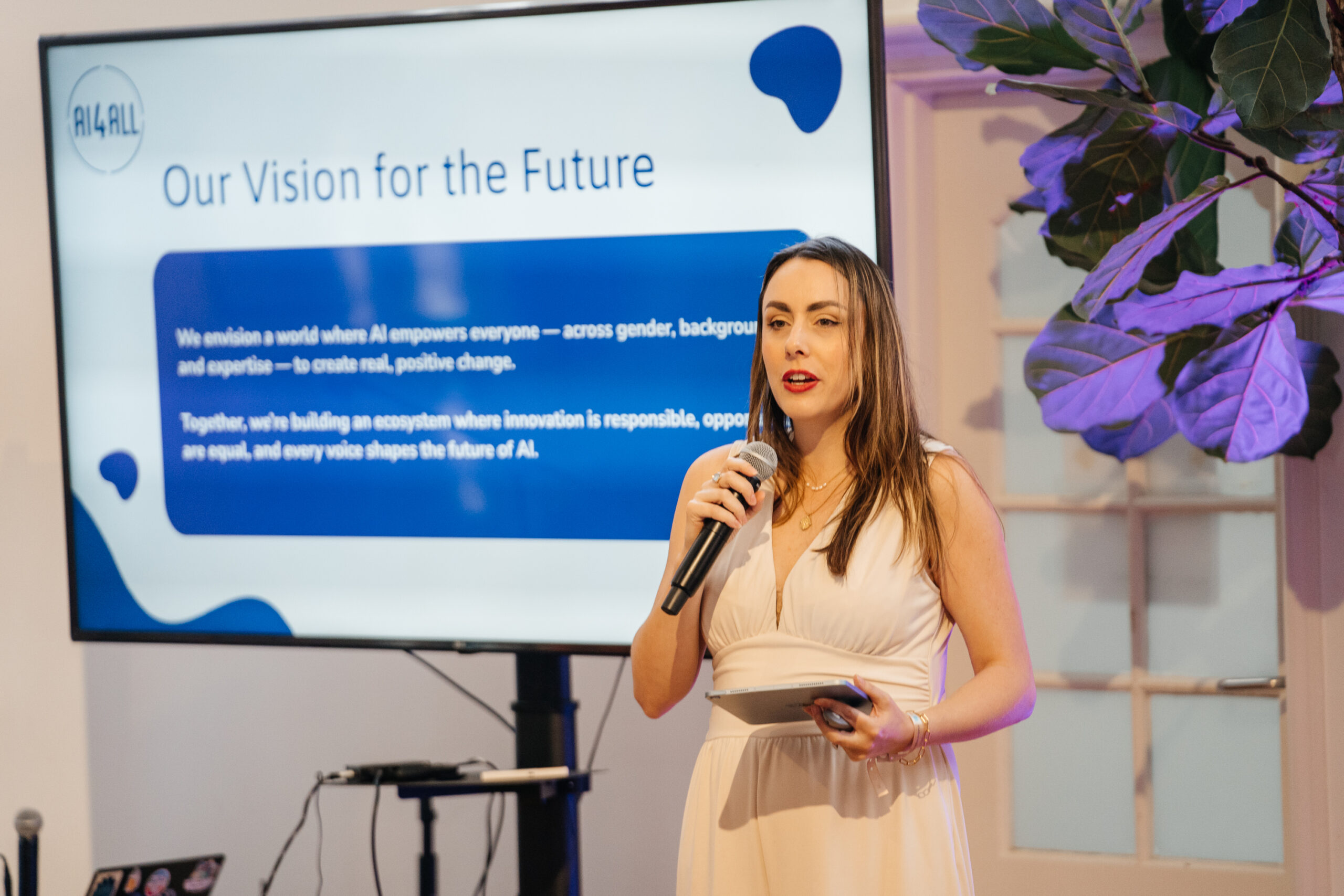
AI before the crowded conversation
There is a dated trace of Bailey’s AI work well before the current rush of general-purpose chat tools. On October 1, 2018, she published an invitation on the European Commission’s Futurium platform for Rockstart AI’s presence at World Summit AI in Amsterdam.
The program concerned collaboration between startups and established companies. Rockstart was returning to a discussion of what those groups could learn from working together, using experience with its alumni startups. The event listing points to a familiar tension: a young company may have something worth building, while a larger organization has resources and a problem that needs solving. Making the connection work takes its own effort.
Bailey was already operating in that space. The date matters because her career in AI did not begin when the subject became a standing item in everyone’s inbox. Its earlier form involved programs, partnerships and people who needed introductions.
Art enters the discussion
A Goethe-Institut program for a debate at Het Nieuwe Instituut in Rotterdam places her in another conversation: artificial intelligence in arts and culture. Listed as a Rockstart program associate, Bailey appeared alongside participants whose work included art, festivals, design research and media research.
The program asked how AI was being used by artists and cultural institutions, what startups could contribute, and how technological developments might affect cultural work. It described Rockstart’s AI program as a route to networks, partners, talent, capital and mentorship.
That is a revealing combination of subjects and participants. AI was being discussed through what it could mean to people working in other fields. Bailey’s role belonged to the machinery of exchange: helping ideas travel between organizations that would not necessarily use the same vocabulary. A room like that has questions well beyond how a system is built.
Making the local invitation count
By 2021, Bailey was working at EscherCloud as Community and Ecosystem Lead and becoming the Netherlands ambassador for Women in AI. At EscherCloud, the work included building a lab community around AI applications and collaboration with NVIDIA. Later professional biographies credit her with leading the Hyperion Lab launch and an NVIDIA partnership.
Taking on the ambassador role, she argued for more local attention. Her experience at ING had exposed her to the distance between the opportunities offered by a broad network and the people who could actually reach them. Connecting local community managers with universities was one possibility she wanted to pursue.
The ambition was specific enough to be useful. A community can announce its openness and still be difficult to enter. Location, introductions and access to education influence who can participate. Bailey’s attention kept returning to the arrangements around the invitation.
A recurring subject, before a foundation
In November 2022, Bailey joined Jasper Wognum on The Automagic Podcast for a 32-minute conversation about building communities and inclusive AI. The episode brought together her experience at Rockstart and Hyperion Lab, her ambassador work, and the question of how an accelerator establishes an AI program.
Read alongside the earlier events, the appearance gives her career a continuity that a list of employers can obscure. The institutions change. The recurring concern is how participation gets organized.
There is also a difference between having an interest in inclusion and undertaking the patient work it requires. Programs need participants. Communities need reasons to return. A mentoring relationship needs a meeting that actually happens. Bailey’s professional experience repeatedly places her near those practical obligations.
Four people at the beginning
When Bailey announced her departure as Women in AI Benelux ambassador after four years, she named the people with whom she was building AI4ALL: Alla Idrisova, Karen Harriss and Jana Wilhelmus. They had come together as volunteers at Women in AI.
The announcement connected their shared experience to a desire to support a wider range of challenges through communities. The first community they were launching focused on women. Here was an organization emerging from work already done together, with relationships preceding the new name.
AI4ALL’s public team listing gives all four co-founder colleagues co-CEO titles, with Wilhelmus also heading strategy. Around them are volunteer responsibilities for mentoring, meetups, entrepreneurship, youth programs, masterclasses and communications. Shared leadership is visible in the organizational particulars. The person delivering the opening remarks belongs to a larger undertaking.
The content person understands the room
Bailey also worked in content at The Next Web. In May 2025, a TNW Backstage episode brought together comedian Derek Mitchell, TNW co-founder Boris, and Bailey, then its head of content, who previewed the conference’s coming activities.
The surrounding conversation ranged across humor, startup ideas and the character of a technology event. It is a useful reminder of the audience work in her background. A conference has to choose what people will hear and how they will encounter it. Serious subjects still need people willing to pay attention.
That experience sits comfortably beside the partnership roles. Both depend on understanding what will make a particular group engage. Technology has plenty of complicated material; deciding how to bring people into the conversation is another professional task entirely.
The room, with its people in it
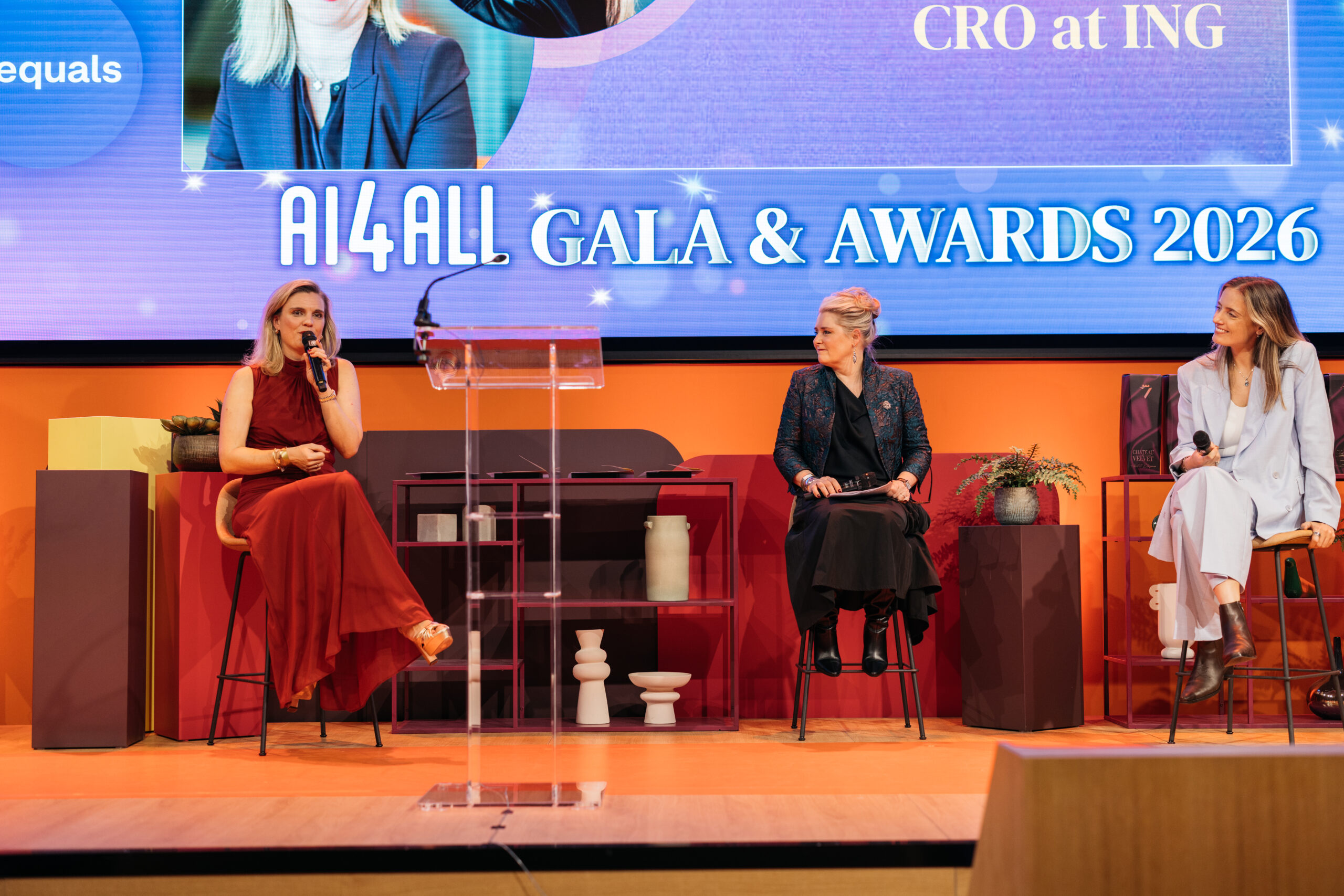
On February 6, 2026, AI4ALL’s gala brought 130 AI leaders, enthusiasts and curious attendees to ING’s Cedar Building in Amsterdam. The evening included awards, fundraising and a silent auction. A magician supplied the less predictable portion of the proceedings.
Bailey’s opening remarks emphasized the possibilities created by people working together. The guest list and program supplied a concrete version of that ambition: people with different positions in the industry gathered around a common organization.
A gala is only one kind of community occasion, and an unusually well-dressed one. But it makes something visible that can be harder to see in day-to-day organizing. The network has people in it. They can meet, contribute and recognize work that might otherwise pass outside their view.
A path someone else can picture
In Equals’ 2026 role-model campaign, Bailey described the value of seeing careers beyond the familiar few. Her own work had involved supporting founders and connecting people rather than writing code. She wanted more women to see opportunities to help shape AI through that broader range of contributions.
“The fewer role models you see, the harder it is to imagine your own path.”Oliviana Bailey, Equals role-model campaign
The remark gives her biography a purpose beyond an account of promotions. Someone reading it can identify useful experience they already have: running a program, translating between groups, knowing when two people should meet. Her career makes those activities visible within an AI setting.
The invitation gets practical
By autumn 2026, her teaching work included a workshop advertised for October 6 at Equals Amsterdam. Participants were invited to bring a laptop and a real challenge, then work with Make.com, Claude and an open-source model to develop an automation.
Her Data Expo program also described a session on assessing tasks for AI workflows, including task fit, data flow and security. These are questions about the work in front of someone: what it requires, how its parts connect, and what needs care before automation begins.
The organizer’s eye remains recognizable. First understand the situation. Work out what belongs together. Help someone take the next step. After years of making introductions in AI, Bailey is extending an invitation that comes with something to do once you arrive.