The most revealing thing about OBSS is the range of old and new technologies that appear in its orbit. COBOL and IBM CICS sit near Kubernetes and Kafka. Oracle Forms shares a page with Databricks, OpenTelemetry and generative AI. That is not a confused shopping list. It is a map of the actual enterprise: decades of systems that still move money, approve policies and reconcile transactions, surrounded by the cloud services and mobile interfaces customers now expect.
OBSS makes its living in the seam between those worlds. Founded in Istanbul in 2005, the privately held software and consulting company has grown to more than 1,000 engineers, with offices publicly listed in Istanbul, Ankara and London. Its customers are the sort of institutions where a clean-slate rewrite is usually fantasy. Banks cannot stop banking while a new architecture arrives. Retailers cannot suspend checkout for a migration. Insurers cannot lose the audit trail while making a claims journey less painful.
So the product OBSS really sells is controlled change. The visible output may be a banking app, an insurance sales channel, a retail search engine or a customer-support site. Underneath is a less photogenic stack of architecture decisions, integrations, test automation, data pipelines, release controls and people who know which dependency will object first.
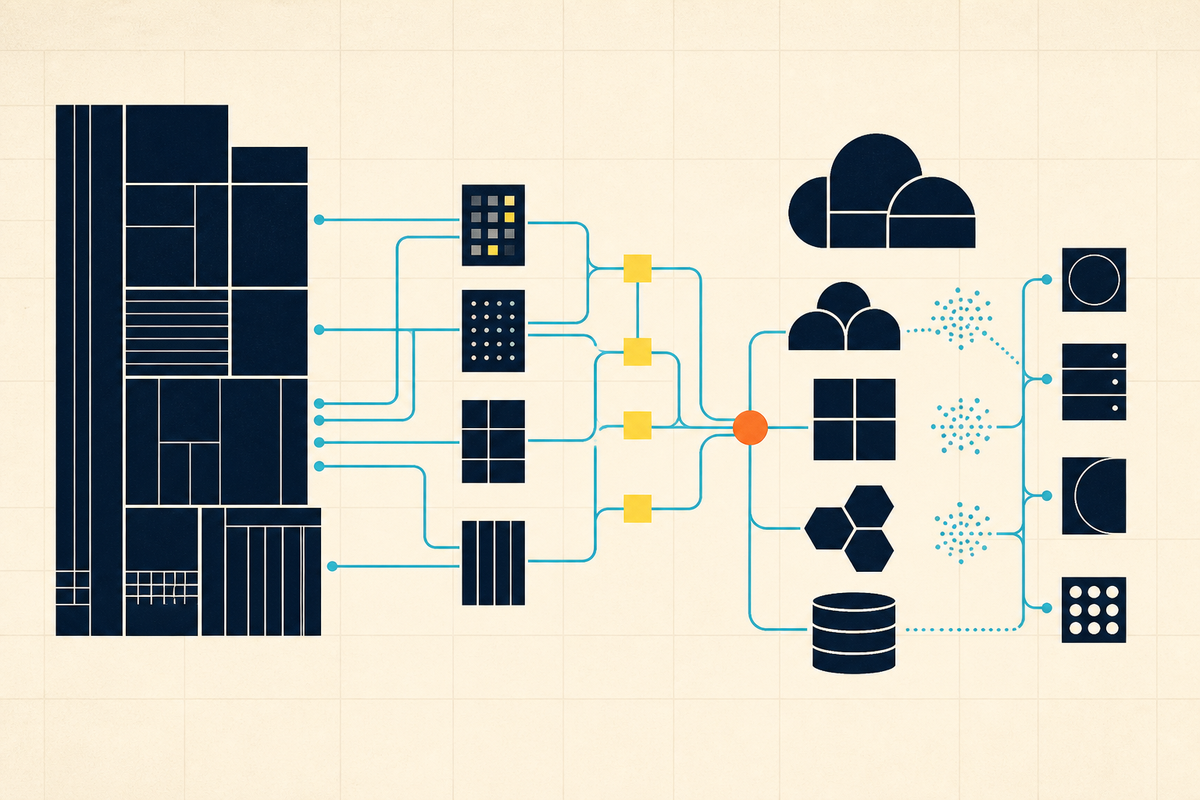
The difficult middle
There are larger global integrators and smaller specialist studios. OBSS sits between them: enough delivery capacity to field substantial teams, but with its roots in hands-on software engineering rather than boardroom strategy alone. Its public capabilities cover cloud transformation, data and AI, architecture assessment, DevOps, security, product design, software testing and team augmentation. The industries repeat a pattern - finance, insurance, retail, e-commerce, telecommunications, aviation and defense all combine high transaction volumes with low tolerance for improvisation.
The case studies are more useful than the capability nouns. For ING's OBizz corporate banking work, OBSS says a microservices rewrite helped reduce response times in credit evaluation and supported 2,000 daily transactions. A prospective business customer could approve documents digitally instead of waiting for couriers, a very specific pandemic-era bottleneck with an obvious cost.
At Unico Insurance, the assignment spread across web, mobile, call center, agency and broker channels. OBSS reports that the resulting system created a direct-sales channel, increased lead generation fivefold and lifted customer acquisition by 15 percent. Sony's support platform is a different kind of proof: a multilingual service site, personalized product information and firmware discovery serving roughly one million daily users, according to the case study.
“We leverage technology to empower people and the ecosystem.”OBSS corporate purpose
These are company-published numbers, not independently audited performance measures. But they show how OBSS wants to be judged: fewer abandoned applications, faster decisions, lower support demand and systems that survive volume. The consultancy vocabulary matters only when it produces one of those outcomes.
One firm, two economic engines
The core business is familiar. An enterprise pays for consulting, implementation, project delivery, managed engineering, licenses or extra team capacity. OBSS supplies specialists and accepts responsibility for a defined part of the technology estate. The company says its relationships with sector leaders last more than seven years on average. That longevity is commercially important because domain memory compounds. A team that understands a bank's exceptions, release rituals and internal owners can start its next project several floors above zero.
The second engine is smaller and more intriguing. OBSS Apps packages recurring annoyances in the Atlassian ecosystem. Timepiece measures how long Jira work remains in each status while respecting actual work calendars. Historian turns issue changes into an audit-friendly record. Baselines compares versions of Confluence pages. TicketBook tracks service contracts and quotas. Keychain, Field Sync and SearchMate handle other gaps around credentials, field synchronization and dependency searches.
High-value, tailored work where architecture, domain knowledge and delivery capacity matter more than repeatability.
Focused Atlassian apps that sell the same solution repeatedly, with marketplace distribution and recurring licenses.
Projects such as SAHI, a sliced-inference framework that helps detect small objects in large images.
A separately branded studio and fund that trades capital and engineering capacity for exposure to startup growth.
This is a useful flywheel if OBSS can keep it turning. Consulting exposes the company to repeated workflow problems. Product teams turn the most portable problems into software. Marketplace users broaden distribution beyond bespoke accounts. Open-source work earns technical credibility and attracts engineers. OBSS Ventures, established in 2023, adds another route: provide capital and product-development capacity to startups, then participate in the value created.
AI enters the org chart
In 2026, OBSS moved “AI-native engineering” to the center of its pitch. That phrase is easy to abuse, but the company's version is more operational than magical. It describes specialized agents placed inside delivery workflows, working with persistent context, playbooks, validation layers and quality controls. The proposal is not that a chatbot replaces a thousand engineers. It is that repeatable parts of analysis, documentation, testing and code production become systematized while people retain responsibility for architecture, exceptions and release risk.
Regulated industries are a sensible proving ground. A bank has plenty of repetitive engineering work and no permission to become casual about it. Code must be reviewable. Decisions need an audit trail. Data cannot wander across borders because a model found that convenient. OBSS's recent Microsoft AI Platform on Azure specialization, plus partnerships with AWS, GitLab, Red Hat, Confluent, Databricks and GitHub, gives it access to the tools. The differentiator will be whether its controls make those tools usable in production.
The partnership list also reveals how the firm goes to market. OBSS does not ask a client to accept a proprietary universe. It meets technology departments inside platforms they already bought, then earns fees for assessment, migration, configuration, engineering and support. With Atlassian, the relationship dates to 2008 and covers licenses, cloud moves, Jira and Confluence configuration, training and custom applications. OBSS says a dedicated team has handled more than 500 projects for over 200 organizations across three countries. With AWS and Azure, the work expands into architecture, cost optimization and cloud operations. Confluent and Databricks fill in the streaming and analytics layers.
For a chief technology officer, this model reduces one kind of risk: the partner has recognizable certifications and a direct line into the vendor ecosystem. It creates another dependency, because every additional specialist must understand both the platform and the client's operating reality. OBSS's claim to difference is that it can connect those layers. A cloud bill is not treated separately from the application portfolio producing it. A machine-learning model is not useful without reliable data pipelines and a deployment path. A redesigned customer journey is unfinished until the core system can honor the transaction.
There is also a talent argument. OBSS says it has a database of 50,000 people whose technical skills, code quality and professional interest were assessed directly. Its CodeMaster and CodeCamp programs turn recruiting into ecosystem building, while a 2026 internship centered on spec-driven development and mandatory AI orchestration signals what it expects junior engineering work to become. The company reports that women hold half the positions on its leadership team and describes mentoring as part of its culture.
That talent machinery matters because customers are not merely buying code by the hour. They are buying access to scarce combinations of knowledge: an engineer who understands mobile identity verification and banking controls, a data specialist who can work around fragmented customer records, or a delivery lead who can sequence releases across internal teams and outside vendors. Remote team augmentation can fill an empty seat quickly. The harder service is assembling a group that becomes useful before the client's deadline moves again.
Where OBSS fits
The alternatives are plentiful. A multinational can hire Accenture, Deloitte, Capgemini or Cognizant. A product leader can assemble specialists, buy a banking platform or expand an internal engineering organization. Cloud vendors and their partner networks compete for the modernization budget from another direction. Against them, OBSS offers scale without quite presenting as a general-purpose conglomerate, plus detailed experience in Turkish and European financial systems.
Its defensibility is not a secret algorithm. It is scar tissue: knowing why an elegant replacement will not pass a regulator, which customer journey hides three manual approvals, how a retail promotion breaks a stock feed, and when the safe modernization is a bridge rather than a demolition. Partnerships provide credentials. Products create leverage. The long client relationships preserve context.
That also defines the risk. Services businesses grow by adding people unless software and automation change the curve. AI may increase throughput, but every large integrator is making the same argument. Marketplace products can create recurring revenue, yet they live inside another company's ecosystem. And the more OBSS expands across industries and countries, the harder it becomes to keep its engineering identity sharper than its sales catalog.
Still, there is something durable in the company's unglamorous position. Most transformation is not invention. It is negotiation between the system a company has, the system customers want and the system operations can safely support. OBSS has spent 20 years learning that negotiation. The app on the screen is merely where the work becomes visible.