A publicist has plenty of ways to make a document travel. Noy Assraf Barnes is interested in what happens when it arrives. Does anyone read it? Does anyone believe it? Will the person behind the announcement answer a question? For the founder and CEO of Noyse, those are professional questions with an awkward habit of spoiling an otherwise handsome report.
Her own business updates sometimes carry a little of that impatience. Marking two years since founding NSA Creatives, she described the work of building a team, then interrupted the familiar promotional rhythm to make fun of LinkedIn buzzwords. The sales pitch briefly acquired a raised eyebrow. It is a useful introduction to a communications executive who writes critically about the conventions her industry sells.
Barnes now leads a firm working across public relations and social media. Before that came military communications, agency accounts, and the Israeli consulate in New York. The route matters because her subject has stayed fairly consistent: the difficult relationship between what an institution wants to say and what another person is prepared to hear.
A career spent answering to an audience
She served in the IDF Spokesperson Unit and subsequently joined CRPR, where she rose to VP of Clients. The work included major American Jewish organizations and press delegations. These were roles involving institutions and their encounters with journalists, rather than simply producing material for an organization’s own channels.
At the Consulate General of Israel in New York, Barnes became Director of Media Outreach and then Director of Strategic Communications. Her remit involved the American press. She also holds two degrees from the Open University of Israel: a bachelor’s in Social Sciences and Humanities and a master’s in Governance and Public Policy.
Her LinkedIn profile lists English and Hebrew at native or bilingual proficiency, with limited working Spanish. That is a concrete detail in a career involving different national audiences. Language is part of the professional equipment here, alongside the less easily listed work of understanding what an audience already knows, assumes, or wants explained.
The titles sit alongside an earlier public interest in how Israel addresses Jewish communities elsewhere. In April 2019, she published an opinion piece urging the next diaspora minister to engage with disagreements between Israel and diaspora Jews. She criticized the habit of attending major gatherings while avoiding the difficult conversation those gatherings made possible.
That argument offers a useful point of connection with her later work. An audience can be assembled and still go unheard. A trip, an appearance, a prepared message: each can happen without the exchange becoming useful. Reading her career through that question gives the sequence of jobs a little more meaning than a ladder of increasingly senior titles.
The business, and the buzzwords
Her anniversary post about NSA Creatives described starting in New York and expanding operations to Washington, D.C., and Miami. She singled out the value of agility and colleagues who could support clients when circumstances changed. The emphasis was on having other people beside her when the work became difficult.
Then came the joke about feeding LinkedIn’s appetite for professional vocabulary. It worked because she was participating in the ritual while pointing at it. Anyone who has written a business announcement knows the temptation: add another adjective, mention the strategy, assure the reader that everything is tailored. Soon the paragraph is wearing three watches and checking none of them.
In a subsequent post about work with Nefesh B’Nefesh, she mentioned an approaching publicity-management rebrand. The Noyse name now supplies an uncomplicated invitation to make some noise. The more revealing question is what the firm promises to put behind that invitation.
- 01Military communications
- 02Agency leadership
- 03Diplomatic communications
- 04Founder & CEO
A name beside the responsibility
Noyse describes an arrangement in which each account has a named senior lead who remains responsible for strategy, major decisions, important materials, and the client relationship. Other team members support production and delivery. For Barnes, whose role includes client strategy and positioning, that places responsibility close to the work being sold.
There are identifiable disciplines around her. Joseph Wolkin, the firm’s VP of PR, brings a journalism background; Romi Zrihen leads social media. Their remits cover different parts of how an organization meets the public. A reporter’s question and a video edit require different kinds of judgment, even when both concern the same person.
The firm offers ongoing communications work as well as assignments around announcements, delegations, events, and other defined moments. Its PR services include preparing spokespeople and coordinating interviews. Those details put some substance around the expansive word “publicity.” Much of the job happens before a reader ever encounters a finished story.
On the social side, Noyse describes planning, filming, editing, design, and writing under coordinated direction. That creates practical opportunities for the two services to meet: an interview can suggest a digital piece, while an event can produce material for several channels. The organizational challenge is keeping the decisions connected without making every output identical.
There is also a public credit outside the firm’s own pages. The Dinah Project names Barnes and Noyse Publicity Management for its USA public relations, alongside Yaniv Rosenberg’s separate PR credit. Such credits make a small part of the work visible: the communications people helping a project reach an audience, usually outside the main frame of the story.
The trouble with a beautiful receipt
In July 2026, Barnes published an essay challenging the presentation of press-release syndication as evidence of meaningful media success. Her criticism concerns the sales transaction: clients may believe they have bought attention when what they receive mainly demonstrates distribution. A long list of links can look reassuringly busy.
Her verdict gives the tactic a suit it has done little to earn. She allows a role for formal announcements and disclosure. Her objection is to letting the delivery mechanism stand in for the entire professional service.
The essay also makes her own business answerable to a tougher question. If distribution alone is insufficient, the adviser must explain the choices behind the work. Why this audience? Why this moment? An attractive spreadsheet cannot settle those questions by becoming longer. The standard she proposes asks for an account of judgment, something rather harder to attach to an invoice.
“It is the lazy option wearing a suit.”
Noy Assraf Barnes, on selling wire distribution as media strategy
Coffee before the conversation
One of Barnes’s public reflections concerns a very different setting for attention: neighborhood coffee shops. She described helping bring Sip & Listen to life with Yad Vashem USA Foundation and The Blue Card, bringing Holocaust survivors into cafés for conversations with everyday people around Yom HaShoah.
Her account mentioned coverage from outlets including NBC, CBS, and Time Out. But she also described the project reaching her personally, beyond the professional routine of securing placements. The encounter itself stayed with her: people meeting someone whose story might otherwise have remained distant.
The idea has a practical grace. A café already belongs to ordinary life; it does not require visitors to adopt the posture of a conference audience. The setting allows a serious subject to enter a familiar room. For a publicist’s career, it is a telling example to dwell on, because the point of contact is a conversation rather than a headline.
Holocaust survivors. Neighborhood cafés. Conversations with everyday people.
With Yad Vashem USA Foundation and The Blue Card.Someone has to answer
Another July essay turns to organizational leadership. Barnes argues that a polished mission statement offers limited reassurance when the people making decisions remain hard to identify. “Trust, at bottom, is a risk calculation,” she writes. Her concern is the person who can be questioned when an organization asks for support.
That is also a useful way to consider the public role she has taken herself. An executive publishing arguments about her profession gives readers something specific to evaluate. They can agree, object, or ask whether the organization lives up to the view. A named opinion creates the possibility of an awkward follow-up. It comes with the territory.
She has chosen to publish those views on a personal website as well as maintaining a professional profile. The site has a newsletter signup, giving the reader a route back to the next argument. For someone who spends her working life helping other people appear in public, it is a place where the byline belongs to her.
In a further public post, she applies a similar test to the debate about artificial intelligence and PR. Her argument puts weight on the relationships that give a journalist a reason to take a publicist seriously. It is a view of professional value built around accumulated encounters: the useful story, the relevant introduction, the email that respected someone’s time. Read beside her criticism of distribution reports, it suggests that she sees a communications career as a series of obligations to both sides of an exchange. The client wants a hearing. The journalist needs grounds for giving one.
Her 2025 inclusion among Dan’s Power List of the East End honorees adds a public marker of recognition. More revealing than the honor, though, is the consistency of the question running through her writing and work: what makes the next person willing to engage? The answer has to survive contact with people who have their own priorities.
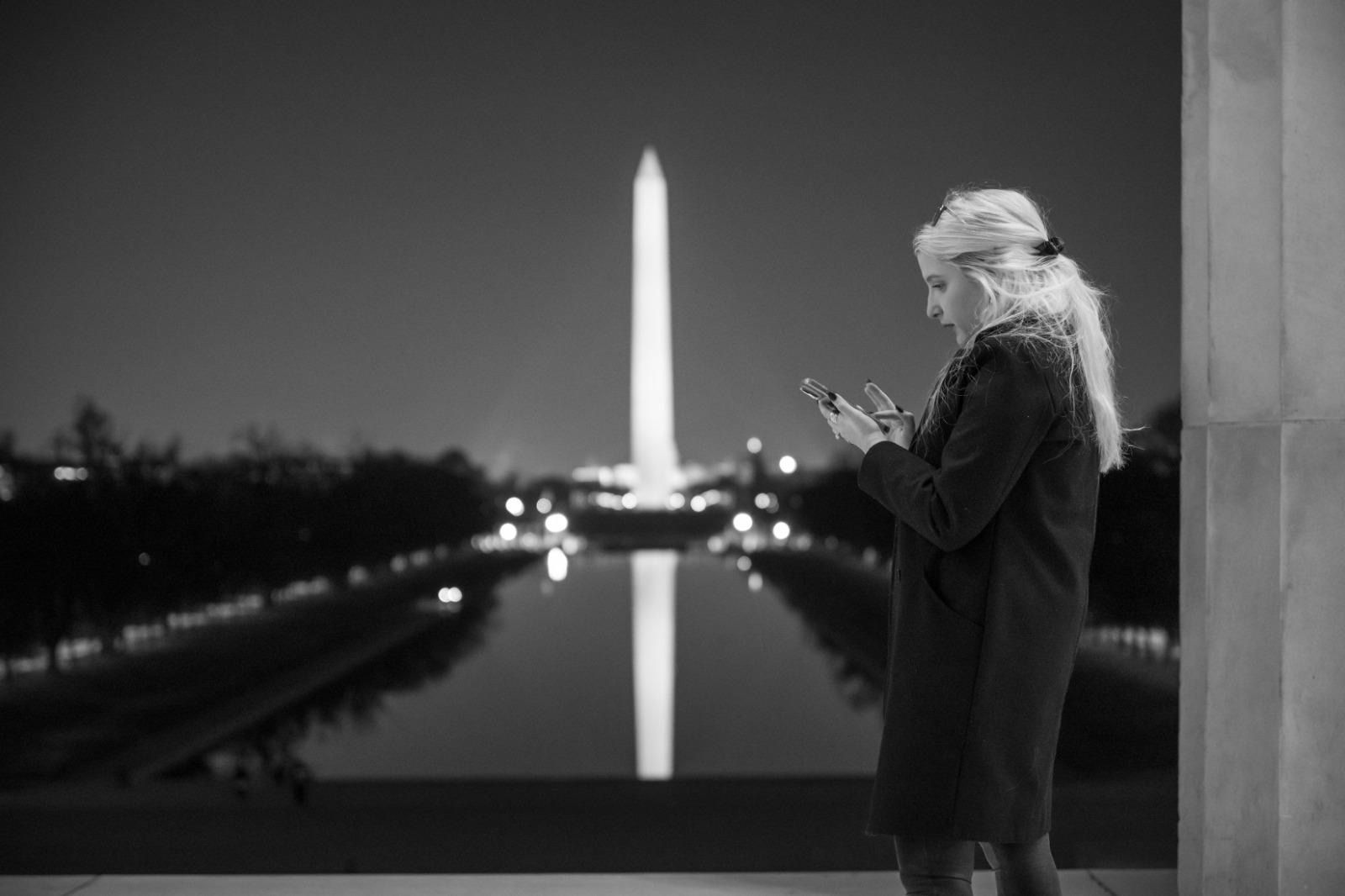
In the Washington photograph, Barnes is looking at her phone while the monument supplies a rather grand background. The picture makes a suitable closing image for this career: public institutions in the distance, an immediate communication in hand. Somewhere between the impressive setting and the small screen, another person still has to decide whether to listen.