At Meera House, a residential care home, the useful detail in a digital record might be a trip to the cinema. The manager can see that a resident has been out, then ask what they thought of the film. A care timeline becomes a conversation starter. In a software market fond of dashboards, this is a refreshingly ordinary measure of usefulness: somebody remembers to ask.
The example comes from a customer account published by Nourish Care, whose software helps care teams plan support, record what happened and pass information to colleagues. Its business sits where personal care meets institutional memory. Preferences, observations and unfinished work need to survive a change of shift. Managers need to see patterns without spending the day excavating notes.
That everyday problem has attracted serious capital. In August 2026, investment firm Hg announced backing for Nourish, with founder Nuno Almeida remaining chief executive and existing investor Livingbridge retaining a minority stake. The ambition has widened considerably from electronic care notes. Nourish now sells tools for the staff rota, incident review and the relationship between care needs and funding.
The wearable idea that lost to the notebook
Almeida’s route into care was indirect. In a 2022 interview, he described growing up in Portugal, studying computer science and artificial intelligence, and working in aerospace and defence. After selling an earlier business in 2009, he remained in Dorset and considered what to build next. He wanted work with a more immediate effect on people’s lives.
Volunteering in a care home supplied the observation. At first, he wondered whether wearable technology could prompt carers or relatives about someone’s needs. Then the sheer volume of written notes caught his attention. Staff documented care; managers sifted through the results. Nourish’s own history describes a shift toward recording interactions in a form that could be analysed and used.
The change of mind is the telling part. The problem was already being worked on, every day, by people holding pens. What needed improvement was the journey from recording an event to doing something useful with it. There is a practical lesson here for software founders: watch what people repeatedly write down, and who has to read it afterwards.
Companies House dates Nourish’s incorporation to March 2011. Its first customers arrived in 2015, following several years of development. Interactive care plans followed in 2016, Analytics in 2017 and Insights dashboards in 2018. The sequence shows a business gradually extending what it could do with the information being collected.
A care plan with somewhere to go
Nourish Better Care brings plans, assessments, observations and daily records into a shared system. Staff can consult and update information through the app, including offline. Authorised colleagues can then work from the recorded information. The appeal is immediate: a note becomes accessible to the next person who needs it, without a hunt for the right folder.
The customers are organisations delivering care, including residential homes, home care agencies and services supporting people with learning disabilities or children. The person receiving support is the subject of the record; the provider buys the system. That distinction matters. Software must serve frontline staff and management while preserving the individual’s preferences and goals.
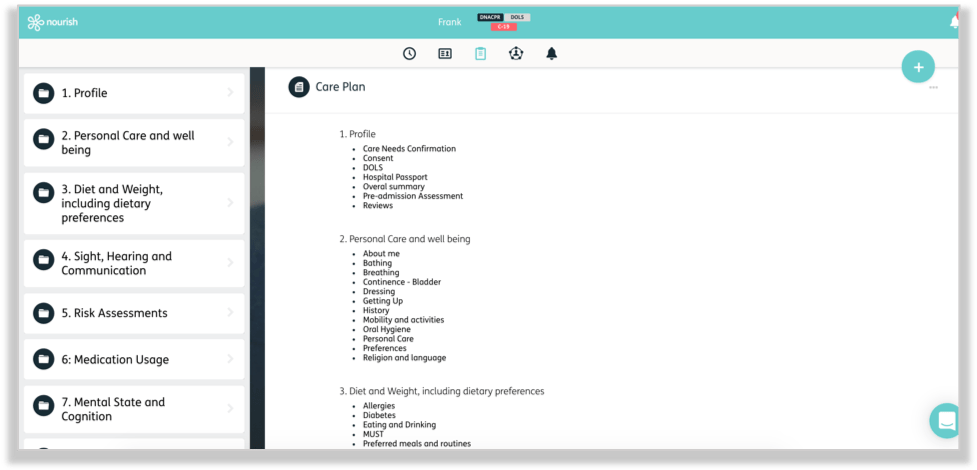
The product family divides the work further. Better Care at Home addresses care management in people’s own homes. Empower handles rostering and related operations. Safety deals with incidents, while Confidence brings together audits, action plans and improvement recommendations. Protect manages mobile devices; eLearning covers training. Buyers are choosing a set of capabilities, with implementation shaped around their service.
When the rota became part of the story
Residential care and home care share a purpose, but their daily logistics differ. Home care requires workers to arrive at many separate addresses, with the right skills and enough time. Nourish expanded into that work through its 2023 acquisition of CarePlanner, which it said served more than 2,000 domiciliary care agencies. NatWest provided acquisition-related financing.
The transaction supplied capabilities in availability, visit requests, rosters, monitoring and payroll. It also created integration work. In a later company account, developers described aligning basic structures such as profiles and address formats. Operations teams spent the first six months bringing processes and policies together. Those are the details that decide whether an acquisition becomes useful software.
Livingbridge’s reporting gives a sense of the resulting footprint: people supported through Nourish rose from 35,000 in March 2022 to 400,000 in September 2024. That period includes CarePlanner. The figures describe the reach of an expanding business, including acquisition, and should not be read as a measure of purely organic growth.
Livingbridge’s reported figures. The period includes the CarePlanner acquisition.
A Continuity Healthcare case study makes the operational problem concrete. Rapid growth had left the agency struggling to know whether visits were happening on time, or happening at all. The reported response combined scheduling and call monitoring with training reminders and invoicing. The customer’s account describes a purchase that became central to running the business.
“We came looking for call monitoring and came away with a crucial part of our business infrastructure.”Continuity Healthcare, customer account published by Nourish
A separate account from care provider Lifeways shows the scale of rollout work. In its first-quarter 2025 newsletter, it described starting with 12 pilot services in November 2023, then onboarding around 7,000 team members, with more than 400 services using Nourish daily. The useful detail is the sequence: a bounded pilot before wider deployment. It gives other providers a practical adoption model to examine, rather than a single switch-on date to imitate.
The licence is only the first line of the bill
Nourish earns money through business software subscriptions and associated services. A public G-Cloud 14 pricing document dated May 2024 offers a concrete example: care-planning licences at £104 per bed of capacity per year, with a £1,200 annual minimum. It also lists £500 implementation per site and £750 for a day of remote training.
For a hypothetical 30-bed service, that schedule produces £3,120 in annual licence fees. Add one site’s implementation and one remote training day, and the arithmetic reaches £4,370. This is an illustration using that published schedule, excluding devices, optional modules and any applicable taxes. It is not a current quotation for every Nourish product or provider.
- Annual licences
- £3,120
- One-site implementation
- £500
- One remote training day
- £750
- Illustrative first-year sum
- £4,370
May 2024 procurement schedule; the specified items only.
Returns also depend on the job. In a supplier-published account, Your Care and Support attributed roughly £700 a month in savings to changes in rota administration. LCCL reported smaller savings on the care floor at Whittingham House: around 20 minutes per carer per week. Neither number is a universal promise. Different starting processes produce different opportunities.
Nourish’s implementation packages acknowledge the work surrounding adoption. Its residential brochure distinguishes small independent services from groups rolling out multiple products across many locations. Training and configuration are part of the purchase. A sensible buyer would time an existing handover or rota task, test the same work during a pilot, and check whether the promised improvement survives an ordinary busy week.
At Meera House, the manager anticipated that some staff would resist using a digital handset. That concern belongs in the buying decision alongside reporting features. Ask the people entering the notes to try the device, and ask the next shift to retrieve them. A system that impresses only the person buying it has passed the wrong demonstration.
The competition has care records, too
Nourish operates in an established field. Person Centred Software offers digital care planning and point-of-care recording for care homes. Birdie combines care management with home-care operations. Both describe person-centred records and better oversight. Those phrases alone do little to separate suppliers; customers need to examine the actual workflow.
Nourish’s proposition rests on its combination of configurable records, residential and home-care operations, reporting and connections to other tools. Its partnership programme separates channel partners, approved partners and healthcare integrations. It advertises GP Connect integration, while PRSB identifies Nourish as its first provider to achieve conformance against a standard. These are relevant credentials when information has to cross organisational boundaries.
Transparency adds a particularly commercial dimension. It compares assessed support needs and their costs with agreed funding, giving providers a way to see gaps and discuss resources. A changing care need can therefore enter a staffing or fee conversation with supporting evidence. That is a different job from simply storing a better care note.
The limits follow from the work itself. An offline app still requires devices, training and synchronisation. A dashboard depends on consistent records, and a staffing assessment depends on sound inputs. For a provider with unresolved processes or little capacity to train staff, adding software may initially add work. The buying test should include who maintains the system after launch.
More capital, and the same daily test
The August 2026 investment brings another owner into the story. HgCapital Trust disclosed approximately £20 million of participation alongside other institutional clients investing through Hg. The overall transaction terms were not disclosed. Treating that contribution as the price of the entire deal would give readers the wrong number.
Almeida used the investment announcement to put AI on the next-stage agenda, describing administrative help and the retrieval of relevant information. Hg’s AI product team, Hg Catalyst, is part of that plan. For care providers, the distinction between an announced ambition and a feature they can test remains essential. The useful demonstration is still a real task completed with accurate information and appropriate human review.
The business has also grown as an employer. Its careers site describes a workforce of more than 220 and hybrid arrangements where possible, with new staff beginning alongside their teams in the office. The company emphasises customer experience and collaboration; its integration retrospective describes support splitting into customer and technical teams as needs became clearer.
For customers, additional investment ultimately faces a small, repeated test. Can the next carer find the information, understand it and act on it? Meera House’s cinema example makes that test unusually clear. A record of an outing can support a conversation. The value appears when someone reads the note, looks up from the screen and asks about the film.