On a spring day in 2017, Norman Kutemperor's company borrowed almost an entire supercomputer. Scientel's engineers occupied 600 of the Ohio Supercomputer Center's 648 standard compute nodes, set 16,800 cores to work and fed them a synthetic weather database. By the time the exercise was done, the Owens Cluster had created 1.25 terabytes of data and passed more than 86 million transactions a minute without an error. OSC called it the largest-scale calculation in its history.
The weather was imaginary. The appetite was not. Kutemperor had spent decades preparing for the moment when information would outrun the ordinary machines built to hold it. In technology, patience is rarely photographed; it looks too much like waiting. Yet here was patience with a stopwatch attached.
Kutemperor has led Scientel since 1981, an almost impolite length of time in an industry that treats last year's vocabulary as a regrettable haircut. His company began with IT services for small and midsize businesses. It automated supply-chain work: orders, inventory, finance and the decisions managers make after the machinery of commerce has produced its figures. The work was practical and close to the customer. It also revealed the obstruction lurking underneath every useful application. Sooner or later, there is too much data.
The small-business problem that became enormous
Scientel's database work did not begin with a fashionable manifesto. It began with a gap. Smaller computer systems needed capable database management without the price and complexity of large systems. The first products met large competitors and the sort of discouragement that is free, plentiful and seldom requested. Research continued. The problem grew until the solution designed for smaller machines had acquired a much larger destination.
The company called its database Gensonix. Over the years, Scientel described it first in the language of NoSQL, later NewSQL and now AI. The recurring idea was to handle different kinds of information in one system - relational records, documents, text and other structures - while distributing work across many processors. In 2015 Kutemperor took that argument to the NoSQL Now conference in San Jose. He spoke about a “polymorphic” database and an in-house query language meant to work across structured and unstructured data.
The claims were muscular, as database claims often are. The useful distinction is between a promise and a public test. Scientel's marketing spoke of trillions of rows and thousands of parallel nodes. The Ohio run, two years later, supplied the harder numbers: 600 compute nodes, 16,800 cores and a clean result. It did not settle every competitive claim. It demonstrated that a small Michigan company could make its software behave across a very large machine.
“The robust nature of the OSC Owens Cluster provided the reliability for this large parallel job.”Norman Kutemperor, on the 2017 test
A founder who stayed for the rewrites
Kutemperor's unusual quality is not simply longevity. Companies can survive by becoming excellent curators of their former selves. His record is one of repeated technical migration. Supply-chain applications led to business intelligence. Business intelligence exposed the database problem. The database pushed Scientel toward parallel computing. Parallel computing now sits beneath the company's private-AI pitch. The nouns change; the bottleneck remains recognizable.
A 2022 profile described the management habits behind that continuity. Customer requests were to be handled quickly. Systems were expected to stay up because customers used them for essential operations. Kutemperor promoted people who understood reliability and performance. None of this is as thrilling as a trillion parameters. It is, however, how one earns permission to keep selling consequential software for another decade.
Kutemperor begins leading Scientel, working in business systems and IT services.
He receives a U.S. technology CEO award and presents Gensonix at NoSQL Now.
Scientel conducts its 16,800-core database run on OSC's Owens Cluster.
Business groups recognize the Gensonix platform and Kutemperor's leadership.
Scientel announces trillion-parameter and mixed-vendor GPU configurations for private AI.
People who have worked with Kutemperor describe the same combination in less technical terms. In a public recommendation, colleague Gary Heitman praised his integrity, customer focus and ability to see trends early. Heitman said the chance to work for Kutemperor brought him out of retirement. Compliments on professional networks are hardly sworn testimony, but this one catches something important: futurism is easier to trust when it answers the telephone.
When the database met the chatbot
Generative AI gave Scientel a new stage and a familiar script. Large language models need processors, certainly, but they also need data in several forms, moved with enough speed and order to remain useful. Kutemperor's latest proposition is that Gensonix can be the repository beneath a private AI system, keeping relational, document, text and vector data in their native stores. The attraction is control: an organization can run a model on its own infrastructure rather than send sensitive material to a public service.
In March 2026, Scientel reported loading the 671-billion-parameter DeepSeek R1 model and running copies across 36 Nvidia H100 GPUs at OSC. It described the aggregate as 6.039 trillion parameters. That wording matters. It was an aggregation across parallel GPUs, not the invention of a new six-trillion-parameter model. The following month the company announced another architecture, intended to let customers combine AMD, Intel and Nvidia GPUs in one distributed LLM system. Both results came to the public through Scientel's own press releases, and should be read as company-reported demonstrations.
Bars show distinct milestones, not like-for-like quantities. Their purpose is to show how Kutemperor's work has moved across business, cluster and accelerator scales.
The mixed-GPU idea is especially revealing. AI hardware is expensive, and incompatibility can strand older equipment when a company upgrades. Scientel proposes a network of nodes in which different processors can run models suited to their capacity. It is a systems integrator's answer to an AI problem: do not demand uniformity from every box; make the boxes cooperate.
There is a tidy temptation to portray every earlier decision as preparation for AI. History is seldom that obedient. Kutemperor did not need to foresee a chatbot in 1981. He needed to notice, repeatedly, where the constraint had moved. His career makes more sense as a chain of adjacent problems than as one grand prophecy.
The geography of a long bet
Although Scientel has described international development and business relationships, Kutemperor's working identity remains attached to Southeast Michigan. His public profile places him in Novi. The company spent years associated with Bingham Farms and now lists its main office in Ann Arbor, at the western end of the region's innovation corridor. In 2013, while discussing expansion, he predicted an effect on Michigan's IT visibility and economy. The sentence is pure chamber-of-commerce optimism, but the local commitment has lasted.
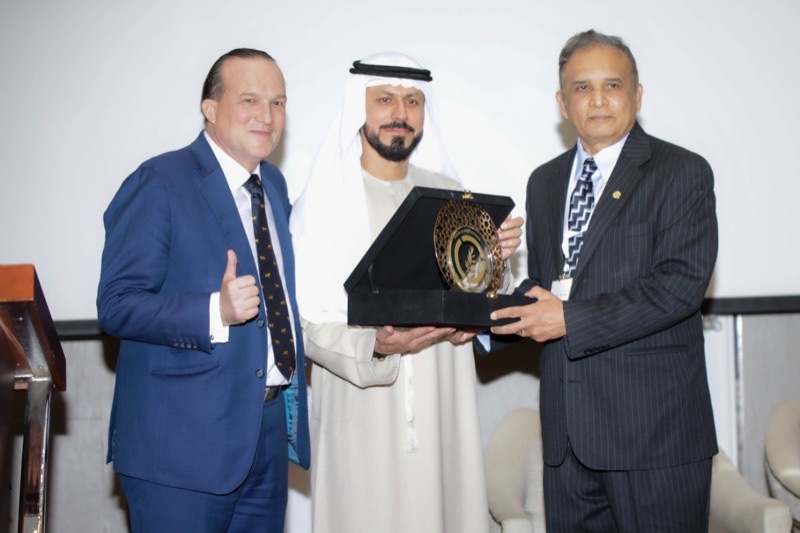
His public appearances have traveled farther. He spoke in California about databases and in Dubai about big data. The Abrahamic Business Circle gave Scientel its 2021 platform award there. Kutemperor later remembered the recognition as “a truly great feeling of achievement,” an uncomplicated sentence that suits the photograph: three men, one elaborate plaque, no visible urge to pretend the moment means nothing.
The biography around the work is spare. Public professional profiles list a Bachelor of Science from Carroll College in Helena, Montana, and three languages: English, Malayalam and Hindi. Kutemperor's LinkedIn network runs past 2,000 followers and 500 connections, but his visible record is more workshop than salon. Conference appearances, product notices and congratulations to collaborators outnumber personal revelations. He presents himself through the systems.
Even his preferred metaphors are architectural. Data is stored, sliced and processed. Nodes scale out. Hardware and software arrive together, adjusted to the customer's workload. Where Silicon Valley biographies often place personality at center stage, Kutemperor's public story keeps pointing back to the apparatus. The reserve has an amusing consequence: one learns more about how he wants 600 computers to cooperate than how he takes his coffee. Perhaps that is appropriate. A database chief should be allowed one unindexed field.
Awards decorate this story; they do not carry it. The more persuasive artifact is the weather test. A small team booked an enormous machine and tried to make a database run across nearly all of it. The result connected Kutemperor's early concern - how a business handles information - to a scale that would have sounded comic when he began.
A durable technology company is not preserved. It is revised - carefully enough to keep its memory, ruthlessly enough to remain useful.
Scientel's present AI claims will require the same treatment as its database claims: public workloads, reproducible measures and patient comparison. Kutemperor appears comfortable with that tempo. He has already spent more than four decades at the same workbench, changing the tools whenever the job required it.
The lesson is neither to chase every wave nor to ignore them. It is to know the enduring problem beneath the fashion. For Norman Kutemperor, that problem has been data - too much of it, in too many forms, waiting for machines that can make it useful. The weather in Ohio was synthetic. The forecast was real.