In 2006, a client had thousands of search-engine-optimization tasks to get through and a reasonable concern: how would he know they had actually been done? He had reached Nitin Agarwal through a recommendation from British SEO author Peter Kent. Agarwal offered timely execution and detailed reports, complete with links the client could check. There are more theatrical ways to begin a business story. Few are quite so useful.
The customer, working as Brooksville Computer for an engineering firm in Florida, later recalled being impressed with the results. What makes the account interesting is the mechanism of reassurance. A distant supplier had proposed a way to make distant work visible. The report would contain evidence. Trust would have something to stand on.
Twenty years later, Agarwal is the founder, CEO and managing director of Wildnet Technologies. His company works across digital marketing, white-label agency services and technology. Its newer brand, Wildnet Edge, concentrates on AI and digital engineering. The vocabulary has expanded considerably since those SEO assignments. The question inside that early exchange remains a good way into his career: what happens between saying the work will be done and delivering something another person can depend on?
A promise with links attached
Agarwal dates Wildnet’s beginning to 2006. In his account, the company started with three people. An early business description places SEO at the center of its web-marketing work. This is a useful scale at which to picture the beginning: a small team, a defined service and customers who needed a reason to trust it.
His education includes SGRRITS, listed on his professional profile for 1997 to 1999. He also lists a gold medal in mathematics. These are spare biographical details, but welcome ones. A founder’s life need not begin with a childhood revelation conveniently pointing toward his eventual company. Sometimes the surviving record is an institution, a subject and the work that followed.
There are two dates in Wildnet’s history worth keeping straight. The business puts its beginnings in 2006; Wildnet Technologies Private Limited was legally incorporated on January 2, 2008. An operating origin and a corporate birthday can coexist quite happily. Companies, unlike people, can acquire a second birthday without demanding another cake.
The early client’s recollection is especially apt for SEO. Much of the work happens away from the finished page a customer sees. A report with checkable links gives that work a shape. It also establishes an expectation: explanations should survive inspection. For a company selling expertise across borders, that is a practical place to start.
Wildnet’s stated beginning.
Three people, in Agarwal’s account.
The business behind the other business
Part of Agarwal’s company now works in a position that requires a certain tolerance for someone else’s applause. In a white-label arrangement, an agency keeps the client relationship and the branding while another team supplies the execution. Wildnet offers specialists, dedicated teams and additional delivery capacity through that model.
The appeal is easy to understand. An agency can win work in a discipline it cannot yet staff fully, or find that an existing team has reached its limit. A new contract is good news. It can also be the moment the calendar begins to look like a practical joke.
White-label delivery introduces an extra relationship into the job. The end customer has expectations. The agency has made promises. The delivery partner must understand both well enough to do useful work. Instructions, confidentiality and reporting become part of the service itself. A technically competent result can still arrive in the wrong format, or at the wrong moment, to solve the agency’s problem.
Agarwal puts relationships near the center of his explanation of competition. I believe differentiation is closely related to service and client relationships.
It is a plain statement. In this business, it has consequences: the customer buys the output and also the experience of relying on the people producing it.
The promise passes through three desks.
- ClientSets the business need
- Partner agencyOwns the relationship and brand
- Wildnet teamSupplies execution and capacity
A diagram of the operating model, not a measured performance comparison.
A longer service menu, a familiar problem
Wildnet’s company timeline puts international expansion in 2010, followed by a thousand-client milestone and broader mobile and app services in 2015. Agile and DevOps delivery appear in its 2019 chronology; AI centers and advanced technology labs follow in 2021. Wildnet Edge was introduced in 2025.
That sequence describes repeated additions to what the company can sell. It also changes what its founder has to organize. Search work, paid advertising and software development involve different skills and different ways of judging completion. Expanding the menu creates a corresponding obligation to build teams capable of doing what the menu says.
The company currently reports more than 4,100 clients served and 8,000 campaigns delivered. Those are Wildnet’s own totals, and campaigns are a different unit from software projects. Treating every published number as interchangeable would produce an impressive graph and a rather confused reader. The more useful observation is that the business now has several kinds of delivery to manage.
Company-reported cumulative figures. Different measures; no growth rate implied.
Wildnet Edge gives the technology work a distinct identity. Its stated focus includes AI transformation, product engineering, cloud operations and related implementation. Agarwal is listed as its CEO and founder. The move puts an explicit name around a newer set of customer demands while keeping it connected to the company he began in 2006.
The people who carry the promise
Agarwal’s current responsibilities extend across the wider business. Waseem Ahmad leads the Agency Business Division, with responsibility for agency relationships and delivery teams. That distinction matters in a founder profile. A company’s work is carried by named people with separate responsibilities, however tempting it may be to place the founder at every desk.
The division says it has more than 250 digital specialists and over 100 agency partners. Its service range includes search, paid media, development, analytics, creative work and automation. At that scale, personal reassurance from the founder cannot be the entire operating system. The challenge is to make the organization capable of keeping promises without routing every decision through one person.
There is a more personal glimpse in a recommendation from former colleague Abhishek Mehta. He credits Agarwal with teaching him about leadership and client management, and with giving him confidence. After changing organizations, he still felt able to call for advice. It is a colleague’s recollection, specific enough to tell us something about the relationship without requiring a grand declaration about character.
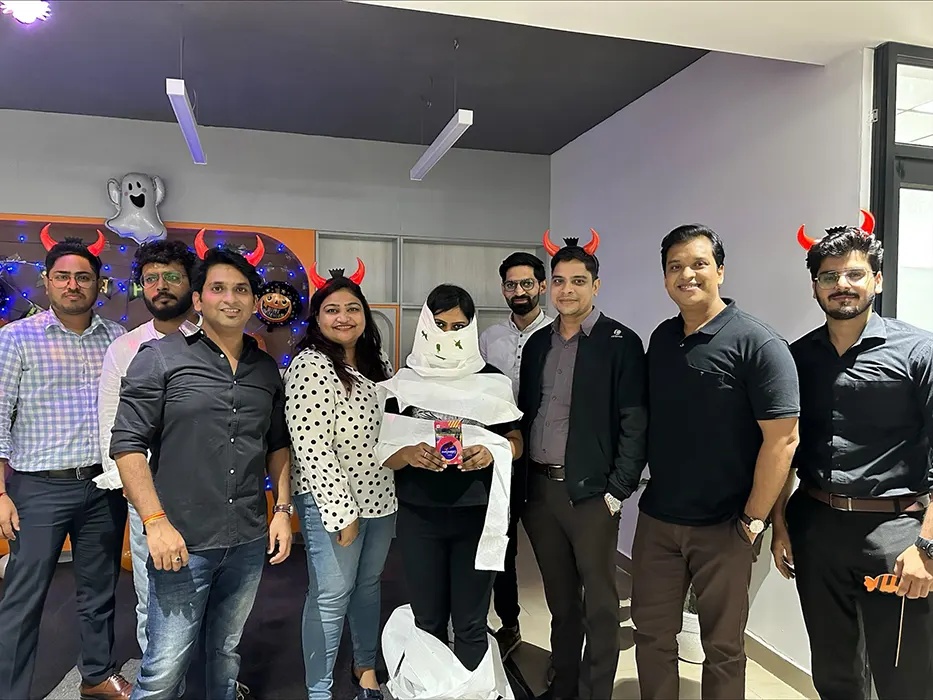
Wildnet’s workplace photographs supply another change of scale: faces gathered for presentations and celebrations rather than service categories arranged on a website. They do not settle every question about a workplace. They do remind a reader that every additional capability on a company page eventually belongs to people who must learn it, explain it and turn up to do it.
The buffering wheel is a business problem
In September 2025, an article under Agarwal’s byline used streaming platforms to discuss reliability. The opening situation was familiar: someone wants to watch a show; a delay interrupts the experience. Behind that small annoyance sit the less visible disciplines of monitoring, infrastructure, deployment and recovery.
His argument connects those engineering choices to customer trust. The subject fits a company that delivers software as well as marketing. A customer sees a product working, or failing to work. The people building it see dependencies, traffic, release processes and the possibility that an apparently minor change will have an unexpectedly large audience.
The piece advocates making reliability part of how teams operate. It is an illuminating subject for Agarwal to take up because it returns to the relationship between hidden work and visible results. The client checking SEO links in 2006 and the viewer waiting for a video are looking at different surfaces. Both need something behind the surface to have been done properly.
The customer encounters the result. The team carries everything required to make it work.
THE DELIVERY PROBLEM
That connection is a way to read his career, rather than a claim that every service follows an identical method. Marketing performance and software reliability have their own measures. What they share is the difficulty of selling work whose full value becomes apparent when someone actually uses it.
One hundred editions, and another change of interface
On April 8, 2026, an article under Agarwal’s name marked the hundredth edition of Wildnet’s Digital Yum newsletter. The milestone piece reported 15,417 subscribers and described a publishing run across two years. Its subjects ranged from AI and search to social discovery and changing consumer behavior.
Publishing adds another task to the founder’s job: explaining a market while operating inside it. The newsletter’s hundredth-edition discussion emphasizes human creativity alongside AI and a broader view of how people find businesses. Those are commercial questions for Wildnet, whose services depend on understanding where customers look and what persuades them to act.
Agarwal also appeared among the featured contributors to Wildnet’s State of Marketing 2025 report, issued in December 2024 alongside Himanshu Bohra and Jaya Singhal. The report’s attention to AI adoption, measurement and organizational capability places his recent interests in a longer conversation than a single product launch.
His stated ambition includes expanding global reach while retaining the company’s core values. Wildnet Edge gives that direction a technology-focused outlet. The next chapter will involve customers deciding which new capabilities deserve their budgets and teams learning how to deliver them. An AI offering still needs a brief, a responsible team and a useful result.
Return, then, to the links in that early report. They were a small courtesy with a substantial purpose: here is what we said we would do; here is where you can look. For Agarwal, another change in the internet has arrived. The old promise remains available for inspection.