BREAKING   Telepatia closes $33M Series A led by Andreessen Horowitz +   14M+ patients reached across 5 countries in under a year +   Backers include founders of Nubank, Rappi & Palantir's CTO +   The whiteboard goal: a LatAm Nobel in Medicine, first since 1984 BREAKING   Telepatia closes $33M Series A led by Andreessen Horowitz +   14M+ patients reached across 5 countries in under a year +   Backers include founders of Nubank, Rappi & Palantir's CTO +   The whiteboard goal: a LatAm Nobel in Medicine, first since 1984
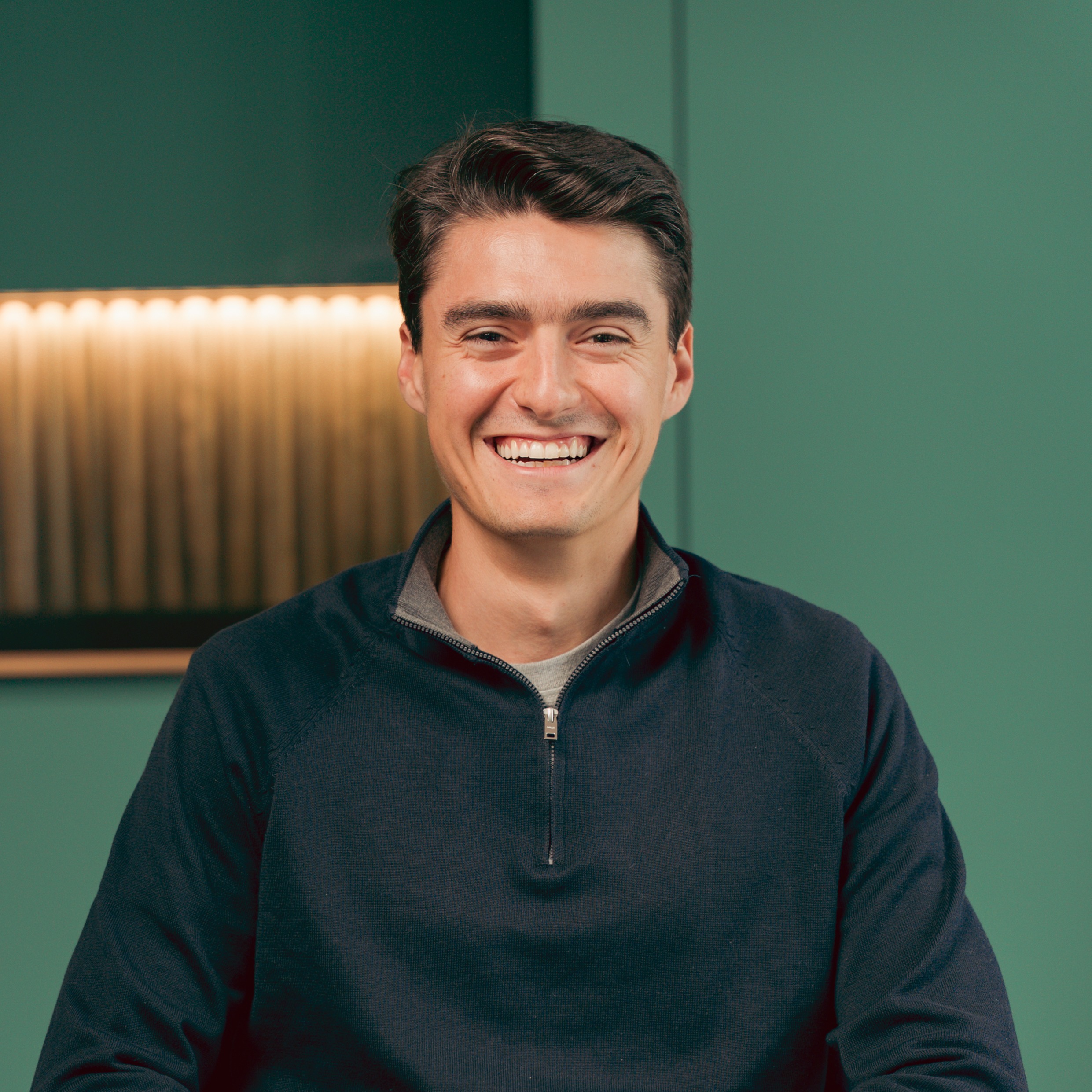
Nicolas Abad, co-founder and CEO of Telepatia
The co-founder who keeps a Nobel Prize where most people keep a sales target.
Profile / Founder

Nicolas Abad

He named a company after his father and pointed it at a continent. Telepatia now talks to millions of patients - and its founder still calls a Nobel Prize a metric, not a fantasy.

Most founders chase a market. Nicolas Abad is chasing a number that fits on a Nobel medal.

The premise

Telepatia builds what Abad calls "artificial healthcare employees." The first one is an AI Doctor: it listens to a consultation, writes the notes, reviews the record, flags conflicting prescriptions, and surfaces guidance from medical literature while the physician is still in the room. The pitch is unusually blunt for a startup. The product, Abad says, is the one his father would have loved to use - and the one the family wishes had existed.

It is named for him. "Telepatia" was his father's nickname, earned for a memory so sharp colleagues swore he read minds.


By the numbers

Less than a year. A lot of ground.

$42M
Total raised
14M+
Patients reached
25+
Institutions
5
Countries

Sources: Andreessen Horowitz Series A announcement; LatamList; TheNextWeb; Brazil Journal. Figures as reported in 2025-2026.

"I made it my life's mission to radically improve healthcare - to transform it from scarcity to abundance."
Nicolas Abad, on why Telepatia exists
Origins

Two kids from a Medellin schoolyard, reunited by a loss

Abad grew up surrounded by medicine without practicing it. Four of his five closest people wear white coats - his father, his sister, his grandfather, his godmother. He went the other way, into business and Latin American startups, with stints connected to companies like Frubana and Neta. Medicine was the family language; he just spoke it as a second tongue.

Then late 2022 took the floor out from under him. Inside a short, brutal stretch, he lost his father, the company he'd been building, and a relationship. The grief did something unusual. Instead of retreating, he turned toward the exact field that had just broken his heart and got obsessed with it.

Enter Tomas Giraldo, a childhood friend from Medellin and a physician. Giraldo sent the best condolence message Abad received. The two reconnected over a shared fixation on what modern medicine could and couldn't do. They began trading research papers daily, then building small prototypes on the side - the kind of nights-and-weekends tinkering that rarely amounts to anything and occasionally amounts to everything.

By 2023 Abad was at Stanford for an MBA, and the side project had quietly become the main thing. The two friends became co-founders. The thesis was simple and stubborn: Latin America does not have enough doctors, and the ones it has are drowning in paperwork. You cannot mint physicians fast enough to close that gap. So build something that gives the existing ones their hours back.

What it actually does

A second brain for the doctor

Listens & writes

The AI Doctor transcribes the consultation in real time and drafts the clinical note, so the physician can look at the patient instead of the keyboard.

Reads the record

It reviews patient history, catches conflicting prescriptions, and flags potential errors before they leave the room.

Cites its sources

Suggestions are pulled from medical literature and clinical guidelines. Abad insists it "doesn't hallucinate, because it doesn't look for information on Reddit or Twitter."

Adoption
90%
Patients who'd recommend
85%
Hours saved / day
~1.7h

Pilot metrics reported by Telepatia, ~263 days post-launch.

In the early pilots, the tell wasn't the install count - it was the refusal to uninstall. At one Brazilian hospital, physicians reportedly kept the tool open roughly eight hours a day, longer than most people use any single app. Around 90% of pilot doctors adopted it. They got back close to two hours a day. The patients noticed too.

Abad's framing for the whole category is deliberately unromantic: the world needs "artificial healthcare employees" that expand capacity and free the doctor "for what really matters: caring for people."

"This is the product that would have saved my father as a patient, and that he would have loved as a doctor."
- Nicolas Abad
The timeline

From dorm-room MVPs to a16z

PRE-2022
Builds a career in Latin American startups, with roles connected to Frubana and Neta - business, not medicine.
LATE 2022
Loses his father, a Colombian physician nicknamed "Telepatia." The turn toward healthcare begins.
2023
Starts a Stanford MBA. Reconnects with physician friend Tomas Giraldo; they swap papers daily and build small prototypes.
2025
Co-founds Telepatia. Pilots the AI Doctor across 15 institutions and 2,000 physicians in Colombia.
OCT 2025
Raises a $9M seed round, with Brazil expansion in the crosshairs.
2026
Raises a $33M Series A led by Andreessen Horowitz. Total funding ~$42M; 14M+ patients across five countries.
"Our goal is to create 100 'AI interns' for every oncologist and reduce cancer mortality by 10%. If we do that, the Nobel stops being a dream and becomes a measurable metric."
Abad, on the goal he keeps on the whiteboard

He reaches for John F. Kennedy's moon-shot logic to justify it: you pick the goal because it is hard, not because it is easy. A first Nobel Prize in Medicine for Latin America since 1984 is, by that standard, exactly the right kind of unreasonable.

The company he keeps

A cap table that reads like a LatAm tech hall of fame

David Velez

Founder of Nubank, the digital bank that rewired Latin American finance.

Simon Borrero

Founder of Rappi, the super-app that put delivery on every phone in the region.

Shyam Sankar

CTO of Palantir, alongside lead investor Andreessen Horowitz on the Series A.

The roadmap doesn't stop at the border. After Latin America's 1.9 million doctors - Abad wants to reach half of them by the end of 2027 - the stated next stops are India, Africa, and Southeast Asia. Same problem, different map.

On the ground

It spread the way good tools spread - quietly, then everywhere

The first proof didn't come from a billboard. It came from Colombia, where Telepatia ran early pilots across roughly fifteen institutions and about two thousand physicians. The numbers that mattered weren't downloads - they were retention. Doctors kept the thing open. In a profession allergic to extra software, that is the rarest signal there is.

From there it climbed into some of the region's biggest names. Hospital groups like Mater Dei, Kora Saude, and Hapvida came on board, along with public health networks in cities including Bogota, Medellin, and Barranquilla. The October 2025 seed round was built to push hardest into Brazil, the largest and most demanding market in Latin America, and the company followed the money there fast.

By the time Andreessen Horowitz led the Series A, the footprint had stretched across Brazil, Colombia, Mexico, Chile, and Argentina - five countries, more than twenty-five institutions, both public systems and private chains. Public and private rarely buy the same software for the same reasons. That both did is its own kind of endorsement.

"He doesn't hallucinate, because he doesn't look for information on Reddit, Twitter, or sources like that - the AI Doctor always pulls only from reliable sources."
Abad, on why physicians trust the output

It is a small line that carries a lot of weight. Trust is the entire ballgame in clinical tools. A suggestion a doctor can't source is a suggestion a doctor will ignore - or worse, follow into a mistake. By chaining every recommendation to medical literature and guidelines, Abad turned "AI in the exam room" from a liability conversation into a workflow one.

The argument

Scarcity is a design problem, not a fact of life

Strip away the funding headlines and Abad is making one tidy argument over and over. Healthcare in much of the world runs on scarcity - too few doctors, too many patients, too much of a physician's day eaten by documentation and bureaucracy. The usual answer is to train more doctors, which takes a decade and money the region doesn't have. Abad's answer is to make each existing doctor able to do more, by handing the boring, repetitive, error-prone parts of the job to software that never gets tired.

That is why he is careful with the word "replace." The AI Doctor augments the clinician; it does not stand in for one. The whole pitch collapses if patients feel handed off to a machine, and Abad knows it. The product is framed as a "second brain for the doctor" - a co-pilot that remembers everything, reads fast, and never skips a guideline, so the human can do the part machines are bad at: looking another person in the eye and caring.

It helps that medicine is the family business. Four of his five closest people are physicians, which means Abad has spent his life listening to doctors complain about exactly the friction Telepatia attacks. He isn't an outsider guessing at the workflow. He grew up at the dinner table where it was described in detail, then spent a year trading research papers with a physician co-founder until he understood it cold.

And then there is the goal that makes investors lean forward and skeptics roll their eyes in equal measure. Abad wants Latin America's first Nobel Prize in Medicine since 1984. He arrives at it through math, not romance: deploy enough "AI interns" per oncologist, push early screening and prevention hard enough, shave cancer mortality by ten percent, and the prize stops being a fantasy and becomes a number you can audit. Whether or not the medal ever arrives, the framing tells you how he thinks - in measurable outcomes, with the ambition dialed all the way up.
The margins

Things that don't fit in a pitch deck

The name is a memorial

"Telepatia" was his father's nickname, given for a near-photographic memory. The whole company carries it.

A KPI, not a daydream

He treats a Nobel Prize as a deliverable with a denominator - lives saved - rather than a fantasy with a tuxedo.

Born from a condolence note

The co-founding friendship restarted with the best sympathy message Abad received after his father died.

He writes, too

Abad keeps a Substack called "Nicobot" and posts on X as @Nicobot01 - founder narration in public.

The takeaway

Why this one is worth watching

There are tidier AI startups - cleaner markets, calmer founders, smaller numbers on the whiteboard. Abad picked the messy version on purpose: a region short on doctors, a personal loss he refuses to leave private, and a goal so large it sounds like a joke until you watch him do the arithmetic. The bet is that a tool doctors won't put down, multiplied across millions of consultations, eventually moves a number that medals are made of.

He has roughly 1.9 million doctors to convince and a deadline he set himself. The clock, like everything else here, is something he chose.

Follow the trail

Reporting compiled from public sources. Quotes as reported by their original outlets; one quote translated from Portuguese.