Before Nick Eatock built software for financial advisers, he coded computer games. It is a pleasingly mischievous opening for a career that would eventually involve compliance records, portfolio research and the orderly movement of client information. Games ask people to spend more time with a computer. Much of Eatock’s subsequent work has concerned how to help people spend their time more usefully.
He co-founded intelliflo in 2004. More than twenty years later, he is still its CEO, although the route between those two points includes a different chair, several owners and a return to the operating job. His public argument has a persistent centre: financial advice becomes easier to extend when the machinery behind it demands less effort.
There is something appealingly unglamorous about this ambition. A client rarely arrives at an adviser’s office hoping to admire the document-management system. The client has questions about money and a life to get on with. Every minute the adviser spends wrestling with a repetitive task is a minute unavailable for that conversation. Eatock’s career has unfolded in that gap.
A games programmer meets the paperwork
The early coding interest became part of the story he discussed with Thomas Spencer in 2024. Their conversation travelled from computer games through consulting and workflow systems to building a financial advice technology company. It also covered delegation, accountability and strategic thinking: subjects that arrive when a business becomes too large for its founder to hold every detail.
Eatock attended the University of Birmingham between 1987 and 1990, studying commerce and accounting. That combination places the eventual business in an interesting light. Software for advisers has to understand the commercial world it serves. An elegant technical answer can still be an inconvenient way to run a firm.
Intelliflo’s original proposition brought web-based technology to the work of financial advice businesses. Its product, Intelligent Office, occupied the territory between the client meeting and the running of the practice. This is where a promising idea encounters a less romantic requirement: the information needs to be in the right place tomorrow morning.
The founder changes chairs
By July 2013, when HgCapital announced a majority investment, almost 10,000 advisers and administrators were using intelliflo’s software daily. Eatock and the senior management team retained a significant stake. A founder’s project had become a business with outside capital and a larger set of expectations.
In November 2014, Hamish Purdey arrived as CEO and Eatock became executive chairman. The distinction matters. Eatock remained involved, but another executive took responsibility for running the company. A biography can compress five years into a line. For a founder, changing the job while keeping the company is a substantial piece of the story.
That same month, intelliflo appeared in the Investec Mid-Market 100. It was being used by 1,250 adviser firms and 11,000 individuals. Eatock credited the teams across the business, putting customer support alongside software innovation. The product had to keep working after the sale. Anyone who has ever waited for a support reply will appreciate the distinction.
In June 2018, Invesco acquired intelliflo. Eatock, then executive chairman, described the opportunity to invest more in the core technology. The customer-facing question survived the ownership change: how could advisers meet changing demands? Corporate transactions supply the dates in this history; the software’s usefulness supplies the reason anyone outside the transaction should care.
A return ticket to the operating job
Eatock returned as CEO in September 2019 after Purdey’s departure. At the time, Intelligent Office had 22,700 users across 2,350 firms, with £395 billion in assets under advice. Those were the assets associated with the firms using the system, a measure of the financial activity around the software.
He publicly thanked Purdey for his contribution over the preceding five years. The announcement also stressed continuity: the two had worked closely, allowing responsibilities to transfer. There was no need to invent an unfamiliar founder arriving to rescue an unfamiliar company. Eatock had been there throughout, doing a different job.
His changing title offers a useful way to read the career. Founding, chairing and running a business require different forms of attention. The early programmer can build something himself. The leader of an established software company has to make it possible for other people to build, maintain and explain it, day after day.
The software licence is the easy part
Eatock’s interest in adoption gave intelliflo a way to examine what happened after a customer bought the product. In a 2020 conversation with Heather Hopkins, he explained that the company had grown tired of conventional discussions about return on investment. His phrasing was refreshingly candid.
“we got a little bit bored in truth”
Nick Eatock, on conventional ROI discussions
The eAdviser Index compared use of the technology with business measures. Eatock described the higher-adoption group as serving roughly 220 clients per adviser, against nearer 100 at the other end. These were observations about groups of firms, rather than a promise that installing software would double anyone’s client list.
Same profession. Different capacity.
The distinction is useful because software often arrives with a quiet assumption: once purchased, it has done its job. Eatock’s argument puts the burden on the working process. A capability sitting unused in a menu cannot help the next client. Adoption happens when the tool becomes part of how the firm operates.
Eleven features, two microphones
At intelliflo’s June 2025 customer conference, Eatock sat down with journalist and broadcaster Lucy Hedges to discuss eleven new and upgraded features. Their conversation covered an AI assistant, video, data partnerships, integration tools and the client portal. It was a varied list, with a familiar practical concern running through it: getting the parts to work together.
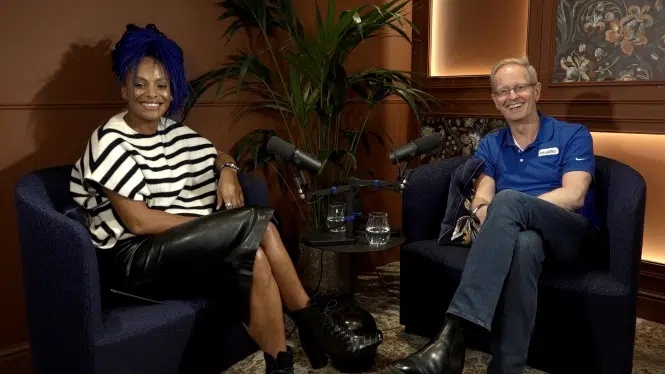
The names included Snowflake and Amazon Q, alongside intelliflo’s own products. For an adviser, the significance of a partnership ultimately rests in the experience of using the system. Does information move? Does a task become simpler? A list of technology partners is more persuasive when it produces a shorter list of things to do.
Eatock’s writing about technology also places it inside a wider change in advice. Record keeping has given way to systems supporting a more client-centred planning process. The software is closer to the work itself, which makes its design more consequential. A poor connection between systems can become an interruption between people.
The people behind the product names
There is a lighter note in Eatock’s public description of the annual customer gathering. Alongside the exchange of ideas, he found room to praise the catering. It is a small detail, but a useful one. Even a conference about the future requires lunch, and people who use the product have to enjoy being in the room.
He has also celebrated recognition from paraplanners, the people who encounter the software in daily work. That emphasis gives the applause a particular address. A platform’s reputation is made partly by people preparing documents, checking information and helping an advice business function. Their experience can be rather more revealing than a launch presentation.
His discussion with Melo’s Nicky Wright in June 2026 brought another group into view: buyers of advice businesses. They explored how data affects a firm’s value before a sale conversation starts. The records created in everyday work can matter years later. Administration has an unexpectedly long memory.
New backing, familiar questions
In August 2025, Carlyle announced an agreement to acquire intelliflo from Invesco. Eatock’s stated focus was the UK and Australia, with investment in products for those customer bases. For a founder still involved after two decades, another ownership chapter came with a recognisable task: explain what the backing would mean for clients.
His Australian writing makes the ambition explicit. Fragmented processes and manual work constrain an advice firm’s ability to grow. Improving productivity could allow more people to receive advice. The moral appeal and the commercial logic sit close together here: a firm needs workable economics before it can make room for another client.
AI has since become part of his argument. In February 2026, he wrote about clients using AI to scrutinise advice and the importance of an adviser’s judgment and nuance. The questions grow more interesting when the client has tools too. The adviser must be able to explain, interpret and respond, with technology helping the work around that exchange.
The next task to disappear
On 12 October 2026, intelliflo announced its acquisition of Mabel Insights, an integration partner since 2024. The plan was to connect investment research and planning more deeply with intelliflo office while keeping Mabel free for advice professionals. The announcement described client and portfolio information moving between the systems without retyping.
That is a suitably practical place to find Eatock’s continuing project. The teenage games have given way to a different set of problems: a repeated entry, a disconnected process, an adviser occupied with preparation when a client needs attention. The work is specific enough to be tested by the people doing it.
In September 2026, he was also writing about the value of continuity in ongoing advice, rather than allowing service to revolve around an annual review. That asks more of a firm’s working habits. It also explains why the machinery matters. After twenty-two years, the interesting question in Eatock’s story remains how much room good software can leave for a human conversation.
Keep the conversation going
- intelliflo’s website · Nick Eatock on LinkedIn
- Watch: Eatock and Lucy Hedges on collaboration
- Watch: AI and the client experience
- Listen: the eAdviser Index conversation with Heather Hopkins
- The early-career conversation with Thomas Spencer
- Carlyle’s 2025 announcement · The Mabel acquisition
- Read Eatock on AI in 2026 · His argument about ongoing advice
- Watch the data and acquisitions discussion