The origin story begins with a router. Nick Chapsas was a teenager in Greece, interested in an online game, when his father switched off the Wi-Fi to keep him from playing. Nick found a way to run the game locally. Then he wanted to change his character's statistics. That meant peering into Java code and teaching himself enough to alter what he saw. He later described the results as rough. Still, a game had done what a formal career plan had not: given him a reason to read a programming language.
The detail is funny because it sounds like a parent winning the argument and losing the war. The internet went away; the curiosity remained. Years later, Chapsas would explain software to an audience far beyond that room, speaking about C#, .NET, architecture and the unglamorous decisions that make systems work. But the route from an improvised game hack to a teaching platform was anything but direct.
At 18, he was considering cooking school. Programming, he said, still looked like a hobby. His mother suggested a different path. He moved to London at short notice, studied software engineering at the University of Greenwich from 2011 to 2014, returned to Greece for mandatory military service, and then came back to the UK to find work. The goal, as he has told it, was straightforward: get a job and become financially independent.
The accidental .NET engineer
He accepted the first offer. It happened to be a .NET job, and it involved Web Forms in 2015. Anyone who has maintained old business software will recognise the education: a real codebase, a real deadline, and no option to wait for the perfect tutorial. It was the sort of practical beginning that would later shape his teaching.
A later move to ASOS put him inside a much larger technology operation. The company was working through microservices and a migration to the cloud. Chapsas has recalled feeling overwhelmed by concepts he had not encountered before. His response was to write about them. A weekly blog let him turn each unfamiliar piece into something he could explain. It was both a record and a study method, and it made the next problem a little less strange.
Writing in a second language added friction. He sent drafts to friends to check the English before posting. Eventually he asked himself whether talking through a problem on screen might be quicker. The first recordings were small and plain. In his own telling, the text was tiny and the videos were poor. For roughly two years, almost nobody knew the channel existed. He improved the gear, adjusted the format and continued recording. The subject matter remained close to his work: things a developer might have to understand by Monday morning.
“I was so overwhelmed, I said, I'm gonna just start blogging about those things.”Nick Chapsas, recounting his time at ASOS
This is the important hinge in the story. Chapsas did not start with a polished theory of online education. He started by trying to understand his own job. Each explanation was a small test: if he could say clearly what a feature did, he probably understood it better. When the audience arrived, the method was already there.
A camera pointed at the code
The videos built an audience among developers who wanted direct explanations of C# and .NET. Chapsas showed language features, tested performance claims, discussed architecture and returned to the sort of production questions that seldom fit neatly into a beginner's syllabus. He also earned Microsoft MVP recognition, first in Data Platform in 2018 and later in Developer Technologies. A conference stage followed the screen recorder, including talks at NDC and dotnetdays.
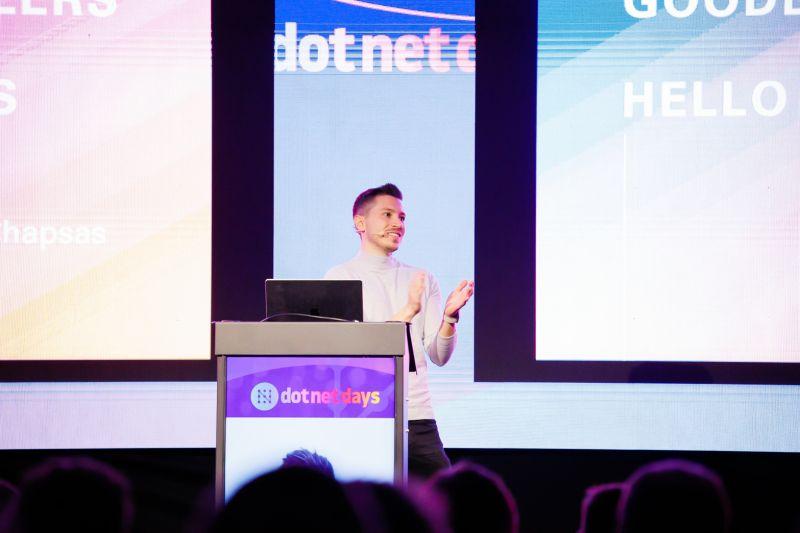
In a reflection posted in early 2025, he counted six years since his first YouTube upload, more than 500 videos and 40 million views. Those were his figures at that moment, not a permanent scoreboard. The more revealing part of the post was the list of changes behind them. He had left a full-time engineering job to make content. He had become a speaker. He had started a course business that was no longer just his own work.
Scale did not settle every question. Chapsas has said he was wary of selling courses to his audience before he felt confident they would deliver. The concern makes sense for someone whose reputation had been built by showing the work. A free video asks for a viewer's time. A paid course asks for money and a larger promise. He waited, built courses on his own site, and only then expanded the idea.
The classroom gets bigger
Dometrain launched in 2023 after those personal courses were rebranded into a platform. Other authors joined. On a podcast that year, the discussion moved beyond filming lessons to why a working engineer would build a place for other engineers to teach. By early 2025, Chapsas said Dometrain had 20 authors and 80 courses. The current catalog reaches beyond his original C# focus into languages, cloud systems, architecture and career topics.
His description of the teaching model is unusually specific. A student should feel as though they have joined a company, sat beside a senior engineer, and learned how to do the work. That is a higher bar than simply delivering information. Documentation can list an API; the engineer beside you can explain why a team chose it, where it failed, and what happened after deployment. Chapsas's own path through Web Forms and cloud migration gives the idea a lived basis.
“the ‘paired programming’ experience.”Nick Chapsas on Dometrain's teaching model
The business also acquired the ordinary complications of selling lessons everywhere. Dometrain has reported sales in 144 countries, bringing billing and tax work along with that reach. This is a less romantic part of an educator's life, though it may be the difference between having a classroom and keeping it open. Chapsas moved from selling individual courses alone to offering subscriptions, partly to make payments to authors more predictable. The teacher who once narrated code on a screen now had to think about invoices, authors and international checkout.
The widened catalog also changes the meaning of his role. On YouTube, the lesson largely depends on his curiosity and his time in front of a microphone. A platform asks him to make room for other voices, choose what belongs, and create a consistent experience for students who may never have heard of him. It is editorial work as much as technical work. The presence of working engineers as authors is part of the promise: their examples come from systems they have had to build, debug and maintain, with all the awkward trade-offs that implies.
There is a nice symmetry in the platform's later direction. Chapsas learned by changing something in a game and seeing the result. Dometrain now offers hands-on lessons in which students write and run code in a browser. In 2026, he described a Git course with an in-browser engine, a Linux environment built for a course, a SkillScore feature that adapts questions to a learner's level, and an AI agent that can help with exercises. The technology is new. The learning loop is familiar: try, inspect, ask, try again.
Still explaining what he learns
The public teacher has not abandoned the private student. In 2024, Chapsas revived his blog as a weekly newsletter called Nick's .NET Knowledge Drops. He wrote that five years of making videos had not exhausted the topics he wanted to cover, and that some ideas worked better in writing. The return to text was less a reversal than another tool on the desk. The boy editing game stats had become an engineer choosing the right format for a lesson.
He is also willing to show enthusiasm before mastery. In a 2026 LinkedIn post about Dometrain's browser-based Linux course, he said he had wanted to learn Linux after moving away from Windows, but did not want the setup hassle. After working through the new course, he ordered a small desktop to use with Linux. The founder was describing a product, certainly, but he was also describing what it felt like to be the learner.
It is easy to flatten a creator's life into a chart of subscribers and sales. His own account has smaller, more instructive markers: a friend correcting a draft, an unread blog post, a recording with text too small to see, a new operating system he wanted to try. None was a grand launch. Each was a practical response to an immediate problem. The public career grew out of a long series of those responses, and the platform keeps giving him new ones.
That mix of teacher and tinkerer is the thread through the career. First there was a game that could be altered. Then a job full of unfamiliar systems. Then a blog, a camera, a course, and a larger classroom. Chapsas has built a business around explanation, but the best part of his story is the impulse before the explanation: noticing something he does not yet understand and opening it up. It is a habit that survives both a turned-off router and a very large audience.