The origin of Nicholas Nicolaides’s business career is a biological typo. In healthy cells, mismatch-repair proteins behave like fussy copy editors, catching errors that slip into DNA. During his oncology fellowship at Johns Hopkins in the 1990s, Nicolaides studied what happened when that editing machinery failed. The work helped explain inherited forms of cancer. It also suggested a deliciously practical inversion: if a broken genetic spellchecker produces variation, perhaps a controlled version of that instability could generate useful traits.
That idea became morphogenics, the platform beneath Morphotek, the company Nicolaides co-founded in 2000 with fellow scientists Luigi Grasso and Philip Sass. Its early pitch was broad. Adjust the cell’s proofreading machinery, create a pool of variation, and select organisms or cells with desirable properties. Crops, research targets, industrial cell lines, antibodies - the toolbox had many drawers.
Toolboxes are thrilling to scientists and mildly alarming to businesses. A platform can do many things, which is another way of saying nobody has yet chosen the one thing customers will pay for. Nicolaides and his colleagues made that choice in public. Morphotek shifted from selling capability toward developing therapeutic antibody products. The company raised $26 million in 2004 to push that transition, and another $40 million in 2006. The broad invention was becoming a focused pipeline.
The platform learns to pick a product
In March 2007, Eisai agreed to acquire Morphotek for $325 million after excess net cash. Morphotek had 45 employees, two antibody programs in early clinical trials, several others in preclinical development, and a manufacturing platform for creating human monoclonal antibodies. For Eisai, the Pennsylvania company offered an entry into biologics. For Morphotek, the buyer offered the infrastructure to move experimental products through a far larger system.
“It really allows us to move to the next stage of value creation, transitioning Morphotek from a technology platform company to a technology platform/product company.”Nicholas Nicolaides, during Morphotek’s 2004 financing
The transaction is the obvious cinematic ending. Cue a photograph of the founders, add a large number, roll credits. Nicolaides declined the tidy version. He remained in charge after the sale, leading Morphotek as an Eisai subsidiary until 2018. Eleven years is not a victory lap. It is operating time: partnership agreements, clinical programs, manufacturing questions, and the steady pressure to make a promising molecule behave in the untidy world beyond a laboratory assay.
His 2016 comment about a Morphotek collaboration is revealing in its plainness. The company was exploring “an array of therapeutic modalities” around its priority pathways. This was a scientist-executive’s vocabulary, more portfolio review than founder mythology. By then, the original idea about genetic variation had grown into an organization that could develop antibodies, license programs, and test new formats. Nicolaides had gone from discovering a mechanism to managing the many ways mechanisms disappoint.
The second company starts with an obstruction
When Nicolaides left Morphotek in 2018, he did not flee his old subject. He narrowed it. He and Grasso founded Navrogen around a stubborn observation from their clinical research: some tumor-produced proteins can bind to antibody-based therapies and interfere with the immune work those therapies are meant to recruit. A promising key can reach the correct lock and still have chewing gum pressed into the mechanism.
Navrogen calls the field humoral immuno-oncology, or HIO. The phrase refers to antibody and complement activity, along with factors that can suppress it. The company’s strategy has two halves. First, screen antibodies and next-generation formats to see whether tumor-produced factors affect them. Second, engineer refractory versions or create antagonists designed to block the interference. The company has disclosed monoclonal antibodies, antibody-drug conjugates, T-cell engagers, and factor antagonists across its pipeline.
The intellectual rhythm resembles Morphotek. Find a source of biological variation or failure. Build a platform that makes it observable. Select or engineer the version that behaves better. The molecules have changed. The habit of mind has not.
The resemblance includes the people. Grasso, a co-founder at both companies, remains Navrogen’s chief scientific officer. Brad Kline, who oversaw antibody discovery and development at Morphotek, became Navrogen’s senior director of research and development. Steven Kyriakos carried finance and operations experience from Morphotek into Navrogen. This is not a reunion tour. It is a compact team taking accumulated, shared judgment into a more specific problem.
A local network with a long memory
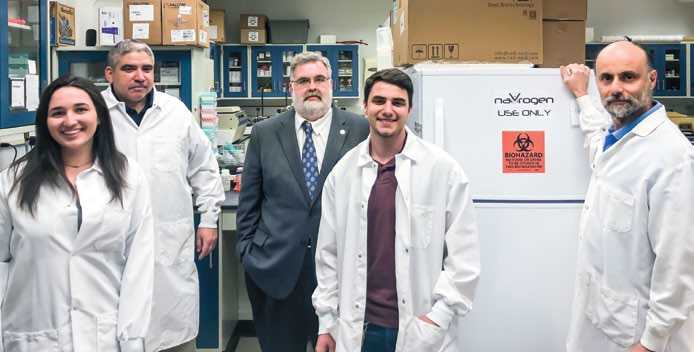
Navrogen’s early geography offers a small lesson in company building. Nicolaides earned his biology degree at Saint Joseph’s University in 1987. Three decades later, when the new startup needed laboratory space, he contacted former classmate Michael McCann, by then a biology professor at the university. Navrogen found a lab. Saint Joseph’s students found themselves working beside active biotechnology researchers without leaving campus.
In 2020, the company moved its research operation to Cheyney University. Nicolaides again paired facilities with training, saying the relationship would teach students about cancer immunity and give them firsthand biomedical research experience. The pattern is practical and reciprocal. A young company needs equipment, space, and talent. A university wants its students close to consequential work. Old relationships become fresh infrastructure.
Southeastern Pennsylvania is not incidental scenery in this career. Saint Joseph’s, Thomas Jefferson, Morphotek’s Philadelphia and Exton roots, Cheyney, and the state’s early technology investors form a tight map. Nicolaides credited Ben Franklin Technology Partners’ early backing as a vote of confidence that attracted local and international investors. The 2007 sale pulled global capital toward that local cluster without moving Morphotek away. In 2013, Pennsylvania gave him its Governor’s Entrepreneur Impact Award for biotechnology accomplishments and international investment in the commonwealth.
A durable scientific career is less a ladder than a recurring question with better equipment.The Nicolaides pattern, from mismatch repair to antibody interference
The work after the applause
Awards accumulated around the first company. Ernst & Young named Nicolaides its 2007 Entrepreneur Of The Year for Greater Philadelphia. R&D Directions included him among its notable people in research and development. His Navrogen biography counts more than 70 peer-reviewed papers and 80 issued patents. These are impressive nouns. The verbs matter more: publish, patent, test, revise, partner, repeat.
His work outside the chief executive’s office follows the same pattern of staying near the science. He serves as an ad hoc reviewer for immunology and cancer-research journals, belongs to the American Association for Cancer Research and the New York Academy of Sciences, and sits on the board of Cage Pharma. The affiliations are less a collection of badges than a set of listening posts. Papers reveal what is newly possible. Boards reveal what is operationally difficult. A small company benefits when its leader can move between those conversations without pretending they are the same conversation.
There is also a useful counterweight in the team around him. Nicolaides is a molecular geneticist; Grasso is a molecular biologist whose early work examined mutated tumor-suppressor genes. Kline brought antibody engineering and immunology. Kyriakos brought finance, facilities, grants, and operations. The founding thesis may begin with one sharp scientific observation, but the organization is designed around the fact that no observation develops itself. Nicolaides’s repeated choice of collaborators suggests that trust, in his companies, is not a soft cultural extra. It is laboratory infrastructure.
Recent work keeps those verbs busy. A 2025 paper listed Nicolaides as a co-author on an engineered version of rituximab designed to avoid CA125-related interference. In June 2026, he was first author on a BMC Cancer paper describing NAV-005, a high-affinity antagonist aimed at that same factor. Navrogen also announced U.S., European, Japanese, and Chinese patent grants across its HIO platform, NAV-005, and NAV-001. Its public statements say several programs are moving toward proof-of-concept clinical studies.
That last phrase is an important line in the sand. Navrogen’s disclosed agents remain experimental, and preclinical results are not clinical proof. Nicolaides knows the distance better than most. He has spent years on both sides of an acquisition, watching platforms become products and experimental antibodies encounter the disciplines of development.
There is a quiet comedy in the name Navrogen. It combines the Greek “na vro,” meaning to find or navigate, with “gen,” a fragment of genesis, generation, and generate. The result sounds like a command issued to a laboratory: go find, then make. For Nicolaides, it also reads like a career summary.
He found a useful possibility inside broken DNA proofreading and helped make a company around it. He found that a technology toolbox needed a product spine and led the turn. He found a global buyer, stayed to do the unglamorous work after the announcement, then returned with familiar collaborators to another obstruction hiding in molecular detail.
Biotechnology likes grand promises because molecules are too small for magazine covers. Nicolaides’s story works at the opposite scale. Look closer. Find the mechanism that everyone else has treated as background. Ask why a sensible therapy is not doing the sensible thing. Then build the assay, the company, and the patience required to answer. The question may be tiny. The career assembled around it need not be.